
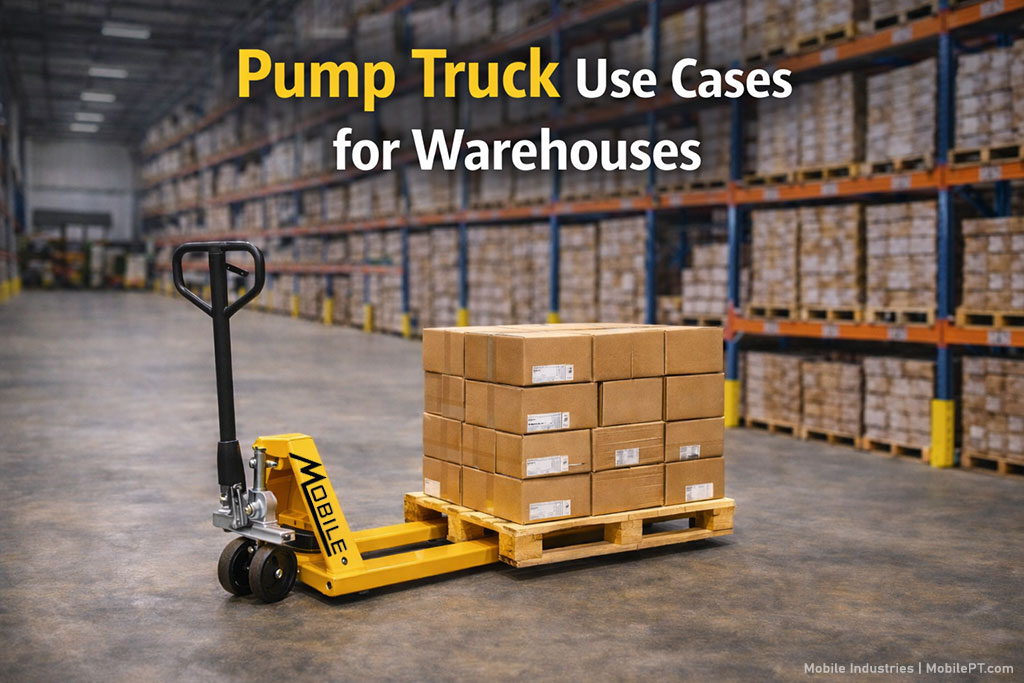
Pump Truck Use Cases for Warehouses
16 April 2026A pump truck is one of the most practical and widely used tools in warehouse operations. Simple, dependable, and cost-effective, it helps workers move palletized goods quickly without the need for larger powered equipment. In many facilities, the pump truck is part of the daily workflow from the moment inventory arrives to the moment it leaves the dock.
Although the term pump truck can sometimes create confusion because it may refer to different types of equipment in other industries, in a warehouse setting it usually refers to a manual pallet truck or manual pallet jack. It uses a hydraulic pumping mechanism to raise pallets slightly off the floor so they can be pushed or pulled to another location.
For warehouses that handle palletized inventory, a pump truck remains one of the most useful tools on the floor. Here is a closer look at the most common pump truck use cases in warehouse environments and why it continues to play such an important role.
What Is a Pump Truck in a Warehouse?
In warehouse and material handling operations, a pump truck is a manual device designed to lift and move pallets over short distances. The forks slide under a pallet, and the operator pumps the handle to activate the hydraulic lift. Once the pallet is raised just enough to clear the floor, it can be moved by hand.
A pump truck is commonly used because it is:
- Easy to operate
- Affordable to purchase
- Low maintenance
- Compact and maneuverable
- Reliable for everyday pallet movement
It may not replace powered equipment in high-volume environments, but it is often the fastest and most practical option for many common warehouse tasks.
1. Receiving Incoming Shipments
One of the most common pump truck use cases is in the receiving area. When pallets arrive by truck, warehouse staff often need to move them from the trailer to a nearby staging area or receiving zone for inspection and sorting.
A pump truck is ideal for this because it allows workers to quickly slide under a pallet, lift it, and reposition it without waiting for a forklift if the load does not need to be stacked vertically.
This is especially useful for:
- Smaller deliveries
- Ground-level unloading
- Short-distance repositioning
- Overflow receiving support
For warehouses that want to keep the receiving area moving efficiently, the pump truck is often the first tool used.
2. Moving Pallets to Staging Areas
Once goods are received, they often need to be transferred to staging zones before being stocked, packed, or shipped. A pump truck works well for this type of horizontal movement.
Instead of using larger equipment for every pallet relocation, warehouse teams can use a pallet truck to move goods from one floor-level area to another quickly and with minimal setup.
This helps with:
- Organizing outbound orders
- Grouping inventory by shipment
- Repositioning stock before put-away
- Moving goods between work areas
For short-distance floor transport, the pump truck is often one of the most efficient tools available.
3. Supporting Packing and Shipping Departments
In many warehouses, the packing and shipping departments rely heavily on palletized goods being brought in and moved out throughout the day. A pump truck helps keep these areas organized and efficient by allowing staff to quickly reposition inventory and completed shipments.
Typical uses include:
- Bringing pallets of goods to packing stations
- Moving completed orders to shipping lanes
- Repositioning packaged loads for pickup
- Organizing outbound freight by carrier or route
Because a pump truck is easy to maneuver and does not require charging or fueling, it is a convenient solution for active shipping environments where constant small moves are common.
4. Repositioning Inventory Within Warehouse Aisles
Not every inventory movement requires powered equipment. Often, products only need to be shifted a short distance within an aisle, moved from one bay to another, or adjusted to make room for incoming stock.
A pump truck is well suited for these lighter repositioning tasks.
Warehouse teams use pallet trucks to:
- Shift inventory within storage rows
- Move pallets closer to picking zones
- Reorganize floor-level stock
- Adjust layouts during inventory changes
Because the pallet truck is compact, it can often be used in areas where larger machinery would be less practical.
5. Working in Tight or Confined Spaces
Warehouses are not always spacious and open. Many have narrow aisles, busy dock zones, tightly packed storage areas, and trailer interiors where maneuverability matters.
A pump truck is highly effective in these spaces because of its simple design and smaller footprint. It can often be used where forklifts or larger powered equipment would be difficult to position.
This makes it valuable in:
- Delivery trailers
- Narrow stock areas
- Small storage rooms
- Retail warehouse backrooms
- Overflow inventory zones
Its ability to handle short, controlled movements in confined spaces is one of the reasons the pump truck remains so widely used.
6. Backup Support for Powered Equipment
Even in warehouses with forklifts and electric pallet movers, the pump truck still has an important place. It serves as reliable backup equipment when powered units are unavailable, charging, in use elsewhere, or down for maintenance.
This backup role helps warehouses:
- Avoid workflow delays
- Keep departments operating during downtime
- Handle lighter loads without using larger machines
- Maintain flexibility during busy periods
In many operations, having multiple pump trucks available reduces dependence on powered equipment for every small task.
7. Loading and Unloading Short-Distance Transfers
A pump truck is also useful for transferring pallets between nearby areas, such as from a workbench zone to storage, from a wrapping area to shipping, or from production to warehouse staging.
These shorter internal moves happen constantly in many facilities. Because the pallet truck is always ready to use, employees can make these quick transfers without delay.
This makes it especially useful in:
- Manufacturing support areas
- Finished goods movement
- Quality control zones
- Temporary holding areas
- Internal transfer points
The simpler the job, the more valuable a simple tool becomes.
Why Warehouses Still Rely on Pump Trucks
Even with more advanced material handling equipment available, warehouses still rely on the pump truck because it fills a very specific need. It is not meant to do everything, but what it does, it does well.
A pallet truck remains valuable because it is:
- Cost-effective
- Easy to train on
- Always available
- Low maintenance
- Effective for short-distance pallet movement
For many businesses, it is one of the smartest and most practical tools on the warehouse floor.
Final Thoughts
The pump truck continues to be one of the most useful tools in warehouse operations because it handles the everyday jobs that keep inventory moving. From receiving and staging to shipping and internal transfers, its role is simple but important.
A pallet truck may not be as advanced as a powered unit, but it remains one of the most dependable ways to move palletized goods quickly and efficiently across short distances. For warehouses focused on flexibility, practicality, and cost control, the pump truck still makes a great deal of sense.
Frequently Asked Questions
What is a pump truck used for in a warehouse?
A pump truck is used to lift and move palletized goods across short distances in a warehouse. Common uses include receiving shipments, moving pallets to staging areas, supporting shipping departments, and repositioning inventory on the warehouse floor.
Is a pump truck the same as a pallet truck?
Yes, in a warehouse setting, a pump truck is generally another name for a pallet truck or manual pallet jack. It uses a hydraulic pump mechanism to raise pallets slightly off the ground for transport.
When should a warehouse use a pump truck instead of a forklift?
A warehouse should use a pump truck when moving pallets short distances at floor level, especially in tight spaces or for lighter-duty tasks. Forklifts are better for lifting pallets vertically or handling heavier, more demanding jobs.
Are pump trucks good for small warehouses?
Yes, a pump truck is ideal for small warehouses because it is affordable, compact, easy to use, and highly maneuverable. It is especially useful in facilities with moderate pallet movement and limited space.
What are the main benefits of a pallet truck in warehouse operations?
The main benefits of a pallet truck include low cost, simple operation, minimal maintenance, strong maneuverability, and reliable short-distance pallet movement. It remains one of the most practical tools for everyday warehouse use.