
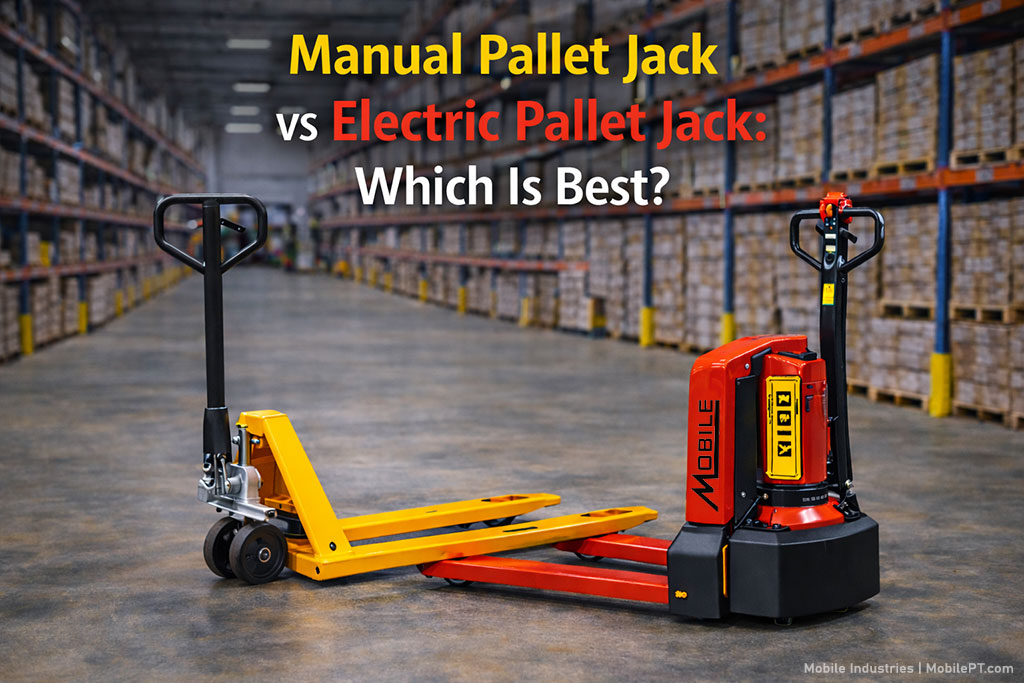
Choosing between a manual pallet jack and an electric pallet jack is a common decision for warehouses, factories, retail stockrooms, and distribution facilities. At first glance, both tools seem to do the same job. They both move pallets. They both help reduce manual lifting. And they both play an important role in day-to-day material handling.
But once you look closer, the differences become much more important.
The right choice depends on how often pallets are moved, how heavy the loads are, how large the facility is, and how much importance is placed on speed, ergonomics, and long-term efficiency. For some operations, a manual pallet jack is the practical and cost-effective answer. For others, an electric pallet jack can dramatically improve workflow and reduce physical strain on staff.
If you are trying to decide which option makes more sense for your operation, here is a detailed look at how they compare.
What Is a manual pallet jack?
A manual pallet jack is a basic hydraulic material handling tool used to lift and move pallets over short distances. The operator inserts the forks under the pallet, pumps the handle to raise the load slightly off the ground, and then manually pushes or pulls it to the desired location.
Manual pallet jacks are often found in:
- Small warehouses
- Retail backrooms
- Delivery trucks
- Stockrooms
- Light-duty industrial spaces
Because they are simple, durable, and affordable, they remain one of the most widely used tools in material handling.
What Is an Electric Pallet Jack?
An electric pallet jack performs the same general function, but it uses a battery-powered motor for movement and, in many models, for lifting as well. Instead of manually pushing a heavy load, the operator uses controls on the handle to direct the equipment while the motor handles most of the physical work.
Electric pallet jacks are commonly used in:
- Distribution centers
- Manufacturing plants
- Large warehouses
- High-volume logistics facilities
- Operations with frequent pallet movement
They are designed to improve speed, reduce operator fatigue, and support heavier daily workloads.
The Main Difference Between the Two
The biggest difference comes down to effort.
A manual pallet jack relies almost entirely on the operator’s physical input. The worker pumps the handle to lift the load and uses body strength to move it.
An electric pallet jack reduces or eliminates most of that physical effort. The machine provides powered travel, making it much easier to move loaded pallets throughout the facility.
That one difference affects productivity, ergonomics, safety, and overall performance.
Cost: Which One Is More Affordable?
If upfront cost is the main concern, the manual pallet jack is usually the better option. It is much less expensive to purchase than an electric model, and it does not require a battery, charger, or electrical components.
This makes it appealing for:
- Smaller businesses
- Startups
- Warehouses with light pallet movement
- Facilities that need several units without a large investment
An electric pallet jack costs more upfront, but that higher price can often be justified in operations where pallets are moved frequently every day. In those environments, the productivity gains and reduced physical strain may more than offset the initial investment over time.
Productivity: Which One Helps Work Move Faster?
When it comes to speed and output, the electric pallet jack usually has the advantage.
In a warehouse with constant movement, employees can move more pallets per hour with an electric model because they are not spending energy manually pulling and pushing heavy loads. This becomes especially important in large facilities where travel distances are longer.
A manual pallet jack still works well for quick short-distance moves, but it is not as efficient when pallet movement becomes frequent or repetitive throughout a full shift.
For operations with high daily volume, electric power often means smoother workflows and faster turnaround times.
Operator Fatigue and Ergonomics
This is one of the biggest deciding factors.
A manual pallet jack is physically demanding. It may not seem like much when used occasionally, but repeated pushing and pulling can wear down staff over the course of a day. This is especially true when handling heavier loads or working in busy receiving and shipping areas.
An electric pallet jack significantly reduces that strain. The operator is still guiding the equipment, but the motor does most of the heavy work. That means less fatigue, less repetitive stress, and a more comfortable workday.
For companies concerned about ergonomics and injury prevention, electric models often provide a clear advantage.
Maintenance and Upkeep
A manual pallet jack has fewer moving parts and is easier to maintain. There is no battery system, no motor, and no onboard electronics. Routine maintenance is typically limited to wheel checks, hydraulic inspections, lubrication, and occasional repairs.
An electric pallet jack requires more upkeep because it includes a battery, motor, controller, and electrical components. Batteries must be charged properly, and service may be needed more often than with manual equipment.
That said, modern electric pallet jacks, especially lithium-powered models, are becoming more efficient and lower maintenance than older systems.
If simplicity is the priority, the manual pallet jack wins. If performance matters more, the extra maintenance of an electric model may be well worth it.
Best Use Cases for a Manual Pallet Jack
A manual pallet jack is usually best for:
- Short-distance pallet movement
- Smaller facilities
- Light-to-moderate workloads
- Budget-conscious operations
- Delivery trailers and compact spaces
- Backup support for powered equipment
It is the practical solution when pallet movement is not constant and the workload does not justify powered equipment.
Best Use Cases for an Electric Pallet Jack
An electric pallet jack is usually best for:
- Large warehouses
- Long travel distances
- Heavier daily pallet volume
- Multi-shift operations
- Receiving and shipping departments
- Operations focused on speed and ergonomics
If pallets are being moved throughout the day, every day, an electric pallet jack can make a meaningful difference in both productivity and worker comfort.
Safety Considerations
Both types of equipment can be safe when used properly, but the risks are a little different.
A manual pallet jack increases physical strain, which can contribute to fatigue-related injuries or repetitive motion issues over time.
An electric pallet jack reduces that strain and often includes built-in safety features such as controlled acceleration, braking systems, emergency stop functions, and smoother travel control.
In high-traffic warehouse environments, these features can improve both safety and handling precision.
Which Is Best?
There is no universal answer because the best option depends entirely on the environment.
If your operation is smaller, your pallet movement is light, and you want something affordable and dependable, a manual pallet jack is often the right choice.
If your facility handles larger workloads, longer distances, and frequent pallet movement, an electric pallet jacks is usually the better long-term investment.
Many warehouses actually use both. Manual pallet jacks are kept for lighter-duty work or backup use, while electric pallet jacks handle higher-volume movement in the main flow of operations.
Final Thoughts
When comparing a manual pallet jack vs electric pallet jack, the best choice comes down to volume, distance, budget, and operator needs. Manual pallet jacks are simple, reliable, and cost-effective. Electric pallet jacks offer more speed, less strain, and better performance for demanding warehouse environments.
Both have a place in material handling. The key is choosing the one that matches how your operation really works, not just what seems cheaper or more advanced on paper.
A smart equipment decision today can improve efficiency, reduce fatigue, and support smoother warehouse performance over the long run.
Frequently Asked Questions
What is the difference between a manual pallet jack and an electric pallet jack?
A manual pallet jack requires the operator to push and pull loads manually, while an electric pallet jack uses a battery-powered motor to move pallets. Electric pallet jacks reduce operator fatigue and improve productivity, especially in larger warehouses.
When should I use a manual pallet jack?
A manual pallet jack is best for short-distance pallet movement, smaller warehouses, and light-to-moderate workloads. They are also ideal when budget is a concern and powered equipment is not necessary.
When is an electric pallet jack better?
An electric pallet jack is better for warehouses that move pallets frequently, transport heavy loads, or operate in larger facilities. They improve speed, reduce operator fatigue, and increase efficiency.
How much weight can a manual pallet jack and electric pallet jack handle?
Most manual pallet jacks can handle between 4,000 and 5,500 pounds. Electric pallet jacks typically handle between 3,000 and 6,000 pounds, depending on the model and application.
Do warehouses use both manual and electric pallet jacks?
Yes, many warehouses use both manual pallet jacks and electric pallet jacks. Manual pallet jacks are often used for lighter-duty tasks, while electric pallet jacks handle high-volume or long-distance pallet movement.