
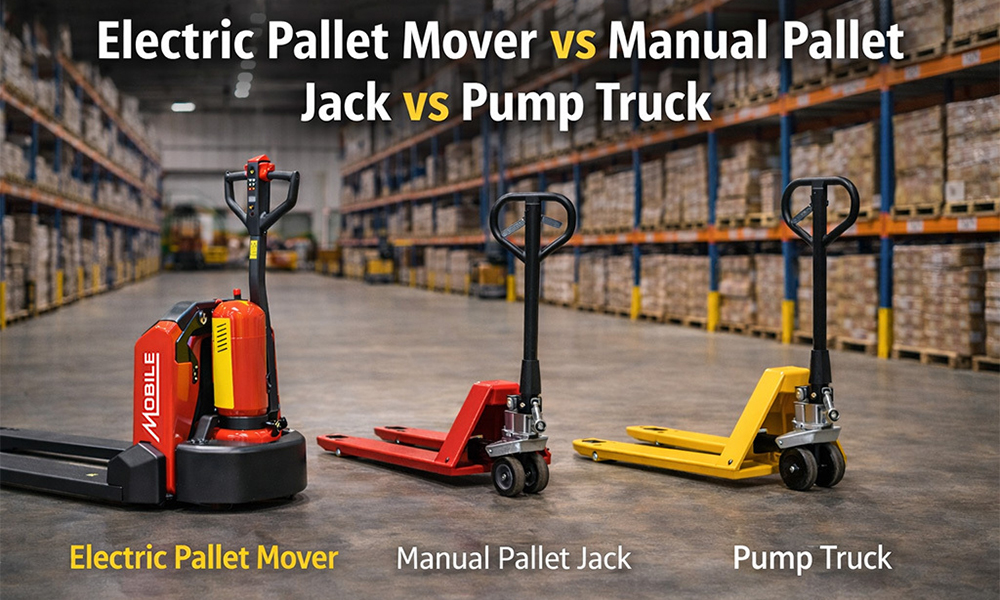
Electric Pallet Mover vs Manual Pallet Jack vs Pump Truck: What’s the Real Difference?
02 March 2026When it comes to moving pallets inside a warehouse, distribution center, retail stockroom, or manufacturing facility, the equipment you choose directly affects productivity, safety, and operating costs. While forklifts often get the spotlight, most day-to-day pallet movement happens on the ground — and that’s where pallet trucks come in.
But not all pallet trucks are the same.
Many businesses use the terms Manual Pallet Jack, Pump Truck, and Jack Pallet Truck interchangeably. Others are considering upgrading to an Electric Pallet Mover but aren’t sure if it’s worth the investment.
If you’re evaluating options, this detailed comparison will break down what each piece of equipment is, how they differ, and which one makes sense for your operation.
Understanding the Basics: What Are Pallet Trucks?
Before diving into comparisons, let’s clarify terminology.
Pallet Trucks are wheeled material handling devices designed to lift and move palletized loads at ground level. They use forks that slide under a pallet and lift it slightly off the floor for transport.
Within this category, there are three primary types:
- Manual Pallet Jack
- Pump Truck (another name for manual pallet jack)
- Electric Pallet Mover
While a Pump Truck and a Manual Pallet Jack are essentially the same piece of equipment, an Electric Pallet Mover operates very differently.
Let’s examine each in detail.
What Is a Manual Pallet Jack?
A Manual Pallet Jack, often called a Jack Pallet Truck, is a human-powered device that uses a hydraulic pump system to lift pallets.
The operator inserts the forks under the pallet, pumps the handle to raise the load, and then manually pushes or pulls the pallet to its destination. A lever on the handle lowers the forks when needed.
Key Characteristics of a Manual Pallet Jack
- Hydraulic lifting system
- No motor or battery
- Human-powered movement
- Simple mechanical design
- Typically 4,000–5,500 lb capacity
Because of its simplicity, the Manual Pallet Jack remains one of the most widely used material handling tools in the world.
What Is a Pump Truck?
A Pump Truck is simply another term for a Manual Pallet Jack. The name comes from the pumping motion required to lift the pallet using the hydraulic handle.
In some regions, “Pump Truck” is the preferred term. In others, it’s called a Jack Pallet Truck or Manual Pallet Jack. Regardless of terminology, the function is identical.
For clarity in this comparison:
Manual Pallet Jack = Pump Truck = Jack Pallet Truck (manual version)
What Is an Electric Pallet Mover?
An Electric Pallet Mover performs the same lifting and transporting function as a Manual Pallet Jack, but it uses an electric motor for travel and lifting.
Instead of manually pushing or pulling the load, the operator uses powered controls to move the pallet. Most models include electric lift, electric lowering, and electric drive.
Key Characteristics of an Electric Pallet Mover
- Motorized drive system
- Battery-powered operation (often lithium-ion)
- Powered lifting and lowering
- Reduced physical effort
- Typically 3,000–6,000 lb capacity
An Electric Pallet Mover significantly reduces operator strain while increasing efficiency in high-volume operations.
Now let’s compare them side by side.
1. Power Source and Operation
Manual Pallet Jack / Pump Truck:
Entirely human-powered. The operator pumps to lift and physically pushes or pulls the load.
Electric Pallet Mover:
Motor-driven. The operator guides the unit while the motor provides propulsion and lifting assistance.
The difference in physical effort is substantial. Over a full shift, this can impact fatigue levels and injury risk.
2. Productivity and Speed
Manual Pallet Jack:
Well-suited for occasional movement and short distances. Productivity depends heavily on operator strength and endurance.
Electric Pallet Mover:
Designed for frequent use and longer travel distances. Consistent speed and minimal fatigue allow higher daily pallet throughput.
In high-volume warehouses, Electric Pallet Movers can significantly increase operational efficiency.
3. Operator Fatigue
Manual Pallet Jack:
Repeated pushing and pulling can lead to strain, especially with heavier loads or long travel distances.
Electric Pallet Mover:
Reduces physical strain dramatically. Operators guide rather than force the load.
For facilities focused on ergonomics and injury prevention, this difference matters.
4. Cost Considerations
Manual Pallet Jack / Pump Truck:
Lower upfront cost. Minimal maintenance. No batteries or electronics.
Electric Pallet Mover:
Higher initial investment. Requires battery charging and periodic maintenance.
However, when factoring in productivity gains and reduced workplace injuries, Electric Pallet Movers often deliver strong long-term value in busy operations.
5. Maintenance Requirements
Manual Pallet Jack:
Simple design means fewer components that can fail. Maintenance typically involves hydraulic fluid checks and wheel replacements.
Electric Pallet Mover:
Includes motor, controller, battery, and electronic systems. Requires battery charging management and occasional service.
Modern lithium-powered Electric Pallet Movers reduce maintenance significantly compared to older lead-acid models.
6. Best Use Cases
Manual Pallet Jack / Pump Truck is ideal for:
- Small warehouses
- Retail backrooms
- Delivery trucks
- Occasional pallet movement
- Budget-conscious operations
- Tight spaces with light-duty needs
Electric Pallet Mover is ideal for:
- Distribution centers
- Manufacturing plants
- 3PL facilities
- High-frequency pallet movement
- Long travel distances
- Multi-shift operations
- Operations focused on efficiency and ergonomics
7. Maneuverability
Manual Pallet Jacks are highly maneuverable due to their compact size and lack of powered components.
Electric Pallet Movers are slightly heavier but still designed for indoor warehouse navigation. Many include turtle-speed functions for tight turns.
8. Safety Considerations
Manual Pallet Jacks:
Safe when used properly, but physical strain increases the risk of repetitive motion injuries.
Electric Pallet Movers:
Often include safety features such as automatic braking, emergency reverse buttons, speed control systems, and onboard diagnostics.
The reduced physical effort also lowers injury risk over time.
When Should You Upgrade?
If your operation currently relies heavily on a Manual Pallet Jack or Pump Truck and you’re experiencing:
- High pallet movement volume
- Operator fatigue complaints
- Slow dock turnaround
- Frequent strain injuries
- Growing operational demands
It may be time to consider transitioning to an Electric Pallet Mover.
On the other hand, if your pallet movement is infrequent and distances are short, a Manual Pallet Jack remains a practical and economical solution.
Final Comparison Summary
Manual Pallet Jack / Pump Truck:
Simple. Affordable. Reliable. Best for light-duty, low-frequency pallet movement.
Electric Pallet Mover:
Efficient. Ergonomic. High-performance. Best for frequent movement, longer distances, and growing operations.
Both fall under the broader category of Pallet Trucks, but they serve different operational needs.
Choosing between them comes down to workload, budget, and long-term productivity goals.
Conclusion
There is no one-size-fits-all solution in material handling. A small retail store may operate perfectly well with a Pump Truck or Jack Pallet Truck. A high-volume distribution center, however, will likely benefit significantly from an Electric Pallet Mover.
Understanding the operational differences helps businesses make smarter equipment investments.
Whether you choose a Manual Pallet Jack, Pump Truck, or Electric Pallet Mover, selecting the right pallet trucks for your environment ensures safer operations, improved efficiency, and better long-term performance.