

The term Pump Truck can mean two very different machines depending on the industry you’re in. In warehouse and material handling environments, a Pump Truck typically refers to a Pallet Truck — often a manual pallet jack that uses a hydraulic pump to lift pallets. In construction, however, a Pump Truck may refer to a concrete pump truck, a heavy-duty vehicle equipped with a boom used to deliver liquid concrete to elevated or hard-to-reach locations.
Because of this dual meaning, confusion is common — especially when buyers search online for equipment. In this article, we’ll clarify the differences and focus specifically on warehouse applications, comparing a Manual Pump Truck, a Powered Pump Truck, and a Powered Pallet Jack, so businesses can better understand which solution fits their operational needs.
Pump Truck Comparison: Quick Answer
A Manual Pump Truck uses a hydraulic pump for lifting and relies on the operator to push or pull the load. A Powered Pump Truck, also called a Powered Pallet Jack, uses a rechargeable battery and electric drive system to assist with travel and, in most cases, lifting.
| Question | Quick Answer |
| What is a Manual Pump Truck? | A hydraulic Pallet Truck operated through manual pumping and physical movement. |
| What is a Powered Pump Truck? | A battery-powered Pallet Truck with electrically assisted travel and lifting. |
| Is a Powered Pump Truck the same as a Powered Pallet Jack? | In most warehouse applications, the terms describe the same category of equipment. |
| Which option costs less initially? | A Manual Pump Truck. |
| Which option is more productive? | A Powered Pump Truck or Powered Pallet Jack. |
| Which is best for short distances? | A Manual Pump Truck. |
| Which is best for frequent daily movement? | A Powered Pallet Jack. |
The right choice depends less on which machine is technically “better” and more on how often it will be used, how far pallets must travel, and how much physical effort the operation wants to remove.
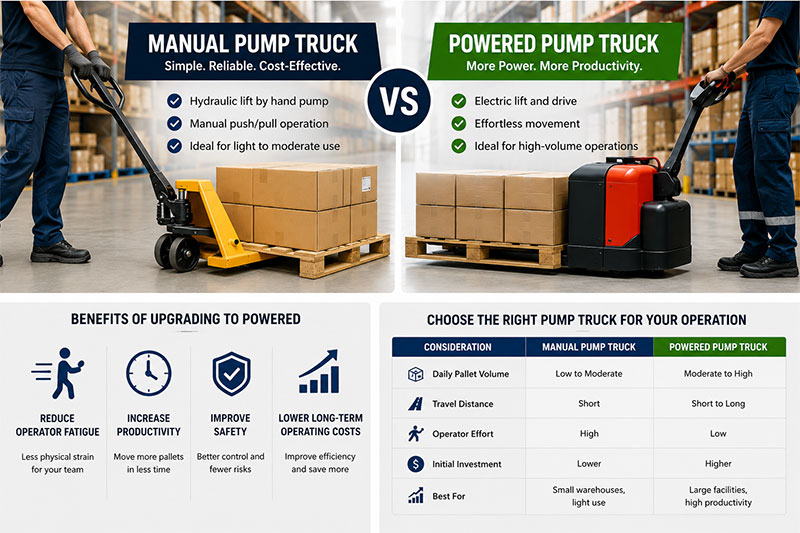
What Is a Pump Truck in Warehousing?
In warehouse terminology, a Pump Truck is a manually operated Pallet Truck. It’s also commonly referred to as a Manual Pallet Jack or Jack Pallet Truck.
The reason it’s called a Pump Truck is simple: the operator pumps the handle to activate a hydraulic system that lifts the pallet slightly off the ground. Once elevated, the operator pushes or pulls the load to its destination.
Manual Pump Trucks are one of the most widely used pieces of material handling equipment worldwide due to their simplicity and affordability.
How It Works
A Manual Pump Truck operates through a hydraulic mechanism built into the steering handle. By pumping the handle up and down, pressure builds within the hydraulic cylinder, raising the forks. A release lever lowers the forks when the pallet reaches its destination.
No battery. No motor. No electronics. It’s purely mechanical.
What Is a Powered Pump Truck?
A Powered Pump Truck refers to an electrically assisted version of a traditional Pump Truck. Instead of relying solely on human strength, a motor drives the wheels and often controls the lifting function.
In many cases, a Powered Pump Truck is also called a Powered Pallet Jack or an Electric Pallet Mover.
While the base function remains the same — lifting and moving pallets — the experience and efficiency level are significantly different.
What Is a Powered Pallet Jack?
A Powered Pallet Jack is essentially the upgraded version of a Manual Pump Truck. It uses electric drive systems and rechargeable batteries (often lithium-ion) to provide powered travel and powered lifting.
Instead of physically pushing heavy loads across the warehouse floor, the operator uses throttle-style controls to guide the unit while the motor handles the work.
Powered Pallet Jacks are designed for higher-volume operations where productivity and ergonomics are priorities.
Clarifying the Construction Meaning of Pump Truck
Outside of warehouse settings, a Pump Truck may refer to a concrete pump truck used in construction. These machines feature hydraulic boom arms that pump liquid concrete through hoses to elevated structures or distant jobsite areas.
This type of Pump Truck has nothing to do with pallet handling. It is a large, specialized construction vehicle designed for building foundations, high-rise structures, and infrastructure projects.
For clarity in this comparison, we are focusing exclusively on warehouse-related Pump Trucks, which fall under the category of Pallet Trucks.
Warehouse Pump Truck vs Concrete Pump Truck
The term Pump Truck creates confusion because the two machines associated with it have completely different purposes.
| Feature | Warehouse Pump Truck | Concrete Pump Truck |
| Industry | Warehousing and material handling | Construction |
| Primary purpose | Move palletized loads | Deliver and place liquid concrete |
| Equipment type | Pallet Truck or Pallet Jack | Heavy commercial vehicle |
| Lifting method | Hydraulic forks | Hydraulic boom and pumping system |
| Typical environment | Warehouses, stockrooms, trailers and factories | Construction sites and infrastructure projects |
| Common alternative term | Manual Pallet Jack | Boom pump or concrete pump |
A buyer searching for a Pump Truck should therefore include terms such as “warehouse,” “pallet,” “manual,” or “powered” to find the correct material handling equipment.
Manual Pump Truck vs Powered Pump Truck
Now let’s break down the differences in practical terms.
1. Power Source
Manual Pump Truck:
Operated entirely by human force. Lifting requires pumping. Movement requires pushing or pulling.
Powered Pump Truck / Powered Pallet Jack:
Operated using an electric motor powered by a rechargeable battery. Lifting and movement are electrically assisted.
The physical demand difference is substantial.
2. Productivity
Manual Pump Trucks are best suited for occasional use and short travel distances. They work well in smaller warehouses or retail environments where pallet movement is limited.
Powered Pallet Jacks increase productivity dramatically in facilities where pallets are moved frequently throughout the day. Travel speed is consistent, and operators fatigue less quickly.
Illustrative Productivity Comparison
The following text-based graph shows the relative productivity potential of each equipment type. It is an operational illustration rather than a guaranteed performance measurement because actual output depends on load weight, travel distance, warehouse layout and operator training.
Manual Pump Truck
████████████░░░░░░░░ 60%
Powered Pump Truck
█████████████████░░░ 85%
Powered Pallet Jack in High-Volume Use
███████████████████░ 95%
A Manual Pump Truck remains efficient when pallet movement is occasional and distances are short. Its productivity begins to decline when operators must repeat the same movement continuously or transport loads across a larger facility.
Powered equipment performs better as volume and distance increase because travel speed remains more consistent and employees spend less energy forcing loads across the floor.
Where Powered Equipment Creates the Most Time Savings
- Moving pallets between receiving and storage
- Repeated dock-to-staging transfers
- Supplying manufacturing or packaging areas
- Moving outbound orders to shipping lanes
- Transporting loads through long warehouse aisles
- Supporting multi-shift operations
The greater the repetition, the easier it becomes to justify a Powered Pump Truck.
3. Operator Fatigue
Manual Pump Trucks require repetitive physical effort, especially with heavier loads. Over long shifts, this can lead to strain injuries.
Powered Pump Trucks reduce physical effort significantly. The operator guides the equipment instead of forcing the load forward.
For growing operations focused on ergonomics and safety, this upgrade can make a major difference.
Relative Operator Effort
The difference in operator effort becomes more noticeable as load weight, distance and daily use increase.
Manual Pump Truck
████████████████████ 100% relative effort
Powered Pump Truck
████████░░░░░░░░░░░░ 40% relative effort
Powered Pallet Jack with Powered Lift and Travel
████░░░░░░░░░░░░░░░░ 20% relative effort
This graph is an illustrative comparison, but the principle is straightforward: powered travel reduces the physical effort required to start, move and control a loaded Pallet Truck.
Reducing operator effort can support:
- More consistent performance across a shift
- Less fatigue during repetitive work
- Better control when transporting heavier loads
- Reduced dependence on physical strength
- Improved employee comfort and retention
- Fewer fatigue-related workflow slowdowns
The goal is not simply to move a pallet faster. It is to help the operator maintain a safe and productive pace throughout the day.
4. Cost Considerations
Manual Pump Truck:
Lower upfront cost. Minimal maintenance. Long lifespan due to simple design.
Powered Pallet Jack:
Higher initial investment. Requires battery charging and occasional electrical maintenance.
However, in higher-volume facilities, the increased productivity often offsets the higher upfront cost.
5. Maintenance
Manual Pump Trucks require occasional hydraulic maintenance and wheel replacement.
Powered Pump Trucks require battery charging, electrical system maintenance, and component checks. Modern lithium-powered systems reduce maintenance compared to older lead-acid units.
Cost and Maintenance at a Glance
A Manual Pump Truck costs less to purchase and is mechanically simpler. A Powered Pump Truck requires a larger investment, but it may produce more value in facilities where labour efficiency and throughput are important.
| Cost Consideration | Manual Pump Truck | Powered Pump Truck |
| Initial purchase cost | Lower | Higher |
| Battery replacement | Not required | Required over the equipment life |
| Charging infrastructure | Not required | Required |
| Hydraulic service | Yes | Yes, depending on model |
| Electrical service | No | Yes |
| Wheel replacement | Yes | Yes |
| Operator labour per move | Higher | Lower |
| Productivity return | Moderate | Higher in frequent-use environments |
| Best financial fit | Occasional use | Repetitive or high-volume use |
The purchase price only tells part of the story. A lower-priced machine may cost more operationally if employees spend significant time and physical effort moving pallets manually.
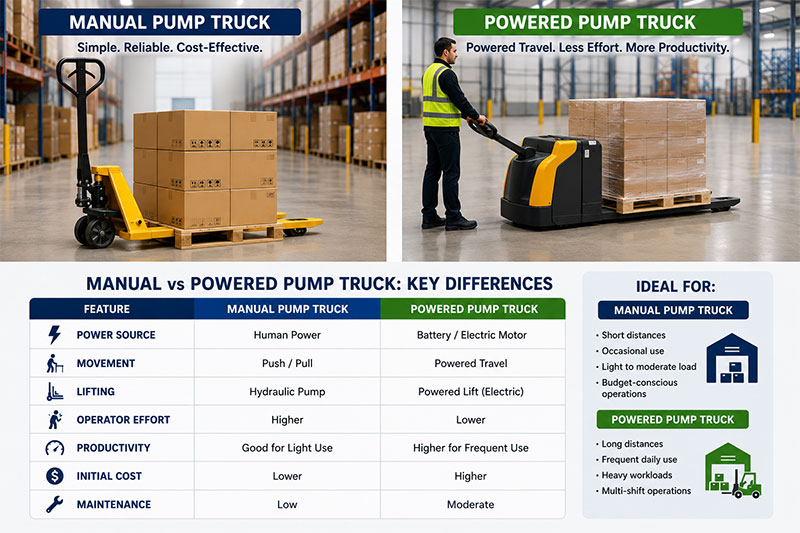
Manual and Powered Pump Truck Comparison Chart
| Comparison Area | Manual Pump Truck | Powered Pump Truck |
| Power source | Human force and hydraulic pump | Rechargeable battery and electric motor |
| Lifting | Manual hydraulic pumping | Electrically assisted |
| Travel | Manual push or pull | Powered travel |
| Initial cost | Lower | Higher |
| Operator effort | Higher | Lower |
| Maintenance complexity | Low | Moderate |
| Charging required | No | Yes |
| Best travel distance | Short | Short to long |
| Best daily volume | Light to moderate | Moderate to high |
| Typical environment | Small warehouse or retail stockroom | Distribution centre, factory or busy warehouse |
| Productivity potential | Good for occasional use | Strong for continuous use |
| Long-term scalability | Limited | Better for growing operations |
The biggest difference is not simply the battery. It is the amount of work transferred from the operator to the equipment.
Which Pump Truck Fits Your Operation?
Use this decision table to narrow the choice.
| Operational Requirement | Recommended Equipment |
| Occasional pallet movement | Manual Pump Truck |
| Short travel distances | Manual Pump Truck |
| Lowest possible upfront cost | Manual Pump Truck |
| No access to charging | Manual Pump Truck |
| Frequent pallet movement | Powered Pump Truck |
| Longer warehouse travel routes | Powered Pallet Jack |
| Heavy daily workload | Powered Pallet Jack |
| Reduced operator fatigue | Powered Pump Truck |
| Faster dock turnaround | Powered Pallet Jack |
| Multi-shift use | Powered Pallet Jack |
| Growing warehouse volume | Powered Pump Truck |
Choose a Manual Pump Truck When:
✓ Pallets are moved only a few times per shift
✓ The travel route is short and level
✓ Loads are manageable for manual movement
✓ Equipment simplicity is a priority
✓ The business wants the lowest initial cost
Choose a Powered Pump Truck When:
✓ Pallets move continuously throughout the day
✓ Operators travel across a large warehouse
✓ Loads are frequently heavy
✓ Labour efficiency is becoming more important
✓ Employee fatigue is affecting output
✓ The operation expects future growth
When Should You Choose a Manual Pump Truck?
A Manual Pump Truck is ideal for:
- Small warehouses
- Retail backrooms
- Light-duty pallet movement
- Delivery trucks
- Occasional use
- Budget-conscious operations
If pallet movement is infrequent and distances are short, a Manual Pump Truck remains a practical and economical solution.
When Should You Upgrade to a Powered Pallet Jack?
A Powered Pump Truck or Powered Pallet Jack is best suited for:
- Distribution centers
- Manufacturing facilities
- 3PL logistics operations
- High pallet volume environments
- Multi-shift warehouses
- Facilities focused on injury prevention
- Operations requiring faster dock turnaround
If employees are moving pallets constantly, the physical savings and efficiency gains can justify the investment quickly.
A Simple Upgrade Test
A facility may be ready for powered equipment when several of the following conditions are present:
- Operators move pallets for a large portion of each shift
- Employees regularly report fatigue from pushing or pulling loads
- Travel routes extend across multiple departments or warehouse zones
- Receiving and shipping areas experience avoidable bottlenecks
- Pallet volume has increased without a corresponding increase in staff
- The operation runs more than one shift
- Manual equipment is being used near its practical workload limit
- Faster material movement would improve production or order turnaround
One isolated issue may not justify an upgrade. When three or more appear together, evaluating a Powered Pallet Jack becomes increasingly practical.
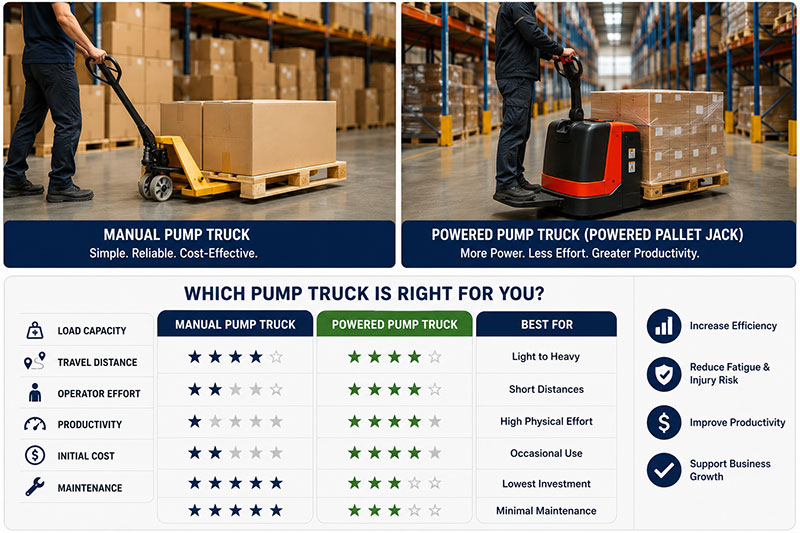
Comparing All Three in Practical Terms
Manual Pump Truck:
Simple, reliable, low-cost solution for light-to-moderate use.
Powered Pump Truck:
Electrically assisted pallet handling for higher efficiency.
Powered Pallet Jack:
Another term for Powered Pump Truck, typically referring to the electric pallet handling equipment used in warehouses.
All fall under the broader category of Pallet Trucks, but they serve different levels of operational demand.
Operational Fit Scorecard
The following scorecard uses a five-point scale to show where each option generally performs best.
| Performance Area | Manual Pump Truck | Powered Pump Truck | Powered Pallet Jack |
| Affordability | 5/5 | 3/5 | 3/5 |
| Simplicity | 5/5 | 4/5 | 4/5 |
| Low maintenance | 5/5 | 3/5 | 3/5 |
| Operator comfort | 2/5 | 4/5 | 5/5 |
| Long-distance travel | 2/5 | 4/5 | 5/5 |
| High-volume productivity | 2/5 | 4/5 | 5/5 |
| Small-space use | 5/5 | 4/5 | 4/5 |
| Scalability | 2/5 | 4/5 | 5/5 |
Overall Equipment Fit
Manual Pump Truck
Best value for light-duty, short-distance and occasional work.
Powered Pump Truck
Strong middle-ground option for facilities upgrading from manual handling.
Powered Pallet Jack
Best fit for repetitive movement, heavier workloads and productivity-focused operations.
Questions to Ask Before Buying a Pump Truck
Before choosing equipment, review the actual workload rather than relying only on a product name or price.
Ask:
- How many pallets are moved during a typical shift?
- What is the average travel distance?
- What is the typical and maximum load weight?
- Is the equipment used occasionally or continuously?
- Are operators experiencing fatigue?
- Does the facility operate multiple shifts?
- Is battery charging space available?
- Will pallet volume increase over the next several years?
- Is the equipment used in trailers, narrow aisles or congested areas?
- Is lower upfront cost or higher long-term productivity the greater priority?
A clear answer to these questions will usually point toward the correct equipment category.
Mobile Industries provides Manual Pump Trucks, Powered Pump Trucks, Powered Pallet Jacks and a wider selection of material handling equipment for warehouses, factories, distribution
Final Thoughts
Understanding the terminology matters. A Pump Truck in construction refers to concrete delivery equipment. A Pump Truck in warehousing refers to a Pallet Truck — typically a manual hydraulic pallet jack.
When comparing Manual Pump Trucks to Powered Pump Trucks or Powered Pallet Jacks, the decision comes down to volume, distance, budget, and ergonomics.
For small operations, a Manual Pump Truck remains a dependable tool. For larger or growing facilities, upgrading to a Powered Pallet Jack improves productivity, reduces operator fatigue, and enhances long-term efficiency.
Choosing the right Pallet Truck ensures smoother operations and smarter material handling investments.
Frequently Asked Questions
Is a Pump Truck the same as a Pallet Jack?
In warehouse terminology, a Pump Truck is generally the same type of equipment as a Manual Pallet Jack or Pallet Truck. The name comes from pumping the handle to activate the hydraulic lifting system.
What is the difference between a Manual Pump Truck and a Powered Pump Truck?
A Manual Pump Truck requires the operator to pump the forks and physically push or pull the load. A Powered Pump Truck uses a battery and electric motor to assist with travel and usually lifting, reducing operator effort.
Is a Powered Pump Truck the same as a Powered Pallet Jack?
The terms are commonly used interchangeably in material handling. Both generally refer to battery-powered equipment designed to lift and transport palletized loads across a warehouse floor.
When should a business upgrade to a Powered Pallet Jack?
A business should consider upgrading when pallets are moved frequently, travel distances are increasing, employees experience fatigue, or faster material movement would improve shipping, receiving or production workflows.
Are Manual Pump Trucks suitable for heavy loads?
Manual Pump Trucks can handle substantial loads when used within their rated capacity. However, moving heavier loads manually requires greater physical effort, particularly over longer distances or uneven surfaces.
Do Powered Pump Trucks require more maintenance?
Powered Pump Trucks require battery charging and periodic checks of electrical and drive components. Manual units are mechanically simpler, but both types require inspections, wheel maintenance and proper care.
Which Pump Truck is best for a small warehouse?
A Manual Pump Truck is often the best choice for a small warehouse with short travel distances and occasional pallet movement. A powered model may still be worthwhile when loads are moved frequently or employee fatigue is a concern.
What does Pump Truck mean in construction?
In construction, a Pump Truck usually means a concrete pump truck. It is a large vehicle that pumps liquid concrete through a boom or hose and is unrelated to warehouse Pallet Trucks.
Can a Powered Pallet Jack replace a forklift?
A Powered Pallet Jack can replace a forklift for many ground-level pallet transportation tasks. It cannot replace a forklift when pallets must be raised to high racks or stacked vertically.
Where can I buy Manual and Powered Pump Trucks?
Mobile Industries supplies Manual Pump Trucks, Powered Pump Trucks, Powered Pallet Jacks and other Pallet Trucks for warehouse and material handling applications. Visit MobilePT.com to review available equipment or request more information.