
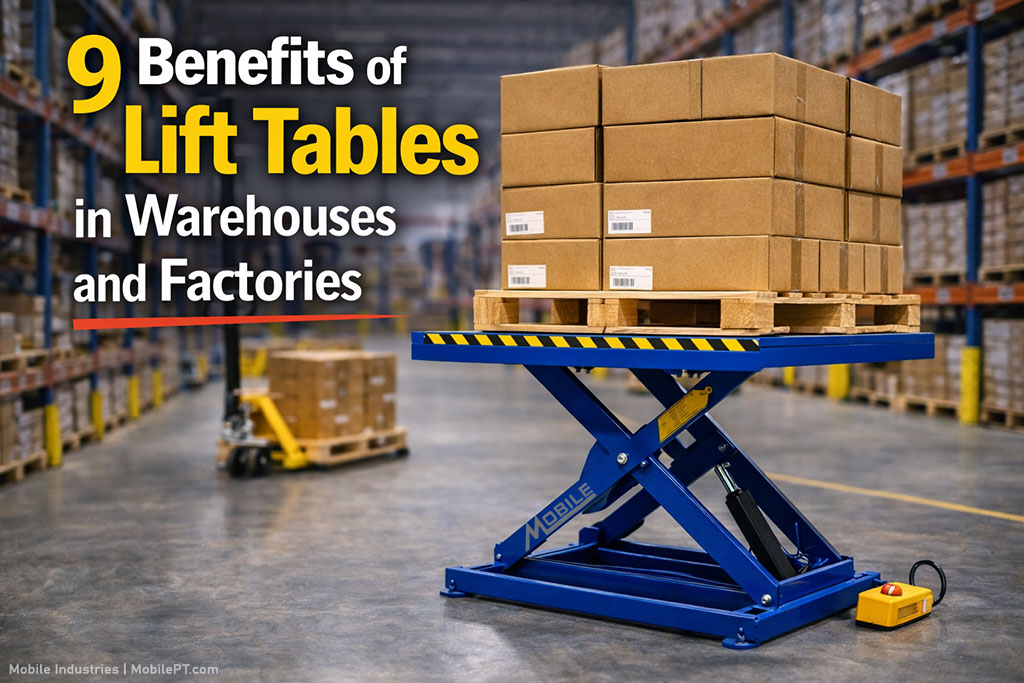
In warehouses and factories, efficiency is often built around the small details that make daily work easier, safer, and faster. One piece of equipment that consistently proves its value in both environments is the lift table. While forklifts, pallet trucks, and conveyors tend to get more attention, lift tables quietly solve one of the most common workplace challenges: safely raising heavy loads to the right working height.
A lift table is designed to lift materials vertically so employees can load, unload, assemble, inspect, or transfer items without excessive bending, reaching, or awkward lifting. In both warehouse and factory settings, that simple function can have a major impact on workflow, safety, and productivity.
Here are nine of the most important benefits of lift tables in warehouses and factories.
1. Improved Ergonomics for Workers
One of the biggest benefits of a lift table is improved ergonomics. In many facilities, employees spend hours bending down to access boxes, parts, or materials placed on pallets or low surfaces. Over time, that kind of repeated motion can cause fatigue, discomfort, and injury.
A lift table raises the load to a more comfortable working height, allowing employees to handle materials without excessive bending or strain. This makes everyday tasks easier on the body and helps create a safer, more comfortable work environment.
In both warehouses and factories, better ergonomics often leads to better performance throughout the day.
2. Reduced Risk of Workplace Injuries
Manual handling injuries are a major concern in material handling environments. Repetitive lifting, awkward posture, and strain from reaching or bending can lead to back injuries, shoulder issues, and other musculoskeletal problems.
A lift table helps reduce that risk by positioning loads where employees can work more safely. Instead of lifting from floor level or stretching over unstable stacks, workers can access items at a controlled height.
This makes lift tables valuable for injury prevention in:
- Packing stations
- Assembly areas
- Shipping departments
- Receiving zones
- Inspection workstations
Reducing injury risk is not only important for employee well-being, but also for minimizing downtime and workers’ compensation costs.
3. Increased Productivity
When materials are positioned at the proper height, employees can work more quickly and efficiently. A lift table reduces wasted movement and makes it easier to load, unload, sort, package, or assemble products.
In a busy warehouse or factory, even small improvements in handling time can add up significantly over the course of a shift. Workers spend less time adjusting their posture, repositioning items awkwardly, or struggling with difficult access.
Lift tables help support smoother workflows by making common tasks faster and more efficient.
4. Better Material Handling at Workstations
A lift table is especially useful at workstations where products, parts, or packages need to be handled repeatedly. Instead of working from a pallet on the floor or a fixed table that is not at the right height, employees can use a lift table to bring materials exactly where they need them.
This is useful in:
- Assembly lines
- Packaging stations
- Labeling areas
- Quality control points
- Repair benches
For facilities focused on workstation efficiency, lift tables are one of the most practical tools available.
5. Easier Loading and Unloading
Warehouses and factories often deal with pallets, containers, bins, and heavy components that need to be loaded or unloaded at different heights. A lift table helps bridge that gap by raising or lowering materials as needed.
This can simplify:
- Transferring items to conveyors
- Loading products into machines
- Unloading heavy bins
- Moving goods between pallets and benches
- Supporting dock and packing operations
By making height transitions easier, lift tables help reduce physical strain while improving accuracy and control.
6. Versatility Across Many Applications
Another major benefit of lift tables is versatility. They are not limited to one specific department or process. In fact, they are useful across a wide range of warehouse and factory tasks.
Common applications include:
- Pallet handling
- Product assembly
- Packaging
- Material transfer
- Maintenance work
- Inspection tasks
- Sorting and staging
Because they can support so many different tasks, lift tables often become one of the most useful shared resources in a facility.
7. Better Workflow and Process Flow
A lift table can help improve the overall flow of materials through a building. By raising materials to the correct height at the right time, it supports smoother transitions between workstations, departments, and handling processes.
For example, a lift table can be used to align materials with a conveyor, support a production station, or make it easier to move finished products from one stage of work to the next.
In both warehouses and factories, good process flow matters. Lift tables help remove small handling barriers that can slow teams down.
8. Support for Heavy Loads
Many warehouse and factory operations deal with loads that are too heavy or awkward to manage safely by hand. Lift tables provide controlled lifting power that makes those loads easier to position and handle.
This is especially important when working with:
- Heavy parts
- Bulk containers
- Palletized goods
- Industrial components
- Large packaged products
Instead of relying on manual lifting or improvised methods, employees can use lift tables to move loads safely and accurately into the correct working position.
9. Long-Term Value for Warehouses and Factories
While a lift table may seem like a simple piece of equipment, it often provides strong long-term value. By improving ergonomics, reducing injury risk, speeding up work, and supporting better handling, it can positively affect several parts of an operation at once.
For many businesses, the return comes through:
- Improved worker comfort
- Higher daily efficiency
- Safer material handling
- Reduced strain-related issues
- Better workstation performance
In other words, a lift table is not just a convenience. It is an equipment investment that can support both productivity and workplace safety over the long term.
Final Thoughts
The benefits of lift tables in warehouses and factories go far beyond simple vertical lifting. They improve ergonomics, support safer handling, reduce strain, increase productivity, and help workstations operate more efficiently.
In environments where materials need to be accessed, assembled, packed, inspected, or transferred at the right height, a lift table becomes an essential tool. It helps employees work smarter, not harder, while supporting safer and more consistent workflows across the facility.
For warehouses and factories focused on practical improvements that make everyday operations better, lift tables remain one of the most valuable pieces of equipment on the floor.
Frequently Asked Questions
What is a lift table used for in warehouses and factories?
A lift table is used to raise and lower materials to a safer and more efficient working height. In warehouses and factories, it is commonly used for packing, assembly, loading, unloading, inspection, and workstation support.
How does a lift table improve safety?
A lift table improves safety by reducing the need for employees to bend, reach, or lift heavy materials from awkward positions. This helps lower the risk of strain injuries and improves overall material handling control.
Are lift tables useful in both warehouses and factories?
Yes, lift tables are highly useful in both warehouses and factories. They support tasks such as pallet handling, packaging, assembly, quality control, material transfer, and workstation setup in a wide range of industrial environments.
Can a lift table handle heavy loads?
Yes, many lift tables are designed to handle heavy loads safely. Capacity depends on the model, but lift tables are commonly used for pallets, industrial parts, containers, and other heavy materials in warehouse and factory settings.
Why are lift tables considered a good long-term investment?
Lift tables are considered a strong long-term investment because they improve ergonomics, reduce injury risk, increase productivity, and support better workflow. Their value comes from making everyday handling tasks safer and more efficient.