
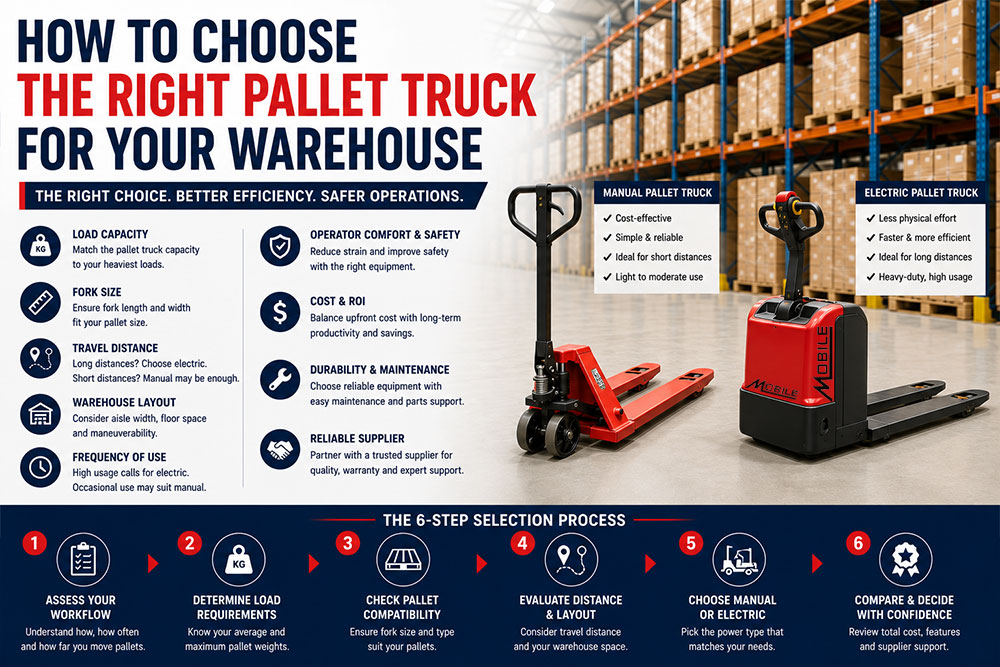
Choosing the right pallet truck for your warehouse is one of those decisions that seems simple at first but can have a big impact on your day-to-day operations. The wrong choice can slow down workflow, increase physical strain on workers, and even lead to unnecessary equipment costs. On the other hand, the right pallet truck can improve efficiency, safety, and overall productivity almost immediately.
Whether you’re outfitting a new warehouse or upgrading your current setup, understanding how to choose the right pallet truck for your warehouse will help you make a smarter, more cost-effective decision.
What Is a Pallet Truck and Why It Matters
A pallet truck, also known as a pallet jack or pump truck, is designed to lift and move palletized loads at ground level. It’s one of the most commonly used tools in warehouses because it handles the majority of short-distance material movement.
From receiving and staging to packing and shipping, pallet trucks play a role in nearly every workflow. That’s why selecting the right type is so important—it directly affects how efficiently your team can move products throughout the facility.
Step 1: Understand Your Warehouse Workflow
The first step in choosing the right pallet truck is understanding how your warehouse operates.
Ask yourself:
- How often are pallets moved each day?
- What distances do pallets typically travel?
- Are pallets moved continuously or occasionally?
- Is your warehouse small, medium, or large?
- Do you have tight aisles or open floor space?
If your operation involves constant movement across large distances, your needs will be very different from a small warehouse that only moves pallets a few times per day.
Step 2: Choose Between Manual and Electric Pallet Trucks
One of the most important decisions is choosing between a manual pallet truck and an electric pallet truck.
Manual Pallet Truck
A manual pallet truck uses a hydraulic pump and requires the operator to push or pull the load.
Best for:
- Short-distance movement
- Light to moderate loads
- Smaller warehouses
- Lower budget operations
- Occasional use
Manual pallet trucks are simple, reliable, and cost-effective, making them a popular choice for many businesses.
Electric Pallet Truck
An electric pallet truck uses battery-powered movement to transport pallets with minimal physical effort.
Best for:
- High-volume operations
- Long-distance movement
- Heavy loads
- Large warehouses
- Multi-shift environments
Electric pallet trucks reduce operator fatigue and significantly increase efficiency in busy environments.
Step 3: Consider Load Capacity Requirements
Every pallet truck has a weight capacity, and choosing the right one is critical for both safety and performance.
Before selecting a pallet truck, determine:
- Average pallet weight
- Maximum load weight
- Type of materials being moved
Standard pallet trucks typically handle around 4,000 to 5,500 pounds, but heavy-duty models are available for more demanding applications.
Choosing a pallet truck with the correct capacity ensures safe operation and prevents unnecessary wear on the equipment.
Step 4: Evaluate Fork Size and Pallet Type
Not all pallets are the same, and your pallet truck needs to match your pallet dimensions.
Key considerations include:
- Standard vs custom pallet sizes
- Fork length requirements
- Fork width compatibility
- Low-clearance pallets
For example, a low-profile pallet truck may be required if your pallets sit closer to the ground than standard designs.
Matching fork size to your pallets ensures smooth handling and avoids operational issues.
Step 5: Think About Travel Distance
Travel distance plays a major role in choosing the right pallet truck.
- Short distances: Manual pallet trucks are usually sufficient
- Medium distances: Electric pallet trucks improve efficiency
- Long distances: Electric pallet trucks are strongly recommended
If employees are moving pallets across large warehouse floors repeatedly, an electric pallet truck can save time and reduce physical strain.
Step 6: Consider Warehouse Layout and Space
Your warehouse layout will influence what type of pallet truck works best.
In tight spaces or narrow aisles:
- Manual pallet trucks offer strong maneuverability
- Compact electric pallet trucks can still perform well
In larger, open spaces:
- Electric pallet trucks are more efficient
- Higher travel speeds improve productivity
Choosing equipment that fits your physical space is essential for smooth operation.
Step 7: Evaluate Frequency of Use
How often you use your pallet truck should influence your decision.
- Occasional use: Manual pallet truck is usually sufficient
- Daily use: Consider electric pallet truck
- Continuous use: Electric pallet truck is the better investment
Frequent use increases the importance of efficiency, durability, and operator comfort.
Step 8: Look at Operator Comfort and Safety
A pallet truck is used by employees throughout the day, so comfort and safety matter.
Electric pallet trucks provide:
- Reduced physical strain
- Smooth acceleration and braking
- Better control of heavy loads
Manual pallet trucks are simpler but require more physical effort, which can lead to fatigue over time.
If employee well-being is a priority, electric models offer clear advantages.
Step 9: Consider Long-Term Cost vs Upfront Cost
A manual pallet truck is less expensive upfront, but that doesn’t always mean it’s the best long-term choice.
Electric pallet trucks:
- Cost more initially
- Reduce labor strain
- Increase productivity
- Lower long-term operational costs
Manual pallet trucks:
- Lower initial investment
- Minimal maintenance
- Ideal for light-duty use
The right choice depends on your usage level and long-term goals.
Step 10: Choose a Reliable Supplier
Choosing the right pallet truck supplier is just as important as choosing the equipment itself.
A strong supplier will provide:
- Quality equipment
- Product availability
- Warranty support
- Replacement parts
- Expert guidance
Companies like Mobile Industries offer a wide range of pallet trucks designed for real warehouse environments, helping businesses find the right solution quickly and efficiently.
Common Mistakes to Avoid
When choosing a pallet truck, avoid these common mistakes:
- Choosing based on price alone
- Ignoring load capacity requirements
- Not considering travel distance
- Overlooking warehouse layout
- Underestimating usage frequency
Taking the time to evaluate your needs will help you avoid costly mistakes.
Final Thoughts
Choosing the right pallet truck for your warehouse comes down to understanding your workflow, space, and operational demands. Whether you choose a manual pallet truck for simplicity or an electric pallet truck for efficiency, the goal is to match the equipment to your needs.
A well-chosen pallet truck can improve productivity, reduce strain on employees, and help your warehouse operate more smoothly every day.
If you’re unsure which option is right for you, working with a trusted supplier can make the process much easier and ensure you get the best solution for your operation.
Frequently Asked Questions
How do I choose the right pallet truck?
To choose the right pallet truck, consider load capacity, travel distance, frequency of use, warehouse size, and whether you need manual or electric operation.
What is the difference between a manual and electric pallet truck?
A manual pallet truck requires physical effort to move loads, while an electric pallet truck uses battery power to assist with movement and lifting.
What size pallet truck do I need?
The size of your pallet truck should match your pallet dimensions, including fork length and width, to ensure proper handling.
Is an electric pallet truck worth it?
An electric pallet truck is worth it for high-volume operations, long distances, and heavy loads, as it improves efficiency and reduces fatigue.
Can a pallet truck replace a forklift?
A pallet truck cannot replace a forklift if vertical lifting is required, but it is ideal for ground-level movement and short-distance transpo