
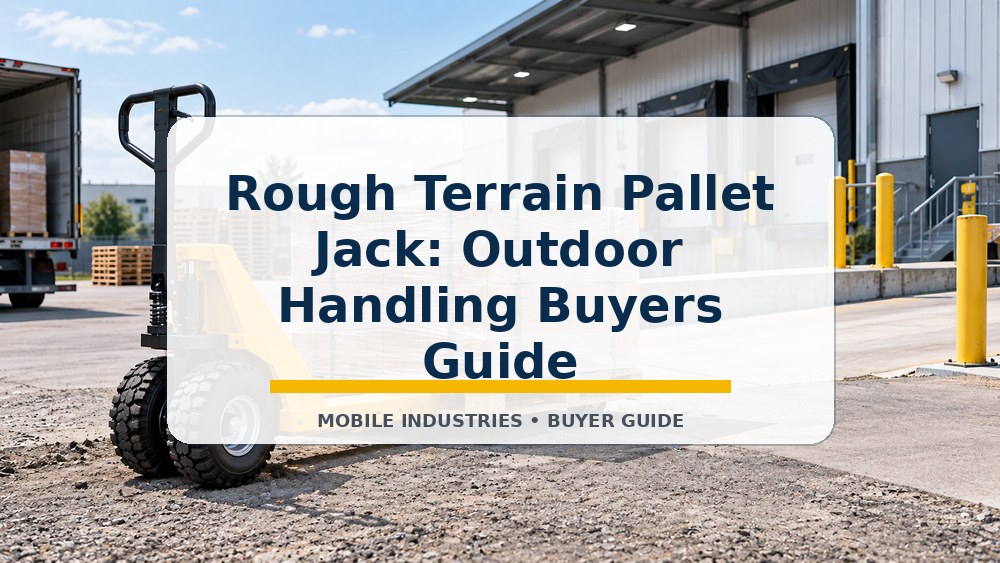
A standard warehouse pallet jack is designed for smooth, hard floors. Move that same truck onto gravel, broken pavement or an uneven yard and the small load rollers can become a major limitation. A rough terrain pallet jack solves that problem with larger wheels, a wider stance and an outdoor-oriented frame.
That does not make it a miniature forklift or an all-surface machine. Manual force, slope, soil firmness, load weight and weather still determine whether the equipment can be used effectively.
This buyer’s guide explains where rough terrain pallet jacks work, where they do not, how pneumatic wheels change performance and what to measure before choosing one for outdoor pallet movement.
Rough Terrain Pallet Jack: Quick Answer
A rough terrain pallet jack is a manually propelled low-lift pallet truck built for firmer outdoor and uneven surfaces. It uses much larger wheels than a standard pallet jack and often includes adjustable forks so it can handle different pallet widths.
| Question | Rough Terrain Pallet Jack Answer |
| Best surfaces | Firm gravel, yards, uneven pavement and outdoor loading areas |
| Main advantage | Larger wheels roll over irregular surfaces more effectively |
| Primary limitation | Manual propulsion becomes difficult on soft ground, steep grades or long routes |
| Vertical lifting | Low lift only; not a stacking machine |
| Key buying factors | Surface, slope, capacity, tires, fork range and route length |
What Is a Rough Terrain Pallet Jack?
A rough terrain pallet jack supports a pallet on forks like a conventional pallet truck, but the chassis and wheel system are designed for larger surface irregularities. Rather than tiny load rollers under the fork tips, the truck uses larger wheels that can cross small stones, joints and uneven pavement more easily.
The ECO RTT rough terrain pallet truck is one example, using pneumatic wheels and adjustable forks for outdoor or undulating surfaces.
The machine remains manually propelled. The operator still has to start, steer and stop the load, so the route must be realistic for the load weight and ground conditions.
How Is a Rough Terrain Pallet Jack Different from a Standard Pallet Jack?
The biggest difference is wheel diameter and frame geometry. A standard pallet jack is compact because its small rollers fit inside pallet openings. That design is excellent on flat concrete but less capable when the floor becomes rough.
A rough terrain truck places the pallet between larger wheel assemblies. The larger diameter helps the truck climb over surface irregularities that would stop or jar a conventional pallet jack.
| Feature | Standard Pallet Jack | Rough Terrain Pallet Jack |
| Best surface | Smooth warehouse concrete | Firm outdoor or uneven surface |
| Wheel size | Small steering/load wheels | Large pneumatic-style wheels |
| Pallet width flexibility | Usually fixed fork spacing | Often adjustable forks |
| Turning footprint | Compact | Larger |
| Outdoor capability | Limited | Designed for suitable outdoor routes |
What Surfaces Can a Rough Terrain Pallet Jack Handle?
Typical applications include firm gravel, compacted yards, uneven concrete, rough pavement and outdoor loading zones. The word “rough” should not be interpreted as unlimited terrain capability.
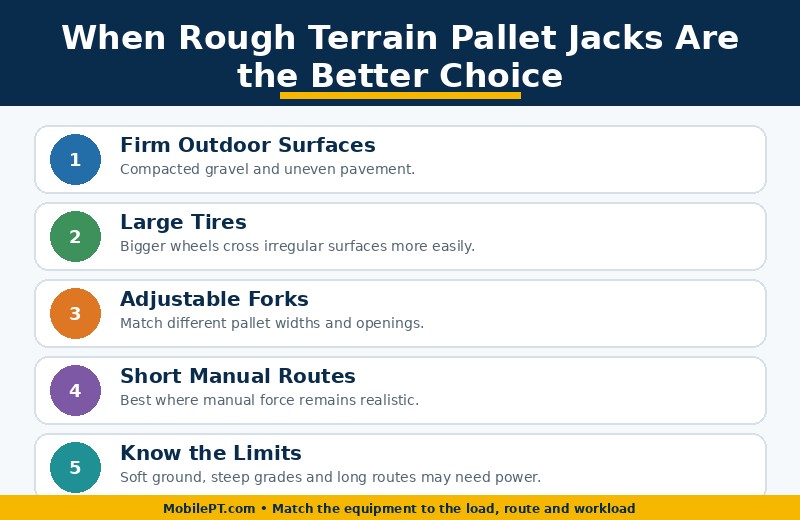
Deep loose gravel can create very high rolling resistance. Mud, sand, snow, severe potholes and unstable soil can reduce traction and make manual control impractical. Steep grades add another problem because the operator must control the full mass of the truck and load.
Evaluate the worst section of the route, not the easiest section. A 200-foot path with one soft gravel patch or steep transition can determine whether the truck is workable.
When Rough Terrain Pallet Jacks Are the Better Choice
A rough terrain pallet jack is useful when loads must move short distances outside a warehouse but a forklift is unavailable, unnecessary or difficult to justify. Examples include agricultural storage, garden centers, temporary staging areas, event logistics, construction material areas and warehouses with exterior yards.
It can also help when a delivery has to cross a rough apron between a truck and a building or when pallets are staged on compacted ground instead of smooth concrete.
Why Pneumatic Wheels Matter
Large pneumatic wheels deform slightly around irregular surfaces, which can improve rolling performance and reduce shock compared with small hard rollers. They also create a larger contact patch than typical pallet-jack wheels.
The tradeoff is maintenance and operating resistance. Tire pressure must be correct, and damaged or underinflated tires can make a loaded truck much harder to move. Solid or foam-filled alternatives may reduce puncture risk but can change ride and rolling characteristics.
Adjustable Forks and Pallet Compatibility
Many rough terrain pallet trucks use adjustable forks because the external wheel-and-leg frame does not fit inside a standard pallet in the same way as a conventional pallet truck. Adjustable forks help the operator match different pallet widths and open or closed bottoms.
Measure pallet width, fork-entry direction and underside construction. A wide outdoor chassis can require more clearance around the pallet than a compact warehouse jack.
How Much Weight Can a Rough Terrain Pallet Jack Move?
Capacity varies by model and is often lower than heavy-duty indoor pallet trucks. That is not necessarily a weakness; the outdoor application is constrained by rolling resistance and operator force as much as by structural rating.
Calculate the heaviest complete pallet, then consider whether a person can realistically move and stop that load on the actual surface. A rated capacity does not guarantee that every rated load is practical on every grade or ground condition.
Rough Terrain Pallet Jack vs Forklift
A rough terrain pallet jack is best for short, low-level moves where the load stays near the ground. A forklift adds powered travel, vertical lift and much greater capability, but also requires more space, training, maintenance and capital.
If the route is long, the ground is soft, the slope is significant or pallets must be stacked, the pallet jack may no longer be the correct machine. The pallet forklift vs pallet truck guide explains the broader capability difference between floor-level pallet movement and vertical lift equipment.
Rough Terrain Pallet Jack vs Powered Pallet Truck
Powered pallet trucks reduce operator effort but are usually designed for improved, compacted warehouse surfaces. Small wheels and limited ground clearance can make them unsuitable for rough yards unless the specific model is designed for that environment.
The right comparison is not manual versus powered. It is whether the truck is designed for the surface. A rough terrain manual truck can outperform a conventional electric pallet truck on a rough route simply because its wheels and frame match the ground.
Outdoor Pallet Handling and Surface Conditions
Surface condition is part of safe material handling. OSHA notes in its industrial truck surface guidance that operating surfaces should be capable of supporting equipment and loads and should be free of holes, grease, oil or obstructions that can cause loss of control.
Although a manual rough terrain pallet jack is not a powered forklift, the same planning logic applies: inspect the route, remove avoidable hazards and do not assume the equipment can compensate for a damaged or unstable surface.
How Do Slopes Affect a Rough Terrain Pallet Truck?
Grades increase the force required to move a load uphill and the force required to control it downhill. A route that feels manageable when empty may be very different with a heavy pallet.
Do not improvise on steep ramps. Use manufacturer limits and workplace procedures. If the application regularly includes grades, powered equipment with appropriate braking may be a better solution.
Weather, Water and Outdoor Storage
Outdoor use exposes equipment to moisture, dirt and temperature changes. A rough terrain truck should not automatically be stored outdoors just because it can operate outdoors.
Keep hydraulic components, bearings and moving joints maintained according to the manufacturer. Clean dirt and debris from wheels and inspect for corrosion or damaged paint. If the application is routinely wet or corrosive, ask whether a galvanized or stainless configuration is more appropriate.
How to Choose a Rough Terrain Pallet Jack
Walk the complete route before looking at specifications. The checklist below focuses on the operating conditions that determine whether a manual outdoor pallet truck is practical.
- Identify the firmest and softest surfaces on the route.
- Measure maximum grade and abrupt transitions.
- Calculate the heaviest complete pallet load.
- Measure pallet width, fork entry and bottom construction.
- Confirm the adjustable fork range matches the pallets.
- Compare pneumatic, solid and other wheel options.
- Check turning space around docks, gates and staging areas.
- Estimate travel distance and moves per hour.
- Determine how weather and moisture will affect storage and maintenance.
- Compare manual effort with a powered or forklift alternative before purchase.
Common Rough Terrain Pallet Jack Buying Mistakes
The most common mistake is assuming “rough terrain” means any terrain. These trucks still need firm enough ground to support the load and allow the wheels to roll.
Other mistakes include ignoring grade, underestimating turning space, choosing the wrong adjustable fork range, neglecting tire maintenance and planning routes that are too long for manual propulsion.
Who Should Buy a Rough Terrain Pallet Truck?
It is a strong fit for operations that occasionally move pallets across outdoor or imperfect surfaces and need a simple low-lift solution. That includes businesses with yards, garden centers, farms, temporary storage areas and facilities with uneven exterior approaches.
For purely indoor work on smooth concrete, the standard pallet truck category will usually provide more compact handling and simpler rolling performance.
How to Perform a Route Test Before Buying
A route test should reproduce the real job as closely as possible. Walk the path with a representative loaded pallet and identify surface changes, drainage channels, gravel depth, dock transitions, turns and grades. Mark the worst section because that section will usually define whether manual equipment is practical.
If a demonstration unit is available, test starting force, steering and stopping at the maximum expected load. Try the route after normal site conditions such as rain or material buildup if those conditions occur regularly. A dry summer demonstration may not represent spring mud or winter debris.
Record travel time and operator feedback. If moving one pallet requires several pauses or two people, the rough terrain pallet jack may be technically capable but operationally inefficient. That is the point where powered outdoor equipment should be compared.
Manual Effort, Throughput and Route Length
Rough terrain pallet jacks trade compact warehouse efficiency for surface capability. Large wheels help the truck roll over irregular ground, but manual movement of a heavy pallet still requires force. Throughput therefore depends heavily on route length and surface resistance.
Estimate how many pallets will be moved per hour, the average one-way distance and the amount of waiting or staging between trips. An occasional 40-foot move across a yard is a different application from continuous 300-foot transfers between buildings.
If the operation expects high volume, a powered truck, tractor-and-cart system or forklift may reduce labor more effectively even if the rough terrain pallet jack has a lower purchase price.
Outdoor Storage, Cleaning and Preventive Maintenance
Outdoor dirt and moisture accelerate wear. Clean mud, gravel and debris from wheel assemblies before it reaches bearings or steering components. Inspect pneumatic tires for cuts, punctures and correct inflation, and check fasteners after repeated travel over vibration-producing surfaces.
Hydraulic components and pivot points should be maintained according to the manufacturer, and exposed steel should be inspected for chipped coating or corrosion. Storing the truck under cover can significantly reduce unnecessary weather exposure.
If the truck is used only seasonally, inspect it before the busy season rather than discovering a flat tire or hydraulic leak when the first shipment arrives.
Cost Comparison: Rough Terrain Pallet Jack vs Powered Equipment
A manual rough terrain pallet jack has a lower equipment cost and simpler power requirements than a forklift, but labor cost grows with distance, load weight and frequency. A forklift or powered outdoor machine costs more to purchase and maintain but can move more loads with less manual effort.
The right comparison is cost per useful move, not purchase price. Include operator time, training, maintenance, fuel or electricity, route distance, utilization and the ability to use the equipment for other tasks.
For occasional outdoor movement, the manual truck can be extremely economical. For continuous yard logistics, the same truck can become the bottleneck. Define the workload before choosing the equipment class.
How to Decide Whether Manual Outdoor Handling Is Practical
Before approving a rough terrain pallet jack, estimate the total physical work expected from the operator. Consider the load weight, surface resistance, number of starts and stops, slope, weather and how many trips occur in a shift. A route that is acceptable for one occasional pallet may be unrealistic when repeated dozens of times.
Use a simple trial: move a representative loaded pallet over the full route at the expected pace, then repeat the move enough times to simulate a meaningful portion of the shift. Watch for excessive force, loss of control, wheel spin, frequent rest stops or the need for a second person. Those are signs that powered equipment may be more appropriate.
Also consider seasonal change. Firm ground in dry weather can become soft after rain, and cold temperatures can affect tire pressure and surface traction. If the route is critical to production, the equipment plan should work under the normal range of site conditions, not only on the best day of the year.
Questions to Ask a Rough Terrain Pallet Jack Supplier
Ask the supplier which surfaces the model is designed for, whether the tires are pneumatic or solid, what fork-width adjustment is available and what grades or operating limits apply. Confirm replacement tire availability, pump service parts, warranty coverage and whether the truck can be demonstrated with your actual pallet.
Also ask what the manufacturer considers acceptable outdoor storage and whether any corrosion-resistant options are available. Clear answers to these questions help distinguish a purpose-built outdoor pallet truck from a standard model with cosmetic changes.
Final Thoughts
A rough terrain pallet jack is valuable because it extends pallet handling beyond polished warehouse floors. Larger wheels and an outdoor-oriented frame can make short moves over firm gravel and uneven pavement practical.
The machine still has limits. Surface firmness, slopes, weather, load weight and manual effort should be evaluated before purchase. Match the truck to the worst part of the route, not just the pallet itself.
Frequently Asked Questions
What is a rough terrain pallet jack?
A rough terrain pallet jack is a manual pallet truck designed with larger pneumatic-style wheels and a wider support structure so palletized loads can be moved across uneven or outdoor surfaces more effectively than with a standard warehouse pallet jack.
Can a rough terrain pallet jack be used on gravel?
It may be suitable for firm gravel or compacted uneven surfaces when the specific model and load are appropriate. Loose, deep, soft or unstable ground can still prevent safe movement.
Is a rough terrain pallet jack the same as a rough terrain forklift?
No. A rough terrain pallet jack is a manually propelled low-lift pallet mover. A rough terrain forklift is a powered lift truck designed for more demanding outdoor travel and vertical lifting.
What tires are used on rough terrain pallet trucks?
Many rough terrain pallet trucks use large pneumatic or pneumatic-style wheels to improve rolling performance over uneven ground, but tire type varies by model.
What should I check before buying an outdoor pallet jack?
Check surface firmness, slopes, load weight, pallet dimensions, fork adjustment, tire type, turning space, travel distance, weather exposure and whether manual propulsion is realistic for the route.