
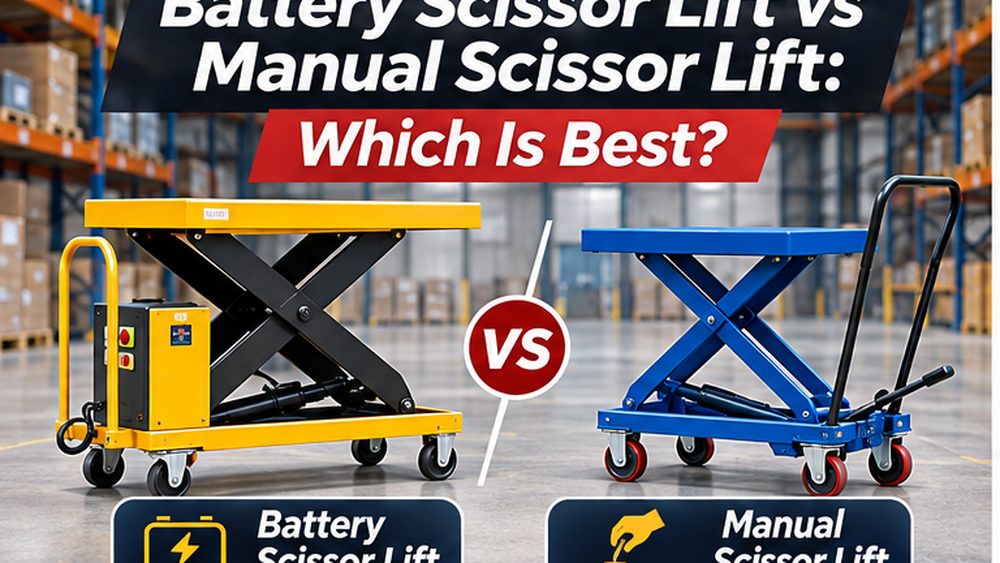
Battery and manual scissor lifts can perform the same basic material-handling task: move a skid or compatible load and raise it to a useful working height. The difference is how the lift cycle is powered. A manual scissor lift relies on hydraulic pumping by the operator, while a battery scissor lift uses an electric pump and battery to raise the load.
The best choice depends less on maximum capacity than on how often the height changes, how many loads are handled per shift, how much operator effort is acceptable, and whether the facility wants the simplicity of manual equipment or the productivity of powered lifting.
Battery Scissor Lift vs Manual Scissor Lift: Quick Answer
| Factor | Battery Scissor Lift | Manual Scissor Lift |
|---|---|---|
| Lift operation | Electric push-button or powered control | Manual hydraulic pumping |
| Best duty cycle | Frequent or repetitive lifting | Occasional to moderate lifting |
| Operator effort | Lower | Higher |
| Lift consistency | Fast and repeatable | Depends on pumping speed |
| Maintenance | Battery, charger, electrical and hydraulic | Primarily hydraulic and mechanical |
| Upfront cost | Higher | Lower |
| Best fit | Production, packing, frequent workstation adjustment | Light-duty or intermittent use |
Choose a battery scissor lift when lift frequency and cycle time matter. Choose a manual model when the equipment is used less often, simplicity is valuable, and manual pumping will not create a productivity problem.
What Is a Material Handling Scissor Lift?
The scissor lifts discussed here are material handling machines, not aerial work platforms. They use crossed lifting arms to raise forks or a load-supporting structure while remaining compact enough to move around a warehouse or production area. Typical uses include skid handling, conveyor loading, packing, assembly, inspection, and mobile workstation positioning.
Mobile Industries offers both manual and battery-powered material handling scissor lifts for indoor warehouse and production applications.
How Does a Manual Scissor Lift Work?
A manual scissor lift uses a hydraulic pump operated by hand or foot. Each pump stroke moves hydraulic fluid and raises the scissor mechanism. The operator stops at the desired height, performs the task, then uses a controlled lowering valve to bring the load down.
The MPS25 Manual Pump Scissor Lift is an example designed for lifting and transporting skids and bottomless containers, loading and unloading conveyors, and serving as a mobile workstation. Its value comes from mechanical simplicity and the ability to combine low-level transport with work-height positioning.
How Does a Battery Scissor Lift Work?
A battery scissor lift replaces repetitive manual pumping with an electric hydraulic pump. The operator uses powered controls to raise the load, while the truck can still be positioned as required by the specific model. Battery power makes each lift cycle more consistent and reduces the physical effort associated with repeated height adjustments.
The BPS25 Battery Scissor Lift uses a built-in battery system and is designed to reach full lift height quickly. Mobile Industries states that this model can perform approximately 50 full-load lifts to maximum height on one battery charge, illustrating why powered lifting can be valuable in higher-cycle applications.
Battery vs Manual Scissor Lift Decision Factors
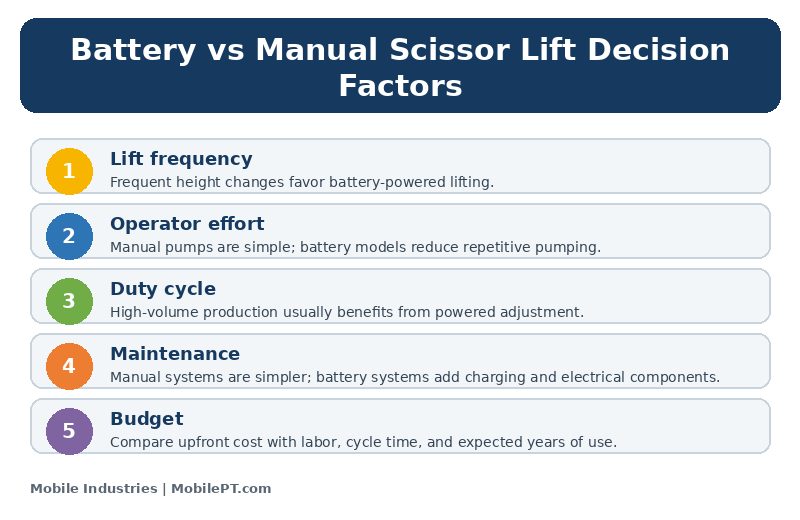
1. Lift Frequency
Lift frequency is usually the most important factor. If the table is raised once in the morning and adjusted only a few times during the shift, manual pumping may be entirely practical. If the operator raises and lowers the platform dozens of times while packing, assembling, sorting, or feeding a process, the cumulative pumping effort becomes significant.
Battery-powered lift does not simply save a few seconds. It standardizes the cycle. Employees can position the load with less interruption, which matters when the scissor lift is part of a repeatable production sequence.
2. Operator Effort and Ergonomics
Manual hydraulic equipment is not inherently difficult to use, but effort accumulates. The heavier the load and the more frequent the cycles, the more valuable powered lift becomes. In a low-volume facility, that difference may be negligible. In a production or packing operation, it can influence fatigue and consistency across the shift.
OSHA warehouse ergonomics guidance identifies repeated bending, reaching, pushing, pulling, and material handling as risk factors and encourages appropriate mechanical handling solutions. See OSHA Warehousing Hazards and Solutions for general guidance.
3. Lift Speed and Workflow
Powered hydraulic lift can raise a load at a predictable rate without waiting for repeated pump strokes. Faster height adjustment is most valuable when the scissor lift directly feeds another process such as a conveyor, packing station, assembly cell, or inspection point.
Manual equipment may still be faster overall if the application is simple and infrequent because there is no battery state to manage. The correct comparison is not maximum lift speed alone; it is total time per task over the whole shift.
4. Capacity and Load Compatibility
Battery power does not automatically increase rated capacity. Manual and battery models can share similar structural capacities. The equipment must still match the skid, container, fork openings, load distribution, and center of gravity.
Many material handling scissor lifts are intended for skids or bottomless containers rather than every pallet design. Confirm fork entry and underside clearance before choosing either power type.
5. Lowered Height and Maximum Work Height
Both manual and battery equipment must reach the required height range. The lowered height determines whether the forks can enter the load. The raised height determines whether the load can align with the conveyor, workstation, machine, or employee work zone.
If the table is being purchased for conveyor work, measure the conveyor deck height and the load itself. The scissor lift must position the top of the product—not just the forks—at the correct transfer level.
6. Battery Runtime and Charging
A battery scissor lift adds an energy-management requirement. Buyers should understand battery capacity, expected lift cycles, charger type, recharge time, shift length, and where the equipment will be charged. A battery model is only productive when charging fits the operating schedule.
For single-shift intermittent use, an onboard charger can make the routine simple: plug the equipment in during downtime. For multi-shift or continuous operation, the facility should confirm whether one battery and charger can support the expected duty cycle.
7. Maintenance Requirements
Manual scissor lifts have fewer electrical components. Maintenance generally centers on the hydraulic system, wheels, casters, pivot points, structural condition, controls, and braking system. Battery models add a battery, charger, electrical wiring, switches, and electric hydraulic components.
That does not make battery equipment unreliable; it simply means the maintenance plan is broader. The productivity benefit can easily justify the additional systems when lift cycles are frequent.
8. Upfront Cost vs Operating Cost
Manual equipment usually costs less to purchase because it does not include the battery, charger, motor, and electrical controls. Battery equipment carries a higher upfront cost but may reduce labor time and physical effort over years of repeated use.
The better financial comparison is cost per useful cycle. If a battery lift saves time during hundreds of weekly adjustments, the productivity difference can outweigh the initial price gap. If the table is used a few times per week, manual equipment may provide the better value.
Manual Scissor Lift Advantages
- Lower initial investment.
- Simple hydraulic and mechanical design.
- No charging schedule or battery replacement cycle.
- Good for intermittent or lower-frequency lifting.
- Easy to keep available as backup equipment.
- Useful where electrical charging infrastructure is inconvenient.
Battery Scissor Lift Advantages
- Powered lifting reduces repeated pumping effort.
- Consistent lift speed supports repetitive workflows.
- Better suited to frequent height adjustment.
- Can improve productivity in packing, production, and conveyor applications.
- Allows the operator to focus on positioning rather than creating hydraulic pressure manually.
Which Is Better for Conveyor Loading?
Battery models are usually the stronger choice when the scissor lift is raised and lowered repeatedly to match changing load height at a conveyor. The powered cycle can keep pace with a repetitive process. Manual models can still work well when a skid is raised once and remains near the same height for a long period.
Which Is Better for a Mobile Workstation?
Both can work. A manual model is attractive for maintenance, occasional assembly, or flexible tasks where the workstation moves more often than it changes height. A battery model is better when employees frequently fine-tune the height throughout the job.
Which Is Better for Packing and Order Preparation?
Packing operations often benefit from powered lift because the ideal work height changes as cartons are removed from or added to a skid. Battery-powered adjustment allows the operator to keep the working layer near a practical height without interrupting the packing sequence to pump the table repeatedly.
Which Is Better for Low-Volume Warehouses?
Manual scissor lifts are often ideal for low-volume facilities. They provide the core benefits of a height-adjustable load without adding battery maintenance or a higher purchase price. If the equipment is only adjusted occasionally, the simplicity can be a feature rather than a compromise.
Battery vs Manual Scissor Lift Decision Guide
| Operating Requirement | Better Starting Point | Reason |
|---|---|---|
| A few lift cycles per day | Manual | Simple and economical |
| Frequent height changes | Battery | Less pumping and faster cycles |
| Conveyor loading all shift | Battery | Repeatable powered positioning |
| Occasional maintenance work | Manual | Low complexity and no charger |
| Packing/assembly with variable work height | Battery | Quick adjustment supports workflow |
| Backup or secondary equipment | Manual | Easy to keep ready |
Common Buying Mistakes
- Choosing battery power when the lift is rarely adjusted.
- Choosing manual equipment for a high-cycle process because the purchase price is lower.
- Ignoring pallet or skid compatibility.
- Comparing only capacity and not lift height, lowered height, and work process.
- Forgetting charger location and battery runtime.
- Using material handling scissor lifts as personnel platforms.
- Failing to inspect the travel route, caster condition, and braking needs.
How to Calculate Whether Battery Power Is Worth It
A practical way to compare manual and battery scissor lifts is to count height-adjustment cycles. Estimate how many times the load is raised or lowered per hour, multiply by operating hours, then compare that number with the time and effort required for manual pumping. A table used five times per day has a very different economic profile from one adjusted 150 times during a production shift.
The calculation should include more than labor seconds. Repeated pumping can interrupt a packing or assembly rhythm, while powered lift can let the operator make small height corrections without leaving the task. In high-cycle applications, that continuity may be more valuable than raw lift speed. In a maintenance department where the table is positioned once and left in place, the same battery system may add cost without delivering much benefit.
What About Battery Replacement and Charger Life?
Battery-powered equipment should be evaluated over its expected service life. Batteries are consumable components, and charger condition affects uptime. Ask what battery chemistry is used, whether the battery is field-replaceable, how long a typical charge takes, and what replacement batteries cost. Also confirm whether the charger is onboard or separate and whether the facility has an appropriate outlet near the storage area.
A well-matched battery scissor lift can remain highly productive for years, but only when the charging routine becomes part of normal operations. Assign a parking and charging location, include the battery in preventive maintenance, and train operators to report reduced runtime before it causes an unexpected interruption.
How Scissor Lifts Fit Into a Broader Material Handling Fleet
A scissor lift does not replace every pallet truck or stacker. Its strength is work-height positioning. Pallet trucks are better for repeated horizontal transportation, while stackers are designed for lifting pallets into elevated storage positions. Many facilities use all three because each machine removes a different bottleneck. The scissor lift stays near packing, assembly, inspection, or conveyor work; pallet trucks move inventory between departments; and stackers handle vertical storage.
Thinking in terms of workflow prevents overspending. A warehouse that buys a battery scissor lift for long-distance transport may be disappointed because mobility is not its primary advantage. Conversely, using a pallet jack at a workstation may leave employees repeatedly bending to floor level. Define the dominant task first, then choose the equipment category and power system that matches it.
Questions to Ask Before Requesting a Quote
- How many lift cycles occur during a typical shift?
- What is the heaviest complete skid or container?
- What are the minimum fork-entry and maximum working heights?
- Will the unit feed a conveyor, packing station, or production line?
- Is manual pumping acceptable at the expected cycle count?
- Where will a battery model be parked and charged?
- Are replacement batteries and service parts readily available?
- Does the route include slopes, thresholds, or floor damage that affect mobility?
How to Document the Equipment Decision
For repeatable warehouse procurement, document the measurements and operating assumptions used to select the equipment. Record load dimensions, maximum weight, pallet construction, route conditions, daily cycles, aisle constraints, operator method, and any environmental exposure. This creates a reference that can be used when the facility expands, a supplier changes pallets, or replacement equipment is purchased years later.
A simple equipment record also helps separate specification problems from maintenance problems. If a truck once performed well but later becomes hard to move, the issue may be wheel wear, bearings, floor damage, or hydraulic condition rather than the original model choice. If the workflow itself changes, the documented baseline makes it easier to identify which specification must change.
Procurement should also consider parts availability, service access, operator training, inspection routines, and expected equipment life. The lowest purchase price can become expensive if a specialized component is difficult to replace or if the machine does not match the facility well enough to be used consistently. Selection is strongest when performance, maintainability, and real workflow are evaluated together.
Final Thoughts
A battery scissor lift is best when frequent height adjustments, cycle speed, and reduced pumping effort have real operational value. A manual scissor lift is best when lifting is intermittent and the facility values simplicity, lower upfront cost, and freedom from charging requirements.
Both can be effective warehouse tools. The correct choice comes from the duty cycle: count how often the table will move, how often it will lift, how heavy the loads are, and how closely the equipment is tied to production. That workload usually makes the answer clear.
Frequently Asked Questions
What is the main difference between a battery and manual scissor lift?
A battery scissor lift uses an electric hydraulic pump to raise the load, while a manual scissor lift relies on hand or foot pumping to create hydraulic pressure.
Is a battery scissor lift faster?
Battery-powered lifting is generally faster and more consistent for repeated cycles because the operator does not need to pump the hydraulic system manually.
Is a manual scissor lift better for occasional use?
Yes. Manual models are often a cost-effective choice when the lift is adjusted only occasionally and charging infrastructure is unnecessary.
Do battery scissor lifts lift more weight?
Not necessarily. Rated capacity depends on the specific model. Battery power changes how the lift is operated, not automatically how much weight the structure can carry.
Can a material handling scissor lift lift people?
No. Material handling scissor lifts in this category are designed for loads, not personnel. A properly rated aerial work platform is required for elevating workers.