
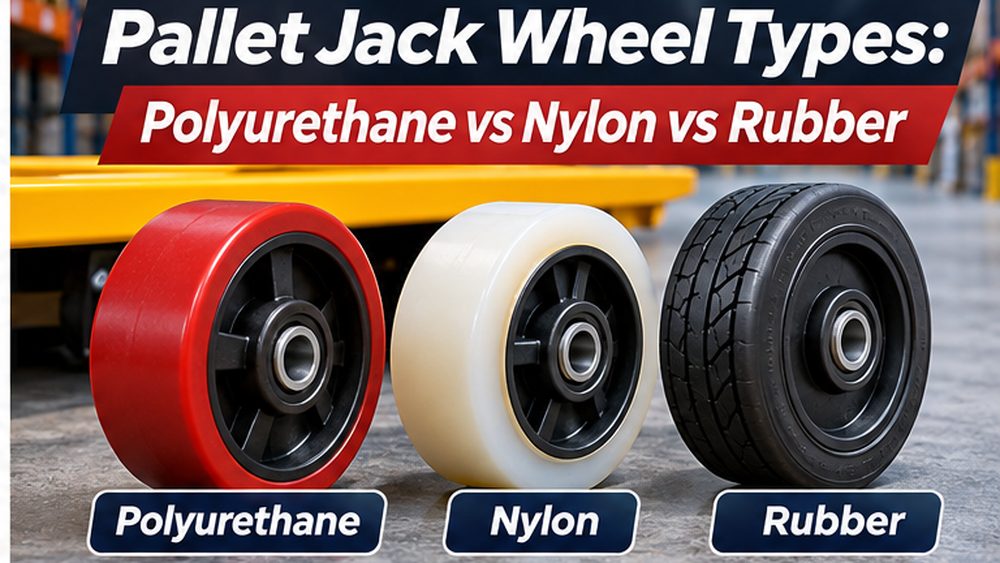
Pallet jack wheels look like a minor replacement part, but they have a major effect on how a truck rolls, steers, stops, protects the floor, and feels to the operator. Polyurethane, nylon, and rubber each behave differently under load. The best pallet jack wheel type depends on the floor, load weight, travel distance, noise requirements, contaminants, and how frequently the truck is used.
This guide compares the three common wheel materials and explains how to choose steer wheels and load rollers for a warehouse, factory, distribution center, retail stockroom, or production operation.
Pallet Jack Wheel Types: Quick Answer
| Wheel Material | Best For | Key Strength | Main Tradeoff |
|---|---|---|---|
| Polyurethane | General warehouses and mixed indoor use | Balanced floor protection and durability | May wear faster on very rough floors |
| Nylon | Smooth hard floors and heavier loads | Low rolling resistance and high hardness | Noisier and less forgiving on joints/debris |
| Rubber | Noise-sensitive areas and traction needs | Quiet, cushioned ride and grip | Higher rolling resistance and potential wear |
There is no universally best wheel. A wheel that rolls effortlessly on a smooth concrete floor may perform poorly across damaged joints. A soft wheel that protects flooring can require more effort under a very heavy load. Select the wheel around the actual route and workload.
Where Are the Wheels on a Pallet Jack?
A manual pallet jack typically has larger steer wheels near the handle and smaller load rollers near the fork tips. These two wheel positions do different jobs. The steer wheels support the rear of the truck, respond to handle movement, and influence turning. The load rollers carry the front portion of the pallet and must fit within the fork geometry so the pallet jack can enter and exit the load.
The exact wheel materials and dimensions vary across manual and electric pallet trucks. Buyers should check both steer-wheel and load-roller specifications rather than assuming every wheel on the truck uses the same material.
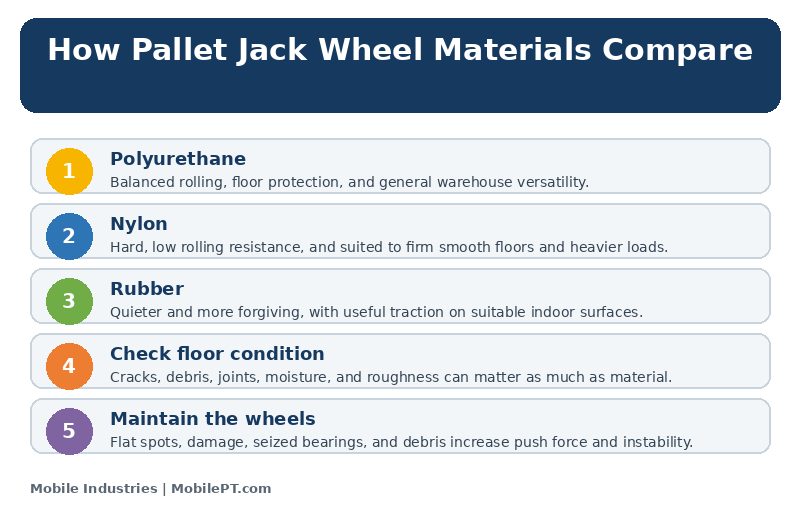
How Pallet Jack Wheel Materials Compare
Polyurethane Pallet Jack Wheels
Polyurethane is one of the most common choices for warehouse pallet trucks because it offers a useful middle ground. It is generally harder than conventional rubber but more forgiving than very hard nylon. That balance can provide good rolling efficiency while reducing marking and impact on many finished floors.
Polyurethane wheels are often chosen for distribution centers, manufacturing plants, retail stockrooms, and general warehouses with reasonably smooth concrete. They can support frequent use while keeping noise and vibration more controlled than a very hard wheel on the same floor.
Advantages of Polyurethane
- Good balance of rolling resistance and floor protection.
- Suitable for many indoor concrete and finished-floor applications.
- Available in many steer-wheel and load-roller sizes.
- Generally quieter than hard nylon on similar surfaces.
- Useful for mixed warehouse operations where one truck serves several areas.
Potential Limitations of Polyurethane
Polyurethane is not immune to damage. Sharp debris, rough concrete, metal chips, broken pallet boards, and severe floor joints can cut or chunk the tread. Heat, chemicals, and continuous high-load duty may also affect certain compounds. Wheel quality and formulation matter, so material name alone does not describe the full performance of a replacement wheel.
Nylon Pallet Jack Wheels
Nylon is hard and can provide low rolling resistance on clean, smooth, firm floors. That makes it attractive where heavy loads must move efficiently and the surface is appropriate. Because the wheel deforms very little, less energy is lost through tread compression.
The same hardness creates tradeoffs. Nylon can transmit more noise and vibration, and it is less forgiving when a route includes cracks, expansion joints, debris, or damaged concrete. Hard wheels can also be more demanding on certain finished floors.
Advantages of Nylon
- Low rolling resistance on smooth hard floors.
- Hard material suited to substantial loads when correctly rated.
- Resists compression compared with softer wheel materials.
- Can perform well in clean industrial environments.
Potential Limitations of Nylon
- Higher noise on hard flooring.
- More noticeable impact at joints, debris, and small surface defects.
- Less cushioning than rubber or many polyurethane compounds.
- May not be the best choice where floor protection or quiet operation is the priority.
Rubber Pallet Jack Wheels
Rubber wheels are softer and more compliant. They can provide quieter operation, better grip, and more cushioning over small floor imperfections. These properties are useful in environments where noise, traction, or floor sensitivity matters.
The tradeoff is rolling resistance. Softer tread deforms under load, which can increase the effort needed to start and keep a heavy manual pallet jack moving. Rubber can also wear faster in high-load industrial service depending on the compound, wheel size, and floor condition.
Advantages of Rubber
- Quieter travel on many indoor surfaces.
- More cushioning over small irregularities.
- Useful traction in suitable applications.
- Can be gentle on finished floors.
Potential Limitations of Rubber
- Higher rolling resistance under heavy loads.
- Can wear or flatten depending on compound and duty cycle.
- Not ideal for every chemical, oil, or debris exposure.
- May require more operator effort on long manual travel routes.
Polyurethane vs Nylon vs Rubber: Detailed Comparison
| Factor | Polyurethane | Nylon | Rubber |
|---|---|---|---|
| Rolling resistance | Low to moderate | Very low on smooth floors | Moderate to higher |
| Noise | Moderate/quiet | Highest | Lowest |
| Floor protection | Good | More demanding on some floors | Very good |
| Cushioning | Moderate | Low | High |
| Heavy load efficiency | Good | Excellent on suitable floors | Moderate |
| Rough-floor tolerance | Moderate | Low | Better for small imperfections |
| Typical use | General warehouse | Smooth industrial floors | Quiet/traction-focused areas |
Steer Wheels vs Load Rollers
Do not choose a wheel material without considering its position on the truck. Large steer wheels influence turning, operator feedback, and rolling effort. Small load rollers must pass through pallet openings and carry concentrated weight near the fork tips. A material that works well as a steer wheel may not be the best load-roller choice for the same application.
Some pallet trucks use tandem load rollers rather than single rollers. Tandem configurations can bridge small floor irregularities more smoothly and distribute contact differently, but they require the pallet and route to accommodate the additional wheel geometry.
Which Wheels Are Best for Smooth Warehouse Concrete?
Smooth, well-maintained concrete gives buyers the widest range of options. Nylon can deliver excellent rolling efficiency under heavy loads, while polyurethane offers a more balanced combination of quietness, floor protection, and durability. Rubber can be useful where noise or traction matters more than minimizing push force.
The decision should consider the heaviest normal load and the longest route. A wheel that feels fine during a short unloaded test can behave differently with several thousand pounds on the forks.
Which Wheels Are Best for Rough or Uneven Floors?
Small pallet jack rollers are inherently limited by diameter. Changing material helps, but it cannot turn a standard warehouse pallet jack into an outdoor rough-surface machine. If the route includes gravel, broken pavement, major joints, or significant surface irregularities, larger wheel geometry may be more important than the tread compound.
For genuinely uneven outdoor handling, see our rough terrain pallet jack buyer guide to understand why large pneumatic-style wheels and a different chassis are used.
Wheel Diameter Matters Too
A larger-diameter wheel generally rolls over a given surface defect more easily than a smaller wheel because the obstacle represents a smaller percentage of the wheel radius. Pallet jacks cannot simply use oversized load rollers, however, because those rollers must fit inside the fork and pallet-entry geometry.
This is one reason low-profile pallet trucks may feel different on imperfect floors: reduced entry height often requires smaller load rollers. Buyers should evaluate minimum fork height and travel surface together rather than treating them as unrelated specifications.
Our low profile pallet jack guide explains how low entry height, fork thickness, and load roller size interact.
Wheel Material and Rolling Resistance
Rolling resistance is the force required to keep a wheel moving under load. Harder wheels deform less, which can reduce resistance on smooth floors. Softer wheels absorb more energy through deformation but may provide better grip and cushioning. Bearing condition, wheel diameter, floor debris, alignment, and load weight can be just as important as tread material.
For manual pallet jacks, high rolling resistance is felt directly by the operator. For powered pallet jacks, it becomes a battery and drive-system efficiency issue in addition to an operator-control issue.
Noise and Floor Protection
Warehouses attached to offices, retail areas, hospitals, laboratories, or other noise-sensitive spaces may value quieter wheel materials. Rubber is typically the quietest of the three broad categories, with polyurethane often providing a good compromise. Hard nylon can create more audible impact as it crosses floor joints or debris.
Floor protection depends on wheel hardness, load concentration, debris, wheel condition, and the flooring itself. No material can protect a floor if metal fragments, stones, or damaged bearings are trapped in the wheel path. Housekeeping remains part of wheel performance.
Wet Floors, Oils, Chemicals, and Temperature
Environmental exposure can change the best material. Certain wheel compounds resist oils, grease, moisture, cleaning chemicals, or temperature extremes better than others. Buyers should not rely on generic material names for demanding environments; verify the exact wheel compound and manufacturer recommendations for the substances and temperatures present.
Cold storage can also affect wheel hardness and traction. A material that performs well at room temperature may behave differently in a freezer. The complete truck, lubricant, bearings, seals, and battery system on powered models must also be suitable for the temperature range.
How Pallet Weight Changes the Decision
Heavy loads increase wheel deformation, bearing load, and the force required to start or turn a manual pallet jack. Hard nylon can be efficient on smooth floors, while polyurethane provides a strong general-purpose option. Rubber may require more operator effort as load increases because of tread deformation.
Always confirm the wheel and truck rating. Replacement wheels should match the axle, hub, bearing, width, diameter, and load requirements of the pallet jack. A wheel that physically fits is not necessarily a safe or durable replacement.
When Should Pallet Jack Wheels Be Replaced?
Replace wheels when wear affects safe, controlled movement. Signs include flat spots, chunking, cracks, severe tread loss, seized or noisy bearings, wobble, uneven wear, and embedded debris that cannot be removed. A truck that suddenly becomes harder to steer or requires much more push force should be inspected rather than treated as normal aging.
OSHA materials-handling guidance emphasizes maintaining transport devices and selecting wheels appropriate to floor conditions. See the OSHA guidance on pushing, pulling, and carrying for related ergonomic considerations.
Pallet Jack Wheel Selection by Application
| Application | Recommended Starting Point | Why |
|---|---|---|
| General distribution center | Polyurethane | Balanced durability, rolling, noise, and floor protection |
| Smooth heavy industrial floor | Nylon | Low rolling resistance under substantial loads |
| Noise-sensitive stockroom | Rubber or soft polyurethane | Quieter travel and cushioning |
| Rough outdoor yard | Rough-terrain equipment | Wheel diameter and chassis matter more than tread compound |
| Low-clearance pallet | Model-specific small rollers | Entry height controls wheel geometry |
Common Wheel-Selection Mistakes
- Choosing by color rather than verified material and compound.
- Replacing only one damaged wheel when paired wheels are worn unevenly.
- Ignoring bearings, axles, and debris when diagnosing high rolling resistance.
- Using hard wheels on damaged floors and assuming the rough ride is normal.
- Selecting very soft wheels for extremely heavy manual loads without considering push force.
- Ignoring temperature, oil, chemical, or washdown exposure.
- Assuming a wheel material can compensate for an unsuitable pallet jack design or wheel diameter.
How to Test Wheel Performance Before Standardizing
If a facility is replacing a large pallet-jack fleet, a short controlled trial can be more useful than selecting wheel material from a catalog alone. Test representative loads on the longest normal route, including the worst floor joints, dock plates, thresholds, and turns. Ask operators to compare starting effort, steering feel, noise, vibration, and stopping control. Inspect the wheels after the trial for cutting, flat spotting, embedded debris, or unusual wear.
Use the same load and route for each wheel material so the comparison is meaningful. A wheel that feels excellent on an empty truck may perform very differently under a 3,000-pound pallet. Likewise, a wheel that is quiet on polished concrete may become harsh or difficult when the route crosses damaged expansion joints. A documented trial is especially valuable when hundreds of replacement wheels will be purchased over the life of the fleet. Record the results so future replacement purchases follow the same operating standard instead of restarting the decision from scratch.
How to Document the Equipment Decision
For repeatable warehouse procurement, document the measurements and operating assumptions used to select the equipment. Record load dimensions, maximum weight, pallet construction, route conditions, daily cycles, aisle constraints, operator method, and any environmental exposure. This creates a reference that can be used when the facility expands, a supplier changes pallets, or replacement equipment is purchased years later.
A simple equipment record also helps separate specification problems from maintenance problems. If a truck once performed well but later becomes hard to move, the issue may be wheel wear, bearings, floor damage, or hydraulic condition rather than the original model choice. If the workflow itself changes, the documented baseline makes it easier to identify which specification must change.
Procurement should also consider parts availability, service access, operator training, inspection routines, and expected equipment life. The lowest purchase price can become expensive if a specialized component is difficult to replace or if the machine does not match the facility well enough to be used consistently. Selection is strongest when performance, maintainability, and real workflow are evaluated together.
Final Thoughts
Polyurethane, nylon, and rubber pallet jack wheels each have a place. Polyurethane is the strongest all-around starting point for many warehouses. Nylon excels on smooth, hard floors where low rolling resistance under load is important. Rubber is valuable when noise, cushioning, and traction are higher priorities.
Choose the wheel system around the floor, load, travel distance, environment, and duty cycle. Then maintain the wheels and floor together. The best wheel material cannot perform well if bearings are damaged, debris is embedded in the tread, or the route is full of cracks and obstructions.
Frequently Asked Questions
Which pallet jack wheel material is best?
There is no single best material. Polyurethane is a versatile general-purpose choice, nylon performs efficiently on smooth hard floors, and rubber is useful where quiet operation, cushioning, or traction is important.
Are nylon pallet jack wheels better for heavy loads?
Nylon wheels can provide low rolling resistance under heavy loads on smooth floors, but they are harder, noisier, and less forgiving over joints and debris.
Are polyurethane wheels good for warehouse floors?
Yes. Polyurethane is commonly used because it balances durability, rolling efficiency, floor protection, and noise for many indoor warehouse applications.
When should pallet jack wheels be replaced?
Replace wheels that have flat spots, cracks, chunking, severe wear, wobble, seized bearings, or damage that makes the pallet jack difficult to steer or stop.
Can different wheel materials be used on the same pallet jack?
Some trucks use different materials or designs for steer wheels and load rollers, but replacements must match the manufacturer’s dimensional, load, bearing, and application requirements.