
Warehouse carts look simple, but choosing the wrong cart can create the same problems as choosing the wrong pallet truck: difficult pushing, unstable loads, poor turning, blocked visibility and wasted travel time.
The best warehouse cart depends on what is being moved. Boxes and totes need different support than lumber, long components or heavy equipment. A cart that works well on smooth concrete may be frustrating across thresholds or expansion joints. A cart used twice per day has different requirements from one used continuously across a large distribution center.
This guide compares the main warehouse cart types and explains how to choose deck size, capacity, casters, handles and powered options for the actual material-handling route.
Warehouse Cart Types: Quick Answer
The main warehouse cart types include platform carts, shelf carts, stock carts, hand trucks, lumber or long-material carts, specialty carts and motorized platform carts. Choose by load shape, weight, travel distance, floor condition and how the operator loads, sees and controls the cart.
| Cart Type | Best For | Primary Advantage |
| Platform cart | Boxes, bulky items and mixed loads | Large open deck |
| Shelf cart | Bins, parts, tools and small cartons | Organized multi-level storage |
| Lumber / long-material cart | Boards, pipe and elongated loads | Supports long or awkward material |
| Hand truck | Stacked cartons and vertical loads | Compact two-wheel movement |
| Motorized platform cart | Heavy or frequent long-distance movement | Powered travel reduces pushing effort |
Why Warehouse Cart Selection Matters
A warehouse cart is part of the operator’s body mechanics. Handle position, wheel size, load height and total rolling resistance determine how much force is needed to start, steer and stop the cart.
The load also affects visibility. A platform cart stacked above eye level may be hard to steer safely through intersections. A shelf cart with low organized bins may provide better visibility and faster access for order picking or maintenance work.
Mobile Industries’ allied warehouse equipment includes carts and specialty handling products for applications that do not require conventional pallet handling.
1. Platform Carts
A platform cart uses a flat deck with casters or wheels and usually one or more push handles. It is one of the most versatile cart formats because the deck can support boxes, containers, equipment, bags and awkward items.
Platform carts are best when the load does not need shelves or side containment. The open deck makes loading easy from several directions but also means the operator may need straps, bins or other methods to prevent unstable items from shifting.
2. Shelf Carts
Shelf carts add two or more levels above the wheelbase. They are useful for parts, maintenance supplies, bins, tools and order picking because items can be separated and kept at accessible heights.
The tradeoff is vertical space and load distribution. Heavy items should generally be kept low, and the total weight must remain within the cart rating. Overloading the upper shelf can raise the center of gravity and affect stability.
3. Lumber and Long-Material Carts
Long products create a different handling problem: they may fit within the weight capacity of a normal platform cart but extend far beyond the deck. Lumber and long-material carts support the load over a longer base and may include vertical guides or racks.
The Mobile Industries lumber cart is an example designed around long materials, with upper and lower rack areas and a combination of swivel and fixed casters.
Turning space becomes especially important because the load can sweep through a much larger area than the cart footprint itself.
4. Hand Trucks and Convertible Carts
Two-wheel hand trucks are compact and useful for stacked cartons, cylinders and vertical loads. Convertible designs can change into four-wheel platform configurations for larger quantities.
OSHA notes in its hand truck guidance that platform-style carts and appropriate hand trucks can reduce repeated bending and that wheel condition, stairs, curbs and load angle all affect manual handling.
A hand truck is not a pallet mover. It is best for individual packages or loads that can be securely supported against the frame.
5. Motorized Platform Carts
A motorized platform cart adds powered travel to a flat deck. It can be valuable when operators move heavy loads over longer routes or when a manual cart would require too much starting and stopping force.
The motorized platform cart offered by Mobile Industries uses powered drive, regenerative braking and a steel platform that can be adapted to different transport applications.
Motorization adds battery charging, controls and maintenance, so it should be justified by the workload rather than selected only because it is available.
How to Choose the Right Warehouse Cart
Start with the load, then map the route. Capacity alone is not enough. A cart needs to fit the material, fit the aisle and remain controllable on the actual floor.
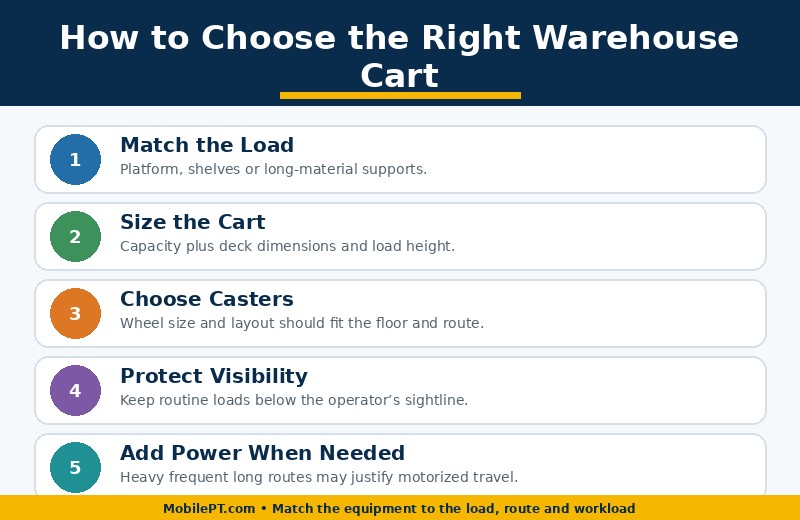
- Define the heaviest complete load and how the weight is distributed.
- Measure the load length, width and height.
- Choose open platform, shelves, side rails or specialty supports.
- Measure aisle width, doorways, elevators and turning areas.
- Inspect floor joints, thresholds, ramps and rough surfaces.
- Estimate travel distance and trips per shift.
- Choose caster arrangement for both tracking and turning.
- Keep normal load height low enough for operator visibility.
- Confirm handle height and grip style are comfortable for the users.
- Consider powered travel when heavy or frequent moves create excessive effort.
How Much Capacity Does a Warehouse Cart Need?
Select capacity based on the heaviest real load, not average use. Include containers, fixtures, shelves or accessories that remain on the cart.
A large safety margin can be useful, but extreme over-sizing can increase cart weight and make manual movement harder. The best cart is strong enough for the load without being unnecessarily heavy or bulky.
Deck Size and Load Footprint
The deck should support the load without excessive overhang. Overhanging boxes can be damaged by racks and doorframes, while long heavy items can shift the center of gravity outside the wheelbase.
Measure the full footprint and consider how the load is placed on the cart. If operators need access from several sides, an open platform may be better than a deep-sided cart.
Caster Layout: Swivel vs Fixed Wheels
Four swivel casters provide excellent turning but can make a heavy cart wander on long straight routes. A combination of fixed and swivel casters can track more predictably while still allowing turns.
Six-wheel arrangements and center-wheel configurations can reduce turning radius on long carts by allowing the cart to pivot near its center. The correct setup depends on cart length, aisle geometry and load.
Wheel Diameter and Material
Wheel size has a major effect on rolling resistance. Larger wheels usually cross joints, cracks and small debris more easily than tiny casters. Softer tread can reduce noise and vibration, while harder wheels may roll efficiently on smooth floors.
No wheel material is best everywhere. Consider floor protection, debris, chemicals, temperature, noise and the load carried by each wheel.
Push vs Pull: How Should Warehouse Carts Be Moved?
Pushing often allows the operator to use body weight and maintain a more neutral posture, but visibility must remain clear. Some tasks require pulling to position a cart precisely or navigate tight locations.
The cart should have handles that allow control without forcing the wrists, shoulders or back into awkward positions. Handle height becomes especially important when several employees of different heights share the equipment.
Visibility and Load Height
A cart that blocks the operator’s view can create collision risk at intersections, doors and pedestrian crossings. Keep routine loads below eye level where practical or use a route and cart design that preserves visibility.
For tall bulky loads, a cart that can be pulled from the side, a spotter process or a powered solution with better operator position may be needed.
Warehouse Cart vs Pallet Jack
A warehouse cart carries loose boxes, bins, parts or equipment on its deck or shelves. A pallet jack is designed to enter and move an entire pallet as one unit.
If goods are already palletized, moving the pallet directly is usually more efficient than unloading it onto a cart. If the task involves picking individual boxes from multiple locations, a cart can be much more useful.
Warehouse Cart vs Tug and Tow System
A tug moves one or more carts or trailers rather than carrying the load on its own deck. Tug systems make sense when the operation needs to move multiple carts in a train or when loads are too heavy for repeated manual pushing.
A motorized platform cart sits between a manual cart and a tug: it carries the load and provides powered travel but is not necessarily designed to tow multiple trailers.
When Should You Upgrade to a Motorized Cart?
Consider powered travel when carts routinely carry heavy loads, routes are long, movement frequency is high or ramps and starts require excessive operator force.
Calculate the number of trips per shift and the distance of each trip. A cart moved 30 feet twice per day is different from a cart moved 800 feet twenty times per shift. Productivity and operator effort should drive the upgrade decision.
Common Warehouse Cart Buying Mistakes
Common errors include buying by capacity alone, ignoring wheel diameter, overlooking door and elevator clearance, allowing loads to block visibility and choosing all-swivel casters for long straight routes without testing tracking.
Another mistake is keeping a manual cart in service after the workload has grown beyond what is reasonable. The cart may still be structurally capable while the human effort required to move it has become inefficient.
Warehouse Cart Maintenance Checklist
Inspect casters for wear, flat spots, looseness and debris. Check handles, welds, deck surfaces, brakes, shelves and fasteners. Keep wheels clean and replace damaged components before a loaded cart becomes difficult to control.
Powered carts also require battery, charger, drive and braking inspections according to the manufacturer’s schedule.
Warehouse Cart Selection by Department
Different departments often need different carts even inside the same building. Receiving may need large open platforms for mixed cartons. Maintenance teams may prefer multi-shelf carts that organize tools and parts. Production may need purpose-built carts that interface with fixtures or workstations.
Order-picking teams benefit from shelves, dividers or totes that keep SKUs organized. Shipping may need heavier-duty platform carts for completed boxes. Long-material departments need guides or racks that prevent boards and pipe from sliding off the deck.
Mapping carts by department can reveal opportunities to standardize without forcing one design onto incompatible tasks.
Pedestrian Traffic and Cart Route Planning
Carts share space with people, pallet trucks and forklifts. A cart route should therefore consider intersections, blind corners, doorways, emergency egress and staging zones. High-volume cart traffic may justify marked travel lanes or designated parking areas so idle carts do not become obstacles.
Load height affects visibility, while cart width affects passing clearance. A cart that barely fits through a doorway when empty may become too wide after cartons overhang the deck. Route planning should use the loaded condition.
Where pedestrian traffic is dense, speed and stopping distance matter even for manual carts. Brakes or wheel locks can be useful when carts are parked on slight grades or beside workstations.
Standardizing a Warehouse Cart Fleet
Fleet standardization can reduce parts inventory and training complexity. Using common caster sizes, handle designs or platform dimensions makes maintenance easier and allows employees to switch between carts with less adjustment.
However, over-standardization can be counterproductive. A small shelf cart may be perfect for parts but inefficient for bulky cartons, while a large platform cart may waste aisle space in a maintenance room. Standardize where the work is similar and keep specialty designs where the load genuinely requires them.
A useful fleet review groups carts by load type, route and daily frequency, then identifies which models can serve several departments without compromising safety or productivity.
Total Cost of Ownership for Warehouse Carts
Manual carts have no battery or drivetrain, but wheels and casters are consumable components. Cheap casters can increase pushing force, noise and downtime if they fail frequently. Deck damage, bent handles and brake repairs also contribute to lifecycle cost.
Powered carts add batteries, chargers, controls and drive components. Those costs can be justified when the cart replaces repeated high-force pushing or improves throughput on long routes.
Compare purchase price with expected trips, load weight, floor conditions and replacement parts. A cart used every hour deserves more attention to wheel quality and serviceability than a cart used once per week.
How to Build a Warehouse Cart Specification Before Buying
A written cart specification keeps purchasing decisions tied to the real job. Start with load weight and dimensions, then document required deck or shelf size, preferred handle style, maximum cart width, doorway clearance, caster layout, wheel diameter and any brake or containment requirement.
Add route information such as travel distance, floor type, thresholds, elevator use and frequency of trips. For a powered cart, include required run time, slope capability, charger location and whether the operator needs variable speed or automatic braking.
Finally, identify the items that are non-negotiable versus desirable. That prevents a buyer from choosing a cart because it has a higher capacity or lower price while missing the feature that actually determines usability, such as a narrow doorway, a long material load or a low shelf height.
Questions to Ask Before Ordering Warehouse Carts
Ask which caster layout is recommended for the expected route, what replacement wheels cost, whether brakes are available and how the stated capacity assumes the load is distributed. Confirm deck construction, handle options, shelf spacing and any available side rails or containment accessories.
For powered carts, ask about battery chemistry, run time, slope capacity, charger type, braking behavior and service support. A short pre-purchase discussion can prevent a cart from being technically rated for the load but poorly matched to daily use.
Final Thoughts
Warehouse carts are not one product category with one answer. Platform, shelf, lumber, hand-truck and motorized designs solve different problems.
Choose by load shape, route, wheel requirements and frequency. When those variables are matched correctly, a simple cart can reduce carrying, organize material flow and keep the right products moving without using larger pallet-handling equipment for every task.
Frequently Asked Questions
What are the main types of warehouse carts?
Common warehouse cart types include platform carts, shelf carts, stock carts, lumber or long-material carts, hand trucks, specialty carts and motorized platform carts.
How do I choose the right warehouse cart capacity?
Add the weight of the heaviest complete load, including bins, boxes, fixtures or accessories, and select a cart rated above that operating requirement while also checking load distribution.
What wheel size is best for a warehouse cart?
Larger wheels generally roll more easily over joints and small surface irregularities, while smaller casters can improve compact maneuverability. The best choice depends on load weight, floor condition and route.
When should I use a motorized warehouse cart?
A motorized cart is worth considering when loads are heavy, travel distances are long, movement is frequent or manual pushing creates excessive effort.
What is the difference between a platform cart and shelf cart?
A platform cart has a single open deck for bulky or mixed loads, while a shelf cart provides multiple levels for organized boxes, bins, tools or parts.