
Fork length is one of the most overlooked pallet jack specifications. Buyers often focus on capacity first, yet a truck with the correct weight rating can still be a poor fit if its forks are too short for the load, too long for the pallet, or too cumbersome for the travel route. The right pallet jack fork length supports the pallet securely while keeping the loaded truck practical to steer through aisles, trailers, staging areas, and production spaces.
This guide explains how pallet jack fork size affects load support, maneuverability, pallet compatibility, and daily workflow. It also covers common fork lengths, how to measure a pallet correctly, when longer forks make sense, and when a custom or specialty pallet truck is the better choice.
Pallet Jack Fork Length: Quick Answer
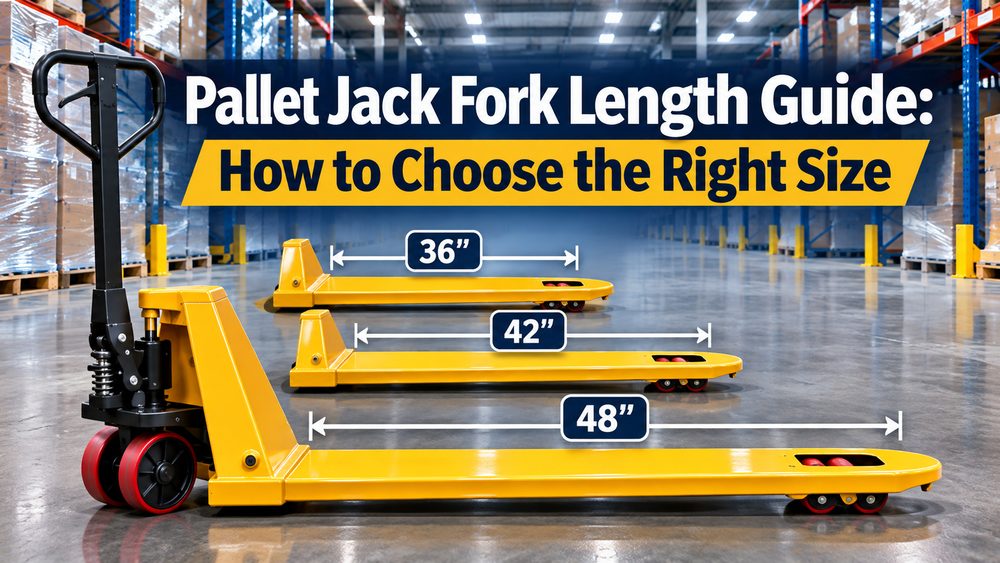
For most standard warehouse pallets, the best fork length is the one that supports most of the pallet deck without extending so far beyond the load that the truck becomes difficult to position. Common pallet jack fork lengths include approximately 36, 42, and 48 inches, while specialty trucks may use longer or custom dimensions. The correct size depends on pallet depth, entry direction, load distribution, and available turning space.
| Fork Length | Typical Application | Main Advantage | Main Tradeoff |
|---|---|---|---|
| 36 in. | Short pallets, compact loads, tight spaces | Smaller turning footprint | May provide insufficient support for longer pallets |
| 42 in. | Mixed warehouse pallets and general handling | Balanced versatility | Not ideal for every long or short pallet |
| 48 in. | Longer pallets, many standard U.S. loads | Greater pallet support | More fork overhang and turning space |
| 60 in.+ | Oversized or specialty loads | Supports unusually long loads | Requires substantially more clear space |
What Does Pallet Jack Fork Length Mean?
Pallet jack fork length is measured from the front face of the fork carriage or heel to the tip of the forks. It describes the usable length that enters beneath the pallet and supports the load. This measurement is different from overall truck length, because the handle, steer wheels, pump housing, or powered drive unit extend behind the forks.
Mobile Industries offers multiple configurations of Pallet Trucks for different pallet sizes, capacities, entry heights, and operating conditions. Fork length should be treated as part of a complete compatibility check rather than a stand-alone specification.
Why Fork Length Matters More Than It Looks
A pallet is a structural platform. When the forks enter beneath it, they become the moving support for the deck and the load above it. If the forks are too short, the rear portion of the pallet may receive less support and the load can feel less stable during starts, stops, or turns. If the forks are unnecessarily long, they may project beyond the pallet and create clearance problems around racks, walls, dock equipment, pedestrians, or the next pallet in a staging lane.
Longer forks also increase the effective footprint of the equipment. That matters inside trailers, elevators, small stockrooms, production cells, and narrow aisles. The best fork size therefore balances pallet support with practical maneuverability.
How to Measure Pallet Jack Fork Length
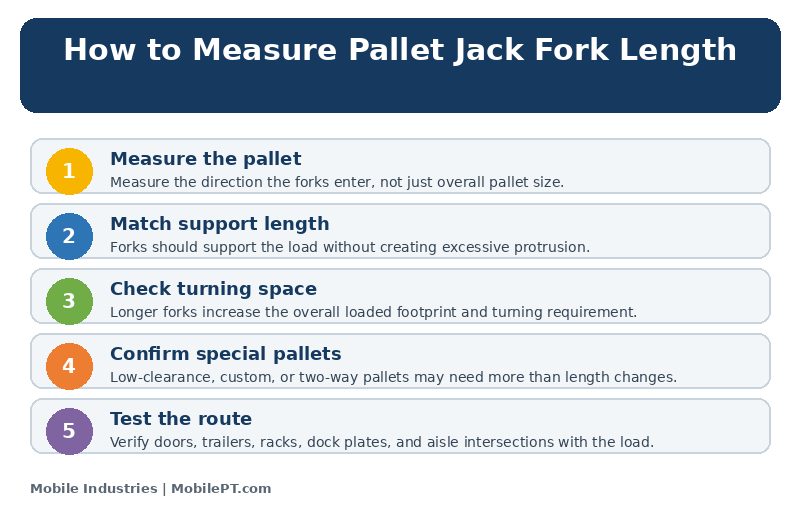
Start by measuring the pallet in the exact direction the pallet jack will enter. A 48-by-40-inch pallet can present a different required support dimension depending on whether the forks enter from the 40-inch side or the 48-inch side. Do not assume the pallet name or outside dimensions tell you the working fork length.
Measure from the entry face to the opposite pallet edge, then inspect the underside for blocks, stringers, cross boards, wheel openings, and other obstructions. If the pallet has only two-way entry, confirm the intended approach direction. For four-way pallets, determine whether the operation will routinely use more than one entry side.
Measure the Load, Not Only the Empty Pallet
A pallet may technically accept the forks while the loaded configuration changes the handling requirement. Long cartons, sheet goods, dies, machinery components, or containers can extend beyond the pallet deck. The forks do not necessarily need to match every inch of product overhang, but the combined center of gravity and structural support must remain appropriate for the equipment and pallet.
Check Fork Tip Clearance
Fork tips should not create a hidden hazard on the far side of the pallet. If the forks protrude significantly, they can strike adjacent loads or enter the next pallet in a tightly staged row. This is especially important in truck trailers, narrow staging lanes, and dense manufacturing areas where multiple pallets are positioned close together.
How Far Should Pallet Jack Forks Extend Under a Pallet?
The forks should extend far enough to provide secure support under the pallet and load without creating unnecessary protrusion. There is no universal percentage that is correct for every pallet construction and load. A long, flexible pallet carrying a concentrated load may need more effective support than a rigid pallet carrying evenly distributed cartons.
The practical rule is to maximize useful pallet support while preserving clearance at the far side. If the operation uses one consistent pallet, measure that pallet and choose the closest appropriate standard fork length. If the facility handles many different pallets, a versatile middle length or more than one truck configuration may be better than forcing a single pallet jack to fit every application.
36-Inch vs 42-Inch vs 48-Inch Pallet Jack Forks
36-Inch Forks
Shorter forks are useful where compact maneuvering matters or where the pallet itself is shallow. They can reduce the overall loaded footprint and make a manual pallet jack easier to turn in confined rooms. The limitation is obvious: a short fork can leave too much of a longer pallet unsupported, so this size should be selected because it matches the load, not simply because the truck feels easier to steer.
42-Inch Forks
A mid-length configuration is often a practical compromise for operations that handle several pallet styles. It provides more support than a compact truck while avoiding some of the protrusion and turning burden of longer forks. Buyers should still measure their actual pallets because a versatile length is not automatically compatible with every load.
48-Inch Forks
Longer 48-inch forks can provide better support for deeper pallets and long unit loads. They are common where pallet dimensions and staging areas can accommodate the extra length. In tight trailers or stockrooms, however, the added fork length may make positioning harder, especially when the truck must turn before the pallet is fully clear of surrounding inventory.
Fork Length vs Pallet Width: Do Not Confuse the Two
Fork length describes how far the forks extend into the pallet. Overall fork width describes the side-to-side spacing of the fork assembly. Both dimensions matter, but they solve different compatibility problems. A truck can have the correct length and still fail to enter a pallet because the forks are too wide, too narrow, or blocked by pallet stringers.
This distinction is especially important with custom manufacturing skids, imported pallets, display pallets, and reusable plastic platforms. Record entry height, opening width, and required insertion depth as separate measurements.
Fork Length and Low-Clearance Pallets
Special pallets may require a different truck even when fork length looks correct. Our low profile pallet jack guide explains how minimum lowered height, wheel diameter, fork thickness, and pallet opening geometry determine whether the truck can physically enter a low-clearance skid.
Do not try to solve an entry-height problem by selecting shorter forks. Length does not reduce fork thickness or wheel height. Likewise, a low-profile truck with the wrong fork length can still be a poor match. The entire geometry of the truck and pallet must work together.
How Fork Length Changes Turning Space
The pallet jack handle may swing in a compact arc, but the load and fork tips determine the complete maneuvering envelope. Longer forks increase the distance from the steer wheels to the front of the load, so a turn can sweep a larger area. In narrow aisles, this can force the operator to make multi-point corrections instead of a clean turn.
Measure critical areas with the pallet attached: rack intersections, dock doors, freezer doors, elevator entrances, trailer interiors, production cells, and any place where the truck must turn while loaded. Straight-line aisle width alone is not enough.
Fork Length for Powered Pallet Jacks
The same compatibility principles apply to powered equipment, but powered travel can make a poorly sized truck more consequential because the equipment may move heavier loads more frequently. Review our Powered Pallet Jack buyer guide when the application requires longer travel, higher pallet volume, or reduced manual pushing and pulling.
A powered unit should still be selected around pallet geometry first. Drive power does not compensate for insufficient pallet support or excessive fork protrusion. Consider the complete machine length, turning radius, battery compartment, operator position, and fork length together.
Long Fork Pallet Jacks for Oversized Loads
Oversized pallets, sheet goods, furniture components, long crates, and custom manufacturing skids may justify forks longer than common warehouse sizes. These trucks can reduce the need for improvised handling methods, but they require more planning. Longer forks can create greater turning demands and may limit use inside trailers or narrow aisles.
Before buying a long-fork truck, confirm the structural design of the pallet, the weight distribution, the route, and the staging layout. If the load is exceptionally long or has an unusual center of gravity, a custom material handling solution may be more appropriate than simply extending fork length.
Does a Longer Fork Increase Pallet Jack Capacity?
No. Fork length and rated load capacity are separate specifications. A longer fork does not automatically allow a pallet jack to carry more weight. In some specialty configurations, the relationship between load position and equipment geometry can become more important, not less.
Always use the manufacturer-rated capacity for the specific model and configuration. Do not assume a 48-inch or 60-inch truck has the same rating as a standard truck from the same product family.
Floor Conditions Still Matter
Fork length is only one factor in real-world handling. Wheel material, wheel diameter, floor joints, cracks, debris, thresholds, and dock plates affect how easily a load moves. A long load can amplify the effect of sudden wheel impacts because more material is moving through a larger footprint.
OSHA warehouse guidance notes the importance of maintaining floors and providing adequate clearances for material handling equipment. See the OSHA Warehousing Hazards and Solutions guidance for broader workplace considerations.
Common Fork-Length Buying Mistakes
- Choosing fork length from a catalog before measuring the actual pallet.
- Measuring the pallet in the wrong entry direction.
- Ignoring fork-tip protrusion on the far side of the load.
- Assuming a longer fork automatically increases load capacity.
- Confusing fork length with overall fork width or pallet opening width.
- Ignoring turning space with the pallet attached.
- Using a shorter truck to solve a low-clearance problem that actually requires thinner or lower forks.
- Buying one universal truck for highly variable pallet sizes without testing representative loads.
Pallet Jack Fork Length Decision Framework
| If Your Operation Has… | Start By Considering… | Verify Before Buying |
|---|---|---|
| Short custom pallets | 36-inch or other compact fork length | Support area and pallet structure |
| Mixed common pallets | 42-inch or versatile standard length | Most frequent pallet dimensions |
| Deeper pallets or long unit loads | 48-inch or longer forks | Turning space and fork-tip clearance |
| Very long specialty skids | Long-fork or custom pallet truck | Load center, route, staging, capacity |
| Low-clearance pallets | Low-profile or super-low truck | Minimum entry height plus fork length |
Questions to Ask Before Ordering
- What is the pallet depth in the actual fork-entry direction?
- Are the pallets two-way or four-way entry?
- What is the smallest fork opening and entry height?
- How much fork protrusion is acceptable on the far side?
- What is the heaviest complete load?
- Where are the tightest turns on the travel route?
- Will the truck be used inside trailers or elevators?
- Do pallet dimensions vary by supplier or product line?
- Would a second specialized pallet jack be more efficient than one compromise configuration?
Fork Length and Warehouse Standardization
Facilities with many operators benefit from standardizing fork lengths where the pallet mix allows it. A consistent fleet simplifies training, replacement parts, parking locations, and operator expectations. Standardization should follow the dominant pallet dimensions, not precede them. If 80 percent of loads use one common pallet and the remaining 20 percent are unusually short or long, the best strategy may be one standard fleet plus a clearly identified specialty truck rather than compromising every pallet jack.
Document the approved fork length for each major pallet family and label specialty trucks so operators do not accidentally use them for incompatible loads. This is especially useful in plants where several departments purchase pallets independently or where imported materials arrive on non-standard skids.
How to Document the Equipment Decision
For repeatable warehouse procurement, document the measurements and operating assumptions used to select the equipment. Record load dimensions, maximum weight, pallet construction, route conditions, daily cycles, aisle constraints, operator method, and any environmental exposure. This creates a reference that can be used when the facility expands, a supplier changes pallets, or replacement equipment is purchased years later.
A simple equipment record also helps separate specification problems from maintenance problems. If a truck once performed well but later becomes hard to move, the issue may be wheel wear, bearings, floor damage, or hydraulic condition rather than the original model choice. If the workflow itself changes, the documented baseline makes it easier to identify which specification must change.
Procurement should also consider parts availability, service access, operator training, inspection routines, and expected equipment life. The lowest purchase price can become expensive if a specialized component is difficult to replace or if the machine does not match the facility well enough to be used consistently. Selection is strongest when performance, maintainability, and real workflow are evaluated together.
Final Thoughts
The right pallet jack fork length is the length that supports the real pallet and load while preserving practical clearance throughout the route. It should be chosen from measurements, not assumptions. A standard size can be ideal for a consistent warehouse pallet, while short, long, low-profile, or custom forks may be necessary for specialized loads.
Measure the pallet, entry direction, fork openings, load dimensions, turning space, and route before ordering. That simple process prevents a common material handling problem: buying a truck with plenty of rated capacity that still does not fit the work.
Frequently Asked Questions
What is the most common pallet jack fork length?
Common pallet jack fork lengths include approximately 36, 42, and 48 inches, but the correct size depends on the pallet depth, entry direction, load, and available turning space.
Should pallet jack forks be as long as the pallet?
Forks should provide adequate support under the pallet without creating unnecessary protrusion. Exact requirements depend on pallet construction, load distribution, and the working environment.
Can pallet jack forks be too long?
Yes. Excessively long forks can extend beyond the pallet, strike nearby loads, and increase the turning space required in aisles, trailers, and staging areas.
Does fork length affect pallet jack capacity?
Fork length does not automatically increase capacity. Always use the rated capacity for the specific pallet jack model and configuration.
How do I measure for pallet jack fork length?
Measure the pallet in the direction the forks will enter, inspect the underside for obstructions, confirm entry height and opening width, and test the loaded route for turning and clearance.