
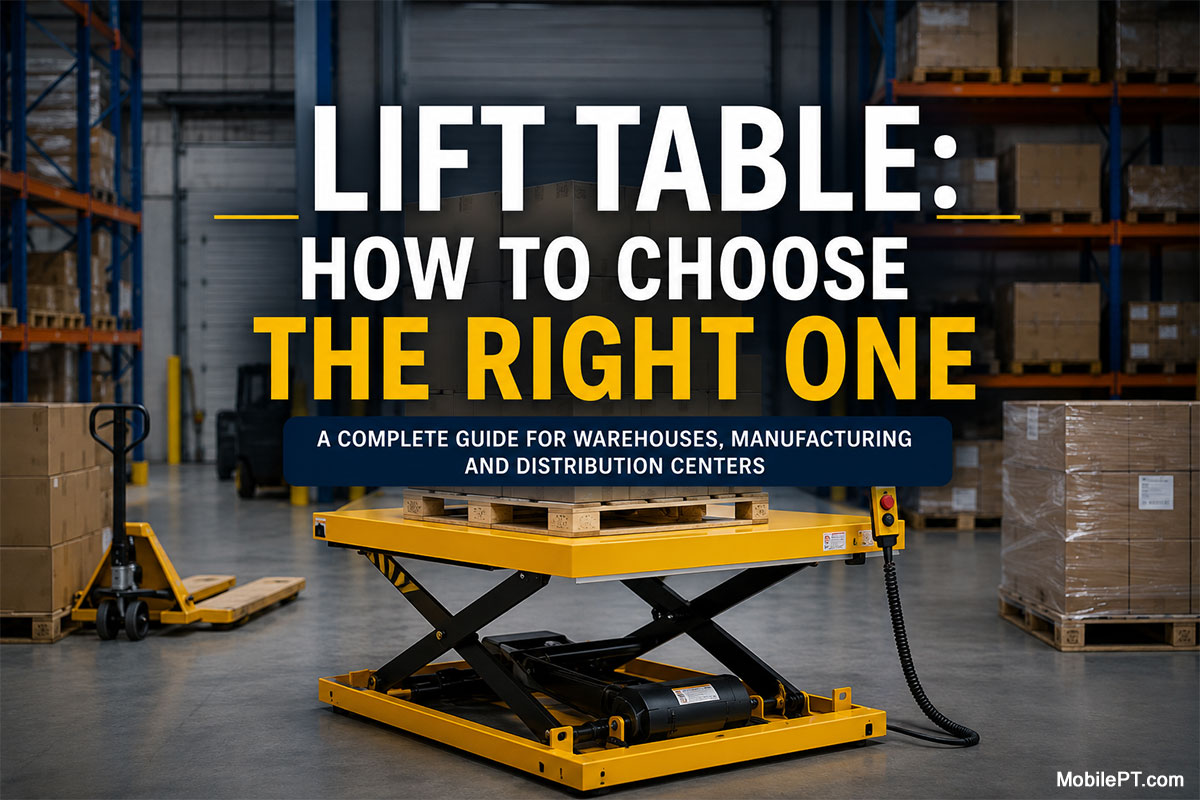
Choosing the right Lift Table is one of the smartest investments a warehouse, manufacturing facility, or distribution center can make. While forklifts and pallet trucks often receive the most attention, lift tables quietly improve productivity by reducing manual lifting, improving ergonomics, and making repetitive tasks safer and more efficient.
The challenge is that not all Lift Tables are designed for the same application. Some are built for loading and unloading pallets, others are designed for assembly lines, while specialized models can support heavy industrial manufacturing or maintenance work.
If you’re evaluating a Pallet Lift for your operation, understanding the differences before purchasing can save time, reduce workplace injuries, and improve workflow for years to come.
This guide explains everything you should know before selecting the right Lift Table.
Lift Table: Quick Answer
| Question | Answer |
| What is a Lift Table? | A powered platform used to raise or lower materials to an ergonomic working height. |
| What is a Pallet Lift? | A Lift Table specifically designed to position palletized loads. |
| Best for | Warehouses, factories, assembly lines, shipping and receiving |
| Main benefit | Improved ergonomics and productivity |
| Typical lifting capacity | 500–8,000+ lbs depending on the model |
| Alternative equipment | Electric Stackers, Forklifts, Powered Pallet Jacks |
Choosing the correct Lift Table depends on load weight, lifting height, available floor space, and how frequently the equipment will be used.
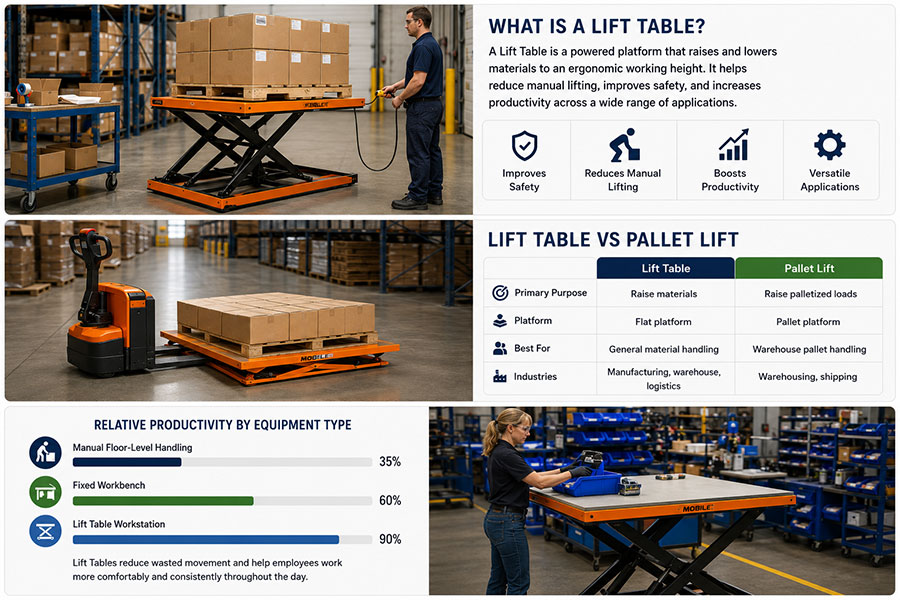
What Is a Lift Table?
A Lift Table is a platform that raises and lowers materials using an electric hydraulic lifting mechanism. Most Lift Tables use a scissor-style support system underneath the platform, allowing heavy loads to be lifted smoothly and safely.
Rather than requiring employees to bend down to floor level or manually lift products, Lift Tables position the load at an ideal working height.
This simple improvement creates significant gains in both productivity and workplace safety.
Lift Tables are commonly used in:
- Warehouses
- Manufacturing plants
- Distribution centers
- Packaging departments
- Shipping facilities
- Automotive shops
- Food processing operations
What Is a Pallet Lift?
A Pallet Lift is a type of Lift Table specifically designed for palletized loads.
Instead of workers unloading products directly from floor level, the Pallet Lift raises the pallet as materials are added or removed.
This helps maintain a comfortable working height throughout the loading or unloading process.
Common uses include:
- Pallet building
- Shipping preparation
- Warehouse packing stations
- Order fulfillment
- Production lines
Many businesses searching for a Pallet Lift are actually looking for a Lift Table designed specifically for pallet handling.
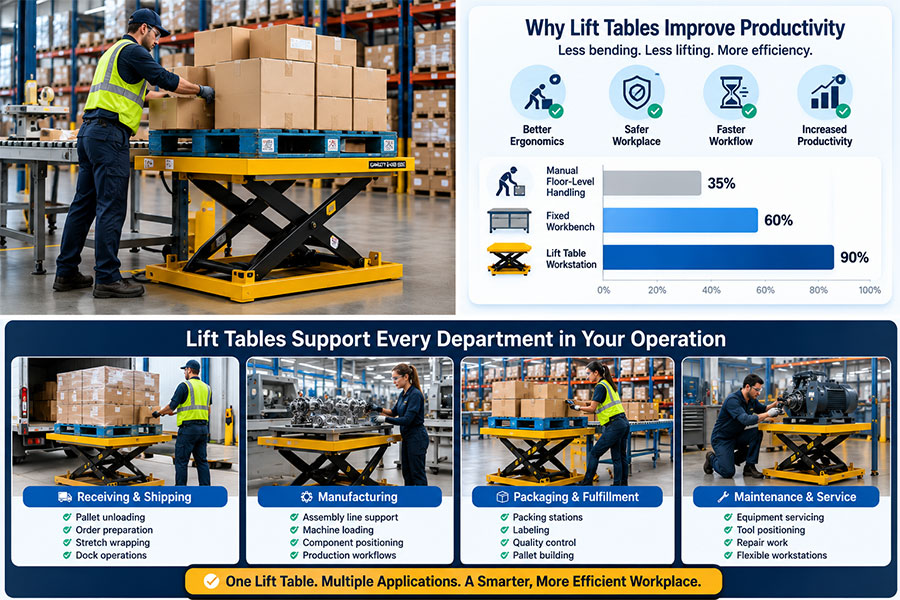
Why Lift Tables Improve Warehouse Productivity
Every unnecessary bend, twist, or lift costs time.
Multiply those small movements by hundreds of products every day, and the productivity loss becomes significant.
Relative Productivity by Equipment Type
Manual Floor-Level Handling
██████████ 35%
Fixed Workbench
█████████████████ 60%
Lift Table Workstation
█████████████████████████████ 90%
The difference isn’t simply speed.
Lift Tables reduce wasted movement, helping employees work more comfortably and consistently throughout the day.
Common Types of Lift Tables
Different applications require different Lift Tables.
Standard Electric Lift Tables
The most common option.
Best for:
- Packaging
- Assembly
- Shipping
- Warehousing
Low-Profile Lift Tables
Designed for easy pallet loading without requiring a pit.
Ideal when forklifts or pallet trucks need direct access.
Heavy-Duty Lift Tables
Built for industrial manufacturing.
Typical applications include:
- Machinery
- Metal fabrication
- Industrial assembly
- Heavy equipment servicing
Mobile Lift Tables
Portable Lift Tables combine lifting capability with mobility.
They’re useful for:
- Maintenance departments
- Production support
- Inventory movement
- Flexible workstations
Lift Table vs Pallet Lift
Although the terms are closely related, there are differences.
| Feature | Lift Table | Pallet Lift |
| Primary purpose | Raise materials | Raise palletized loads |
| Platform | Flat platform | Pallet platform |
| Best for | General material handling | Warehouse pallet handling |
| Industries | Manufacturing, warehouse, logistics | Warehousing and shipping |
| Typical users | Production workers | Shipping and receiving teams |
Most Pallet Lifts are Lift Tables, but not every Lift Table is designed specifically for pallets.
Choosing the Right Lift Table
Several factors should guide your decision.
1. Load Capacity
Always select a Lift Table rated above your typical working load.
Common capacities include:
- 500 lbs
- 1,000 lbs
- 2,000 lbs
- 4,000 lbs
- 6,000 lbs
- 8,000+ lbs
Choosing too small a capacity can reduce equipment life and create safety concerns.
2. Lift Height
Determine how high materials need to be raised.
Typical applications include:
- Floor-to-waist height
- Conveyor alignment
- Machine loading
- Assembly stations
- Shipping docks
The correct lifting range depends entirely on workflow.
3. Platform Size
The platform should comfortably support the products being handled.
Consider:
- Pallet dimensions
- Product footprint
- Future growth
Larger isn’t always better if floor space is limited.
4. Frequency of Use
Ask yourself:
How many cycles will the Lift Table complete every day?
Occasional use requires different equipment than continuous production environments.
High-cycle operations benefit from heavier-duty hydraulic systems.
Lift Table vs Electric Stacker
Many buyers compare Lift Tables with Electric Stackers.
Although they can overlap, they solve different problems.
| Feature | Lift Table | Electric Stacker |
| Raises materials | ✔ | ✔ |
| Moves pallets | Limited | ✔ |
| Stacks pallets | ✘ | ✔ |
| Best for workstations | ✔ | ✘ |
| Best for storage | ✘ | ✔ |
| Best for production | ✔ | Moderate |
If your goal is ergonomic material positioning, choose a Lift Table.
If your goal is stacking pallets, an Electric Stacker is usually the better solution.
Learn more in our Electric Stacker Buyer’s Guide.
Lift Table vs Powered Pallet Jack
Another common comparison is between Lift Tables and Powered Pallet Jacks.
| Feature | Lift Table | Powered Pallet Jack |
| Lifts materials | ✔ | ✔ |
| Moves materials | Limited | ✔ |
| Best for transportation | ✘ | ✔ |
| Best for workstation ergonomics | ✔ | Moderate |
| Best for warehouse travel | ✘ | ✔ |
Powered Pallet Jacks excel at moving loads.
Lift Tables excel at positioning loads.
Many facilities use both.
Read our Powered Pallet Jack Buyer’s Guide.
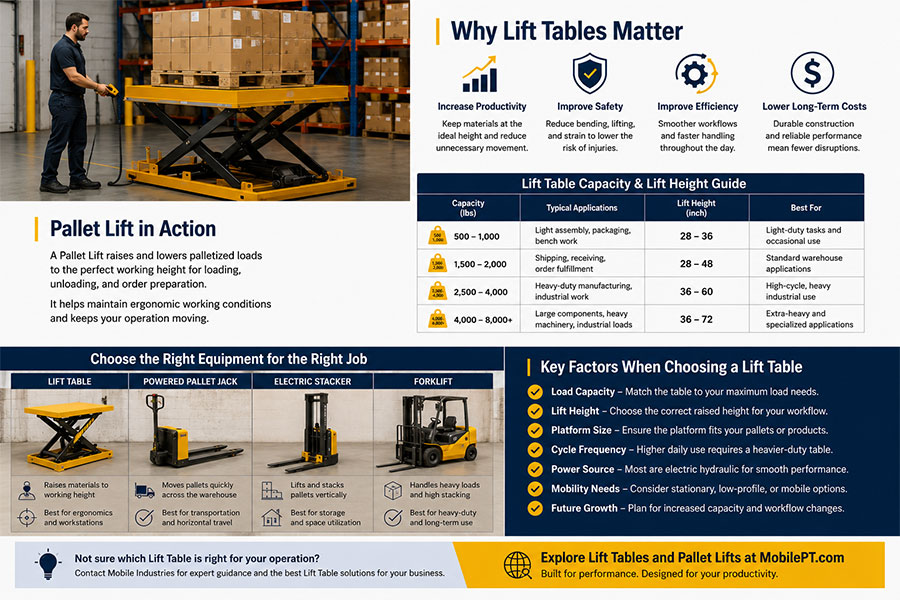
Typical Lift Table Applications
Lift Tables support nearly every department in a warehouse.
Receiving
- Product inspection
- Carton handling
- Inventory processing
Shipping
- Order preparation
- Stretch wrapping
- Pallet building
Manufacturing
- Assembly
- Machine loading
- Production support
Packaging
- Boxing
- Labeling
- Quality control
Maintenance
- Equipment servicing
- Tool positioning
Benefits of Lift Tables
Businesses invest in Lift Tables because they provide measurable operational improvements.
Ergonomics
Workers perform fewer awkward lifting movements.
Productivity
Materials stay within easy reach.
Safety
Reduced lifting decreases injury risk.
Consistency
Workstations remain organized and efficient.
Flexibility
Lift Tables adapt to numerous workflows.
Decision Guide
Use this quick reference when selecting equipment.
| If You Need To… | Best Equipment |
| Raise products to working height | Lift Table |
| Move pallets around the warehouse | Powered Pallet Jack |
| Stack pallets vertically | Electric Stacker |
| Improve workstation ergonomics | Lift Table |
| Transport heavy pallet loads | Powered Pallet Jack |
| Increase storage height | Electric Stacker |
Selecting equipment based on the actual task produces the best long-term results.
Common Buying Mistakes
Avoid these common mistakes.
✘ Choosing based only on price
✘ Buying too little lifting capacity
✘ Ignoring future production growth
✘ Selecting the wrong platform size
✘ Overlooking daily cycle requirements
✘ Forgetting operator ergonomics
A properly selected Lift Table often lasts for many years, making the initial buying decision extremely important.
Questions to Ask Before Buying
Before purchasing a Lift Table, ask:
- What is the maximum load weight?
- How often will the Lift Table be used?
- What lifting height is required?
- Will pallets be handled?
- Does the workstation need mobility?
- Is future production expected to increase?
- Does the Lift Table integrate with conveyors or machinery?
The answers will quickly narrow your equipment options.
Final Thoughts
A Lift Table is much more than a lifting platform. It is an investment in productivity, safety, and workplace efficiency.
Whether you’re building pallets, supporting production, loading shipments, or improving assembly workstations, the right Lift Table can reduce physical strain while helping employees work faster and more comfortably.
Businesses evaluating Lift Tables should consider capacity, lift height, platform size, workflow, and future growth before making a decision.
If your operation also involves transporting pallets or increasing storage capacity, you may benefit from combining a Lift Table with a Powered Pallet Jack or an Electric Stacker to create a more efficient material handling system.
To learn more about Lift Tables, Pallet Lifts, Powered Pallet Jacks, Electric Stackers, and other warehouse equipment solutions, visit MobilePT.com.
Frequently Asked Questions
What is a Lift Table used for?
A Lift Table is used to raise and lower materials to an ergonomic working height for packing, assembly, loading, unloading, inspection, and manufacturing tasks.
What is the difference between a Lift Table and a Pallet Lift?
A Pallet Lift is a type of Lift Table designed specifically for lifting and positioning palletized loads, while a standard Lift Table can support many different material handling applications.
How much weight can Lift Tables handle?
Lift Tables are available in capacities ranging from approximately 500 pounds to more than 8,000 pounds depending on the model.
Should I choose a Lift Table or an Electric Stacker?
Choose a Lift Table when you need ergonomic material positioning. Choose an Electric Stacker when you need to lift and stack pallets into storage locations.
Where can I buy Lift Tables in the USA?
Businesses can purchase Lift Tables, Pallet Lifts, Powered Pallet Jacks, Electric Stackers, and other material handling equipment from Mobile Industries through MobilePT.com.