
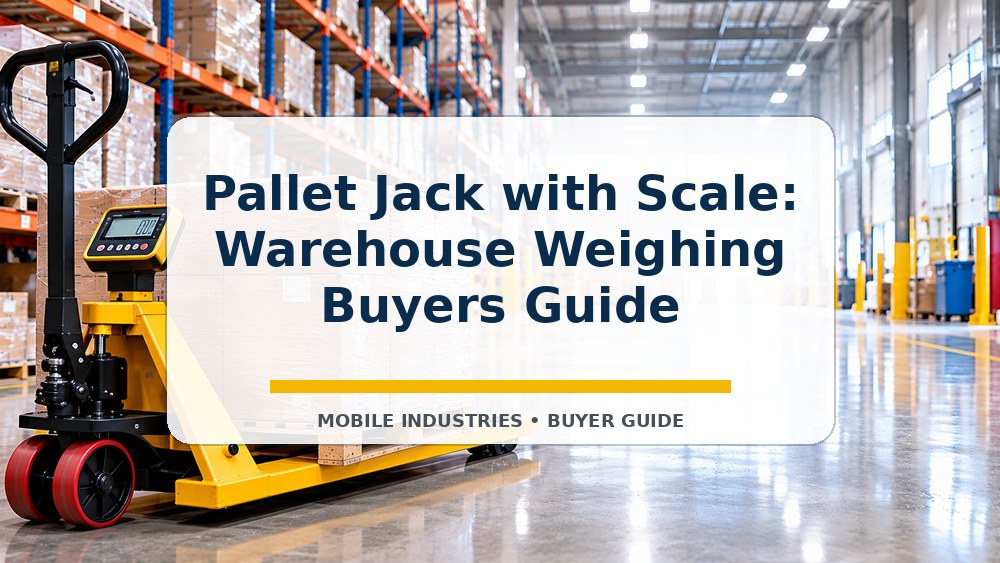
A pallet jack with a scale combines two warehouse steps that are often separated: moving a pallet and weighing it. Instead of taking a pallet to a fixed floor scale, the operator can lift the load, capture a weight and continue moving the pallet through receiving, staging or shipping.
That can save handling time, but the buying decision is more technical than choosing a conventional pallet jack. Scale accuracy, legal-for-trade requirements, load placement, battery power, display functions and calibration all matter in addition to fork size and load capacity.
This guide explains how weigh scale pallet jacks work, where they provide the most value and what U.S. warehouses should evaluate before relying on one for shipping, inventory, freight or commercial weighing tasks.
Pallet Jack with Scale: Quick Answer
A pallet jack with scale is a pallet truck with integrated load sensors and a digital indicator. It can weigh a pallet while the load is supported on the forks, allowing the operator to combine transport and weighing in one workflow.
| Question | Buyer Answer |
| Best use | Receiving, shipping, freight checks, inventory and in-process weighing |
| Main advantage | Move and weigh the pallet without a separate scale trip |
| Key specifications | Capacity, scale tolerance, fork size, display functions and approval status |
| Common functions | Gross, net, tare, totalization, unit selection and zero |
| Main alternative | Floor scale, forklift scale or standalone platform scale |
What Is a Pallet Jack with Scale?
A pallet jack with scale uses the same fork-and-hydraulic layout as a manual pallet truck but adds load cells or other sensing components, electronics and a display. The weighing system measures the force applied through the forks and converts it to a displayed weight.
The ECO I-44WL weigh-scale pallet truck is an example of an integrated manual design that combines pallet transport with gross/net weighing and total-weight functions.
Powered weigh-scale pallet trucks also exist, combining electric travel and lifting with onboard weighing. The right format depends on travel distance, pallet volume and whether weighing is occasional or part of every movement.
How a Pallet Jack with Scale Works
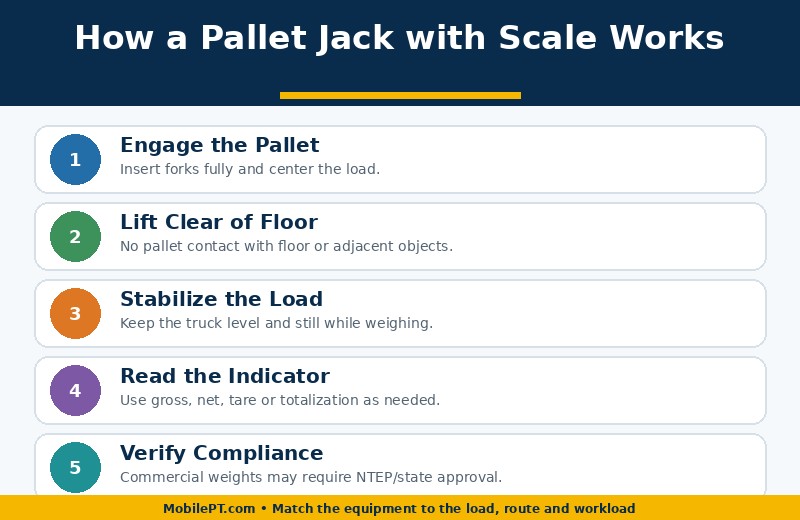
The operator inserts the forks fully beneath the pallet, raises the load clear of the floor and waits for the scale to stabilize. Sensors in the fork or load path detect the force created by the load, while the indicator converts that signal into a weight value.
Because the truck itself is part of the weighing system, load position matters. A pallet that is only partly engaged, leaning on another object or touching the floor can produce an incorrect result.
The display may provide simple gross weight or more advanced functions such as tare, net weight, accumulated totals, pounds/kilograms switching and print output. These features can turn the pallet jack into a mobile data-capture point rather than just a transport device.
Why Use a Pallet Jack with a Built-In Scale?
The main benefit is fewer handling steps. In a traditional process, a pallet may move from receiving to a floor scale, then back into the material flow. If weighing can happen during the first movement, the separate scale trip may disappear.
That can improve receiving checks, shipping verification, production control and freight preparation. It can also help identify obvious weight discrepancies before a pallet reaches the next process.
Common Warehouse Applications
Receiving teams can compare delivered pallet weights with expected quantities. Shipping departments can verify outbound freight. Inventory teams can estimate bulk material quantities where weight is a practical control. Manufacturing operations can weigh work-in-process materials without routing every load through one fixed station.
A mobile scale is especially useful when pallets are spread across a large facility or when the weighing point would otherwise become a bottleneck.
Pallet Jack Scale Accuracy: What Should You Expect?
Accuracy depends on the model and how it is used. Manufacturer-stated tolerance should be the starting point, but field conditions such as uneven floors, unstable loads, poor fork engagement and damaged components can affect results.
The scale should be allowed to stabilize, and the pallet should be supported entirely by the forks without touching adjacent equipment. If the weight is used for a critical transaction or regulatory purpose, verify the applicable accuracy and approval requirements rather than relying on a general product claim.
What Does Legal for Trade Mean?
A weight used only for internal process control is different from a weight used to determine what a customer pays. In the United States, commercial weighing devices are regulated through state and local weights-and-measures authorities.
NIST explains in its weighing and scales guidance that all 50 states have adopted NIST Handbook 44 and that commercial devices generally need appropriate approval, including an active NTEP Certificate of Conformance, plus inspection by the authorized jurisdiction before commercial use.
That means a warehouse should ask a clear question before buying: Is this weight only for internal information, or will it be used in a commercial transaction? The answer can change the required equipment and approval process.
Gross, Net, Tare and Total Weight Functions
Gross weight is the total measured load. Tare allows known packaging or container weight to be removed so the system can display net product weight. Zero correction resets the scale within its permitted operating range, while totalization adds multiple weights for batch or shipment tracking.
These functions can reduce manual calculations and make the scale more useful in receiving or production. Buyers should compare how functions are accessed, whether the display is readable in the actual lighting and whether operators can use the interface without slowing the workflow.
Manual vs Electric Weigh Scale Pallet Jacks
A manual weigh scale pallet jack is often the right choice for short routes and moderate pallet volume. It keeps the transport mechanism simple while adding weighing capability.
A powered weigh-scale pallet truck becomes more attractive when loads travel farther or the truck is used repeatedly throughout the shift. Mobile Industries also offers a self-propelled weigh-scale model for operations that want electric travel and weighing in one machine.
The weighing function should not distract from the underlying transport requirement. If operators move hundreds of heavy pallets over long distances, choosing a manual truck only because it has a scale can create a productivity problem.
Pallet Jack with Scale vs Floor Scale
A floor scale creates a fixed weighing station and can provide a large stable platform. It may be preferable for very heavy loads, frequent commercial transactions or processes that need high repeatability at one controlled location.
A pallet jack scale brings the weighing station to the load. It is more flexible and can reduce travel to a fixed scale, but the floor condition and operator technique become part of the weighing process.
| Factor | Pallet Jack with Scale | Floor Scale |
| Mobility | Excellent | Fixed location |
| Transport capability | Moves the pallet | Requires separate handling equipment |
| Workflow | Weigh during movement | Move pallet to scale station |
| Controlled setup | More dependent on floor/operator | Typically more controlled |
| Best fit | Distributed weighing across warehouse | Dedicated high-volume weighing point |
Pallet Jack with Scale vs Forklift Scale
A forklift-mounted scale can weigh loads during forklift handling and may suit operations where forklifts already control most pallet movement. A pallet jack scale is better for floor-level processes where forklifts are unnecessary or cannot enter the work area easily.
The decision should follow the material flow. The best scale is usually the one integrated into the equipment already doing the handling task.
Load Capacity and Scale Range
The pallet jack must be rated for the load before the scale specification matters. Calculate the heaviest complete pallet and verify both the truck capacity and the scale’s approved operating range.
Do not assume that a 5,000-pound transport rating automatically means the scale is equally accurate across the entire range. Review the manufacturer’s scale resolution, increments and tolerance.
The article on pallet truck load capacity provides a broader explanation of why rated capacity, pallet condition and load distribution should all be considered together.
Fork Dimensions and Pallet Compatibility
The scale adds electronics, but the forks still have to fit the pallet. Measure overall fork width, individual fork width, fork length and lowered height. A pallet jack that weighs accurately but cannot enter the facility’s pallets is not useful.
If the operation handles several pallet styles, test the truck against the smallest openings and lowest clearances.
Display, Power and Printer Options
A clear high-contrast display matters in dock areas and bright warehouses. Check whether the unit displays pounds, kilograms or both, and whether the keypad can be used with gloves if necessary.
Some scale systems use replaceable batteries while others use rechargeable power. Optional printers can be useful where weight tickets are required, but they add consumables and maintenance. Decide whether printed output is truly part of the process or whether digital recording is more practical.
Calibration and Verification
Scale performance should be verified at the intervals required by the manufacturer, workplace quality system and any applicable authority. Calibration is not a one-time purchase event. Impacts, overloads, load-cell damage and repairs can affect accuracy.
For internal checks, a warehouse may have its own verification routine. For commercial applications, follow the state or local weights-and-measures process and use qualified service providers where required.
How to Choose a Pallet Jack with Scale
The best model is the one that fits both the material-handling task and the weighing task. Use the following checklist to compare options.
- Define whether weights are internal, shipping-related or commercial/legal-for-trade.
- Confirm the heaviest complete pallet and required capacity.
- Compare stated scale tolerance, increments and resolution.
- Check pallet dimensions, fork size and minimum lowered height.
- Decide between manual and powered travel based on route length.
- Confirm gross, net, tare, zero and totalization functions needed.
- Check display readability and preferred units of measure.
- Determine whether printer output or digital records are required.
- Plan calibration, verification and service access.
- Confirm any state weights-and-measures approval before commercial use.
Common Buying Mistakes
Common mistakes include buying for scale features while ignoring pallet compatibility, assuming every onboard scale is legal for trade, comparing accuracy claims without reviewing tolerance conditions and selecting a manual truck for a high-volume travel application.
Another mistake is expecting the scale to compensate for poor weighing technique. The pallet must be fully supported, stable and clear of other surfaces for the measurement to be meaningful.
When Is a Weigh Scale Pallet Jack Worth It?
It is most valuable when pallets already move through the facility and a weight is needed somewhere along that route. Combining the two tasks can reduce handling steps and keep a fixed scale from becoming a bottleneck.
For occasional annual inventory checks, a separate scale may be enough. For daily receiving, shipping or production weighing, integrating the scale into the pallet truck can create much more value.
Mobile Industries’ full pallet truck range includes standard and specialty models for different warehouse workflows.
Receiving Workflow Example: Weighing at First Touch
A receiving team can use a pallet jack scale to capture weight as soon as a pallet leaves the trailer. The operator unloads the pallet, raises it fully on the scale truck, waits for a stable reading and compares the weight with the purchase order, supplier paperwork or expected shipment profile.
If the weight is outside the expected range, the pallet can be directed to inspection instead of entering inventory. That makes the scale part of exception management rather than a separate quality-control station.
The process is most effective when the weight is captured only once and then reused. If employees still reweigh the pallet on a floor scale because nobody trusts the mobile reading, the business has added equipment without removing a process step. Validation and clear procedures are therefore essential.
Shipping and Freight Verification Considerations
Outbound weight data can support carrier paperwork, load planning and freight checks, but the required accuracy depends on how the number will be used. A rough internal estimate may be adequate for staging, while a weight used to calculate charges can fall under commercial weights-and-measures rules.
Shipping teams should define whether the pallet-jack weight is authoritative or informational. If a carrier, customer or government requirement demands a certified commercial weight, verify that the specific device, jurisdiction and inspection status meet the requirement.
For mixed shipments, totalization can be useful because several pallet weights can be accumulated into a shipment total. That function saves manual addition, but the workflow should still preserve individual pallet identities if traceability matters.
Floor Level, Stability and Environmental Effects on Weighing
A scale pallet jack performs best on a firm, level surface. If one wheel sits in a depression or the truck rests across a steep floor transition, the load path through the sensors can change. Vibration from nearby equipment can also make the display take longer to stabilize.
Temperature, moisture and washdown exposure may affect electronics depending on the scale enclosure rating. If the truck will be used in cold storage, food processing or wet receiving areas, confirm the indicator and load-cell system are designed for that environment.
Good weighing practice therefore includes choosing a repeatable measurement location even though the scale itself is mobile. The truck can travel anywhere, but the most reliable readings often come from a known flat zone where the operator can stop safely and let the measurement settle.
Data Capture, Printers and Warehouse Systems
Some operations only need a visible weight. Others need the number attached to a shipment, purchase order, inventory record or quality document. Before paying for printer or connectivity features, decide what happens to the weight after the operator sees it.
A thermal printer can create a simple ticket at the point of use. Manual entry into a warehouse system may be enough at low volume. Higher-volume operations may benefit from digital integration if supported by the scale system, but integration should remove duplicate entry rather than create another screen for the operator.
The best data workflow is usually the simplest one that preserves the required traceability. Scale hardware, operator procedure and software should be designed as one process.
Final Thoughts
A pallet jack with scale is not simply a pallet jack with a display attached. It is a combined material-handling and measuring system, so both sides of the equipment need to fit the operation.
Choose the transport format first, then verify scale performance, functions, approval requirements and service. When those elements align, a weigh scale pallet jack can remove unnecessary trips to fixed scales and make receiving, shipping and inventory workflows more efficient.
Frequently Asked Questions
What is a pallet jack with a scale?
A pallet jack with a scale combines a manual or powered pallet truck with an integrated weighing system so an operator can lift, weigh and transport a pallet using one piece of equipment.
How accurate is a pallet jack scale?
Accuracy varies by model, capacity, load placement and operating conditions. Buyers should use the manufacturer’s stated tolerance and verify whether the scale is approved for any required commercial or legal-for-trade application.
Can a pallet jack with a scale replace a floor scale?
It can replace a separate scale for many receiving, shipping and internal inventory tasks, but a dedicated floor scale may still be better for very high accuracy, very heavy loads or fixed weighing stations.
What does legal for trade mean for a pallet jack scale?
Legal-for-trade use generally means the weighing device meets applicable weights-and-measures requirements for commercial transactions. In the United States, requirements are administered through state and local authorities and commonly reference NIST Handbook 44 and NTEP certification.
What should I look for in a weigh scale pallet jack?
Compare capacity, scale tolerance, display readability, fork dimensions, gross/net/tare functions, battery requirements, printer options, pallet compatibility, service support and whether the device meets any required commercial weighing rules.