
A low profile pallet jack solves a very specific warehouse problem: the pallet or skid is too close to the floor for a standard pallet truck to enter. That situation is common with custom pallets, display pallets, specialized manufacturing skids, low-clearance containers and certain imported or non-standard load platforms.
The mistake is assuming that every pallet jack with narrow forks will fit. Minimum fork height, wheel diameter, fork thickness and pallet opening geometry all matter. A truck can have the right capacity and still be unusable if its forks cannot physically enter the pallet.
This guide explains how low profile pallet jacks work, how they differ from standard models, which specifications matter most and how to choose the right truck for special pallets without creating a new handling problem somewhere else in the workflow.
Low Profile Pallet Jack: Quick Answer
A low profile pallet jack is a manually propelled pallet truck built with a reduced lowered fork height so it can enter pallets that sit closer to the floor than standard pallets. It is best for low-clearance skids, custom pallets and specialized loads where a normal pallet truck cannot get its forks underneath.
| Question | Low Profile Pallet Jack Answer |
| Primary purpose | Move low-clearance or specialty pallets at floor level |
| Key specification | Minimum lowered fork height |
| Typical use | Warehouses, manufacturing, displays, specialty skids and custom pallets |
| Main alternative | Standard pallet jack, super-low pallet jack or custom pallet truck |
| Critical measurements | Entry height, fork width, fork length, capacity and floor condition |
What Is a Low Profile Pallet Jack?
A low profile pallet jack uses the same basic hydraulic lifting principle as a standard manual pallet truck, but the fork and load-wheel assembly is designed to sit closer to the floor. The operator pumps the handle to raise the forks after they are fully engaged beneath the pallet, then manually pushes or pulls the load along the travel route.
Mobile Industries offers several specialized pallet trucks, including low-profile and super-low configurations designed for pallets that cannot be handled by standard-height forks.
The defining feature is not simply a shorter truck. It is the relationship between the lowered fork height and the pallet opening. A low profile truck is only useful if the complete fork-and-wheel assembly can enter the load without striking bottom boards, blocks or deck material.
Why Do Some Pallets Need a Low Clearance Pallet Jack?
Standard pallet dimensions are common, but they are not universal. Manufacturers, retailers and logistics operations often use pallets and skids designed around product dimensions, display systems, machine interfaces or shipping constraints. Some of those designs sit unusually close to the floor.
A standard pallet jack may contact the underside of the pallet before the forks can enter far enough to support the load. Operators sometimes try to solve this by tilting the pallet, forcing the forks or using makeshift ramps. Those approaches can damage pallets, destabilize loads and create unnecessary handling risk.
A correctly selected low clearance pallet jack eliminates the workaround by matching the truck geometry to the load geometry.
Standard vs Low Profile vs Super Low Profile Pallet Jacks
The categories are best understood by minimum entry height rather than by marketing name. A standard pallet jack is designed for common pallet openings. A low profile model reduces that height for tighter spaces. A super-low model goes further for specialized pallets with very limited clearance.
| Pallet Jack Type | Best For | Main Tradeoff |
| Standard pallet jack | Common warehouse pallets and skids | May not enter low-clearance pallets |
| Low profile pallet jack | Custom or low-entry pallets | Smaller rollers may be more sensitive to poor floors |
| Super low profile pallet jack | Extremely low pallet openings | More specialized application and route requirements |
How Low Is a Low Profile Pallet Jack?
There is no single universal lowered height that defines the category. The actual number depends on the manufacturer and model. For example, the ECO MINI low profile pallet truck is designed with a 2-inch lowered height for pallets where entry height is restricted.
That specification should be compared with the real pallet under load. Wood can flex, boards can sag and damaged pallets can reduce clearance. Measure more than one pallet if the supply varies, and measure at the actual fork entry points rather than only at the outer edge.
Which Pallets and Loads Use Low Profile Pallet Trucks?
Low profile pallet trucks are useful anywhere the pallet or skid does not provide standard fork clearance. Typical examples include custom manufacturing skids, thin display pallets, low machine bases, certain printing or paper pallets, specialized metal or plastic platforms and non-standard imported pallets.
They can also be useful where loads are intentionally kept close to the floor for stability or where the pallet is integrated into a process that does not use conventional warehouse pallet dimensions.
The truck still needs to match the load capacity and fork spacing. Low entry height is only one part of compatibility.
How to Measure Pallet Clearance Correctly
Measure the vertical opening where the forks will actually enter. Do not measure from the highest part of the deck or from an opening the truck will never use. Record the smallest usable entry height because that dimension controls whether the truck can engage the pallet.
Then measure the clear width of the fork openings, the distance between internal obstructions and the required insertion depth. If the pallet is two-way entry rather than four-way entry, confirm the intended approach direction.
Finally, repeat the measurement with several representative pallets. A nominal specification may not account for wear, broken deck boards, manufacturing variation or load-induced deflection.
Fork Width and Fork Length: Why They Matter
A low fork height does not help if the forks are too wide, too narrow or too short for the pallet. Overall fork width affects whether both forks can enter the load, while individual fork width determines clearance around stringers and blocks.
Fork length should support the pallet without extending so far that it creates interference on the opposite side. Long forks may be useful for deeper loads, but they also increase the space needed to turn and position the truck.
When comparing models, match fork geometry to the pallet family used most often rather than selecting by capacity alone.
Load Wheels and Floor Conditions
Low profile trucks often use smaller load rollers because the wheel assembly must fit inside a thinner fork profile. Smaller rollers can make floor condition more important. Cracks, debris, dock transitions, expansion joints and thresholds that are minor for a standard pallet truck may feel more significant on very small rollers.
OSHA identifies material handling, slips, trips and powered equipment as important warehouse hazards in its warehousing guidance. Even when using a manual pallet jack, a clean, smooth and unobstructed travel surface improves control and reduces sudden stops.
Before buying, test or inspect the entire route from pickup to destination. Equipment that fits the pallet but cannot travel smoothly through the facility is not a complete solution.
How Much Weight Can a Low Profile Pallet Jack Carry?
Capacity depends on the specific model. Low profile design does not automatically mean low capacity, but buyers should never assume a specialty truck matches the rating of a standard 5,500-pound pallet jack.
Use the manufacturer’s rated capacity and consider the complete load, including pallet, packaging and any fixtures. Load distribution matters as well. A dense load concentrated at one end of a pallet can affect steering and structural stress differently than an evenly distributed load.
Low Profile Pallet Jack vs Standard Pallet Jack
The standard truck is usually the better general-purpose choice when all pallets provide normal entry clearance. It typically offers common wheel sizes, broad parts availability and straightforward compatibility with conventional warehouse pallets.
The low profile truck is the better choice when clearance is the limiting factor. Buying one simply because it appears more versatile is not always ideal, especially if the smaller load rollers perform less smoothly over the facility’s floors.
The goal is not to buy the lowest possible truck. It is to buy the lowest truck required by the actual pallet while maintaining the capacity, wheel performance and fork dimensions the operation needs.
Low Profile Pallet Jack vs Forklift
A forklift can sometimes approach special pallets with thinner forks or attachments, but it is a fundamentally different machine. If the task is short-distance floor-level movement in a tight area, a low profile manual pallet jack can be simpler and less expensive.
If the load must be stacked, moved outdoors over demanding surfaces or transported long distances, a forklift or powered alternative may be more appropriate. Equipment should be matched to the complete task, not only the pallet opening.
How to Choose a Low Profile Pallet Jack
Start with the pallet, then work outward to the route and workload. The checklist below captures the specifications that eliminate most mismatches before purchase.
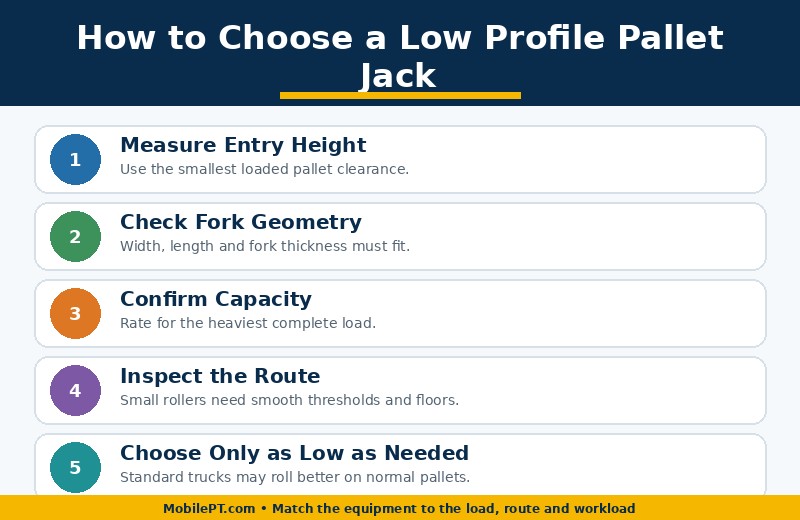
- Load the pallet and measure the smallest real fork-entry clearance.
- Measure overall fork opening width and internal obstructions.
- Confirm required fork length and overall fork width.
- Calculate the heaviest complete load, not the average load.
- Inspect the route for thresholds, cracks, joints and debris.
- Confirm turning space with the full pallet attached.
- Compare wheel and roller materials with the floor surface.
- Check service access and replacement wheel availability.
- Confirm whether a standard, low-profile or super-low model is actually required.
- Test compatibility with a representative pallet whenever possible.
What Specifications Matter Most?
Minimum lowered height should be the first filter, followed by capacity and fork dimensions. After that, evaluate raised height, wheel material, steering arc, overall length, turning space and serviceability.
A low profile truck used ten times per day on smooth concrete has different priorities from a truck used continuously across rough joints and ramps. Frequency of use should influence how much emphasis you place on wheel durability, handle ergonomics and service access.
Common Low Profile Pallet Jack Buying Mistakes
The most common mistake is measuring only the pallet opening and ignoring the travel route. Other errors include choosing a truck with forks that are too wide, assuming every pallet in the same supplier batch has identical clearance, underestimating load weight and overlooking wheel size.
Another mistake is using a specialty low profile model for all warehouse tasks when a standard pallet jack would roll more smoothly and cost less to maintain for normal pallets.
Maintenance Tips for Low Profile Pallet Trucks
Keep load rollers clean and replace badly worn or damaged wheels before they affect control. Inspect fork tips and undersides for impact damage because a small change in fork geometry can matter when clearance is tight.
Check the hydraulic system for leaks or inconsistent lifting, lubricate service points according to the manufacturer and keep the route free of debris that can stop small rollers abruptly.
If you are comparing several pallet truck formats for a mixed fleet, the right pallet truck selection guide provides a broader decision framework for manual and electric models.
How to Test a Low Profile Pallet Jack Before Fleetwide Use
A short application test can prevent an expensive mismatch. Use representative pallets from the real operation, including older pallets, loaded pallets and the lowest-clearance versions. Confirm that the forks enter without force, the load rollers clear internal obstructions and the pallet can be raised without scraping or shifting.
Then move the load through the complete route. Test the tightest turn, narrowest doorway, roughest threshold and busiest staging point. A pallet jack that looks perfect beside the pallet may still create problems when the loaded truck has to turn around a rack end or cross a floor joint.
Ask several normal operators to use the truck and document recurring issues such as hard steering, poor visibility, fork interference or excessive rolling resistance. A ten-minute demonstration on an empty pallet is not enough to validate a specialty truck for daily production.
How Pallet Condition Changes Low-Clearance Handling
Low-clearance pallet handling leaves less room for variation. A standard pallet with generous fork openings may still accept a truck when one board sags slightly. A specialty pallet with only a small clearance margin can become incompatible when boards warp, nails protrude or the load causes the deck to deflect.
Build pallet inspection into the process. Damaged or distorted pallets should be repaired, repalletized or removed rather than forced onto the truck. If the operation receives pallets from many suppliers, define a minimum acceptable entry height and communicate that specification to purchasing or receiving teams.
This also helps separate an equipment problem from a pallet-quality problem. If the truck fits new pallets but not damaged incoming pallets, buying an even lower truck may treat the symptom while allowing poor pallets to remain in circulation.
Turning Radius, Storage Space and Fleet Planning
Low profile pallet jacks are often purchased for one special load, but they still occupy space in the fleet. Decide where the truck will be stored, how operators will identify it and whether it should remain near the process that needs it. A specialty truck that constantly disappears into general warehouse use may not be available when the low-clearance load arrives.
Turning radius should be checked with the actual pallet attached because the pallet, not the jack, often controls the swept path. Long forks and wide loads can require more working aisle space than expected even if the jack itself is compact.
If only one department uses low pallets, dedicating a truck to that department may be more efficient than replacing every standard pallet jack. Mixed fleets can be a better solution than trying to make one specialty model serve every load.
Total Cost of Ownership for Specialty Pallet Jacks
The purchase price is only one cost. Low profile trucks may use specialized load rollers, forks or replacement parts that differ from the facility’s standard pallet jack fleet. Before buying, ask about replacement wheels, pump components, seal kits and local service support.
Downtime also matters. If one low profile pallet jack supports a critical production line, the operation may need spare wear parts or a backup truck. For a low-frequency application, that may be unnecessary; for a high-frequency process, parts availability can be more important than a small difference in initial price.
Standardizing on a few proven models can simplify maintenance, but specialization is justified when the load genuinely requires it. The right goal is not the fewest truck models possible. It is reliable coverage of the pallet types the warehouse actually handles.
Final Thoughts
A low profile pallet jack is a specialized tool, but it can be the correct tool when ordinary pallet trucks simply cannot enter the load. The best purchase starts with accurate pallet measurements, then confirms fork dimensions, capacity, wheel design and route conditions.
Do not buy based on the word “low profile” alone. Match the actual lowered height to the actual pallet clearance, verify compatibility under load and choose a truck that can complete the full movement safely and efficiently.
Frequently Asked Questions
What is a low profile pallet jack?
A low profile pallet jack is a pallet truck designed with a lower minimum fork height than a standard pallet jack so it can enter pallets or skids with reduced ground clearance.
How low can a low profile pallet jack go?
Minimum fork height varies by model. Some low profile pallet jacks are designed around roughly 2-inch lowered heights, while super-low models may be designed for even tighter clearances.
Can a low profile pallet jack move standard pallets?
Often yes, provided the pallet dimensions, fork spacing, entry height and load capacity match the truck. Buyers should verify compatibility rather than assume one truck fits every pallet.
What is the difference between low profile and super low profile pallet jacks?
A super low profile pallet jack is designed for pallets or equipment with extremely limited entry clearance. It may use smaller load rollers and different fork construction than a conventional low profile model.
What should I measure before buying a low profile pallet jack?
Measure pallet entry height, fork opening width, fork length, overall pallet dimensions, maximum load weight, floor conditions and the route the pallet jack will travel.