

Electric Stackers are compact powered material handling machines designed to move palletized loads and raise them vertically for stacking, storage, loading, and production tasks.
They fill an important gap between pallet trucks and conventional forklifts. A pallet truck is primarily designed to move pallets across the floor, while an Electric Stacker adds a mast that allows pallets to be raised into shelving, racking, platforms, or other elevated positions.
For warehouses that need vertical lifting but do not always require a full-size forklift, Electric Stackers can provide a practical combination of maneuverability, lifting capability, and electric operation.
This guide explains what Electric Stackers are, how they work, the different types available, where they are used, and what warehouse operators should consider before buying one.
Electric Stackers: Quick Answer
| Question | Answer |
|---|---|
| What is an Electric Stacker? | A powered machine that transports and vertically lifts palletized loads |
| Main purpose | Moving, lifting, and stacking pallets |
| Best environments | Warehouses, factories, stockrooms, and distribution centers |
| Power source | Rechargeable battery |
| Operator style | Walk-behind or ride-on |
| Main advantage | Vertical lifting in a compact footprint |
| Main alternatives | Manual stacker, pallet truck, Powered Pallet Jack, forklift |
| Key buying factors | Capacity, lift height, pallet type, aisle width, battery, and workload |
Electric Stackers are best for warehouses that need to move pallets and place them into elevated storage without using a larger forklift for every task.
What Is an Electric Stacker?
An Electric Stacker is a powered warehouse machine with forks, a vertical mast, wheels, controls, and a battery-powered lifting system.
The forks enter beneath the pallet.
The operator then raises the load using the stacker’s hydraulic or electro-hydraulic lifting system and moves it to the required location.
Depending on the model, electric power may operate:
- Lifting
- Lowering
- Forward travel
- Reverse travel
- Braking
- Steering assistance
Fully electric models power both lifting and travel.
Semi-electric models typically provide powered lifting while the operator manually pushes or pulls the equipment.
Mobile Industries offers multiple stacker configurations through its Electric Stackers for sale, including semi-electric, battery hydraulic, platform, and other warehouse stacker designs.
How Do Electric Stackers Work?
Electric Stackers use a combination of battery power, hydraulic lifting, and a vertical mast.
The basic process is straightforward:
- The operator positions the forks beneath the pallet.
- The forks lift the pallet clear of the floor.
- Powered travel moves the load through the warehouse.
- The operator aligns the stacker with the storage location.
- The mast raises the pallet to the required height.
- The pallet is positioned and lowered into place.
The process is similar to forklift pallet handling but occurs with a smaller machine.
Main Components of an Electric Stacker
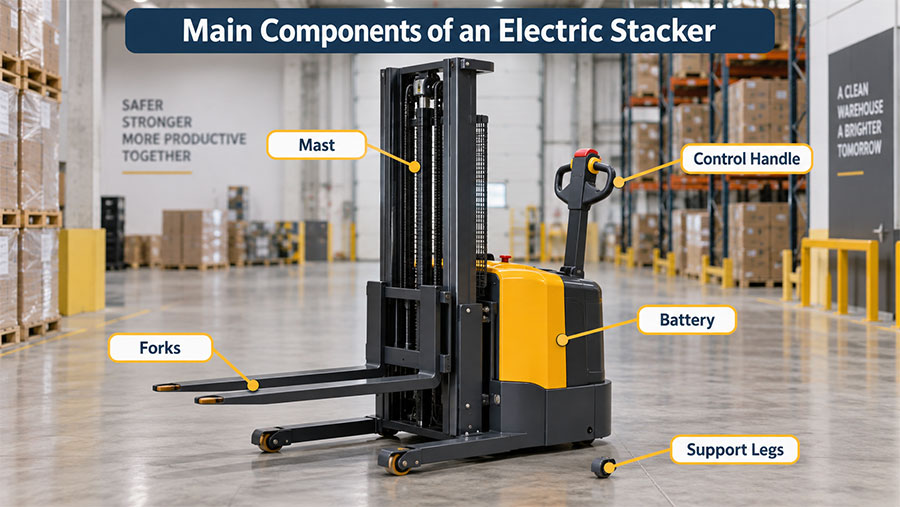
Forks
The forks support the pallet during lifting and transport.
Fork length, width, spacing, and configuration must match the pallets used in the facility.
Mast
The mast provides vertical lifting capability.
Different mast configurations provide different maximum lift heights and collapsed heights.
Battery
Rechargeable batteries power the machine.
Battery size, chemistry, charging requirements, and operating time vary by model.
Control Handle
Walk-behind Electric Stackers normally use a tiller-style control handle.
It may control:
- Forward and reverse travel
- Speed
- Lifting
- Lowering
- Horn
- Braking
- Emergency reverse
Support Legs
Many stackers use support or straddle legs to stabilize the machine while lifting.
These legs affect pallet compatibility and rack access.
Types of Electric Stackers
Not every Electric Stacker is designed for the same job.
Semi-Electric Stackers
Semi-electric models use battery power for lifting while the operator manually moves the machine.
They can work well for:
- Occasional stacking
- Short travel distances
- Lower pallet volumes
- Smaller facilities
They provide powered vertical lifting without the cost and complexity of fully powered travel.
Full Electric Walkie Stackers
A full Electric Stacker powers both lifting and travel.
The operator walks behind the machine while controlling it through the tiller handle.
These models are commonly used for:
- General warehouse work
- Narrow aisles
- Production areas
- Stockrooms
- Shipping and receiving
Ride-On Electric Stackers
Ride-on models include an operator platform.
They are more appropriate when employees travel longer distances or move higher pallet volumes throughout the shift.
Straddle Stackers
Straddle legs extend around the outside of the pallet.
This configuration provides stability and may work well with certain pallet and rack designs.
Fork-Over Stackers
Fork-over models use load forks positioned above the support legs.
They require compatible open-bottom pallets.
Counterbalanced Stackers
Counterbalanced Electric Stackers use rear weight to balance the load instead of placing support legs around the pallet.
This can increase pallet compatibility and allow access to certain racks, machines, and closed-bottom pallets.
What Are Electric Stackers Used for in Warehouses?
Warehouse Rack Storage
One of the most common applications is placing pallets into elevated storage.
Electric Stackers allow facilities to use vertical warehouse space without assigning a forklift to every rack movement.
Shipping and Receiving
Stackers can move incoming pallets, stage outbound loads, and position materials around loading areas.
Manufacturing
Factories use Electric Stackers to deliver palletized components to production lines and move finished goods into storage.
Inventory Replenishment
Electric Stackers can transfer reserve inventory from floor storage into rack positions or replenish picking locations.
Production Support
A stacker can position pallets beside machinery, workstations, assembly lines, and packaging areas.
Benefits of Electric Stackers for Warehouses
Compact Size
Electric Stackers generally occupy less space than conventional counterbalanced forklifts.
That makes them useful in narrow aisles and compact warehouse layouts.
Vertical Storage Capability
Unlike conventional pallet jacks, Electric Stackers can raise pallets several feet above the floor.
This allows warehouses to use vertical storage more effectively.
Electric Operation
Battery-powered operation is well suited to indoor environments.
Electric equipment also avoids engine exhaust at the point of use.
Reduced Manual Effort
Powered lifting eliminates the need to manually raise heavy palletized loads.
Fully electric models also reduce the physical effort required to move pallets.
Lower Equipment Requirements for Certain Tasks
A warehouse does not necessarily need a full-size forklift for every pallet movement.
For defined indoor stacking applications, a smaller Electric Stacker may provide the required capability.
Electric Stacker vs Powered Pallet Jack
| Feature | Electric Stacker | Powered Pallet Jack |
|---|---|---|
| Horizontal pallet movement | Good | Excellent |
| Vertical lifting | Yes | Minimal |
| Rack placement | Yes | No |
| Mast | Yes | No |
| Long travel routes | Moderate | Better |
| Compact warehouse use | Excellent | Excellent |
| Main purpose | Transport and stack | Transport |
The decision is largely about lift height.
Choose an Electric Stacker when pallets must be raised into storage.
Choose a Powered Pallet Jack when the main requirement is fast horizontal transport.
For more information about floor-level powered pallet movement, see the Powered Pallet Jack: Complete Buyer’s Guide.
Electric Stacker vs Forklift
| Feature | Electric Stacker | Forklift |
|---|---|---|
| Equipment footprint | Smaller | Larger |
| Narrow aisles | Excellent | Model dependent |
| Heavy-duty capacity | Limited by model | Greater |
| Outdoor use | Usually limited | Better with suitable model |
| Specialized attachments | Limited | Extensive |
| Long-distance travel | Moderate | Better |
| Initial investment | Generally lower | Generally higher |
| Best application | Compact indoor stacking | Heavy and varied handling |
A forklift remains the stronger option for heavy loads, outdoor environments, rough surfaces, specialized attachments, and demanding multi-purpose work.
An Electric Stacker is often better when warehouse tasks are predictable and primarily involve indoor pallet storage.
Electric Stacker vs Manual Stacker
| Feature | Electric Stacker | Manual Stacker |
|---|---|---|
| Powered lifting | Yes | No or manually assisted |
| Powered travel | Often | No |
| Operator effort | Lower | Higher |
| Frequent use | Better | Limited |
| Purchase cost | Higher | Lower |
| Best workload | Moderate to high | Low |
Manual stackers can be practical for occasional lifting.
Electric models become more valuable as lift frequency, pallet weight, and travel distance increase.
How to Choose an Electric Stacker
Determine Maximum Load Capacity
Identify the heaviest pallet the machine will lift.
Include the pallet, product, packaging, fixture, and any uneven weight distribution.
Measure Required Lift Height
Measure the highest storage location the forks must reach.
Also check the stacker’s collapsed mast height for:
- Doorways
- Ceilings
- Mezzanines
- Overhead equipment
Confirm Pallet Compatibility
Not every stacker works with every pallet.
Check:
- Pallet width
- Pallet length
- Fork entry
- Bottom boards
- Stringer design
- Support leg clearance
Measure Aisle Width
The machine must have enough room to turn while carrying the pallet.
Measure working aisles, not just straight travel aisles.
Evaluate Travel Distance
Short warehouse routes may suit a walk-behind model.
Longer routes and higher volume may justify a ride-on design.
Review Battery Requirements
Consider:
- Shift length
- Daily operating hours
- Charging time
- Charging location
- Number of shifts
- Replacement batteries
- Maintenance requirements
For a more detailed equipment-selection process, read the Electric Stacker Buyer’s Guide: Choosing the Right Model.
Electric Stacker Selection Guide
| Warehouse Requirement | Recommended Direction |
|---|---|
| Occasional vertical lifting | Semi-Electric Stacker |
| Frequent narrow-aisle stacking | Full Electric Walkie Stacker |
| Longer warehouse routes | Ride-On Electric Stacker |
| Closed-bottom pallets | Counterbalanced model |
| Compatible open-bottom pallets | Fork-over model |
| Specialized pallet access | Straddle model |
| Heavy outdoor work | Suitable forklift |
Safety and Operator Training
Electric Stackers must be operated according to their rated capacity, manufacturer instructions, and applicable workplace requirements.
Operators should understand:
- Load stability
- Rated capacity
- Load center
- Steering and braking
- Pedestrian traffic
- Ramps
- Loading docks
- Battery charging
- Daily inspections
- Safe stacking procedures
The Occupational Safety and Health Administration provides requirements and guidance for powered industrial trucks, including operator training, workplace conditions, and safe operation.
Common Electric Stacker Buying Mistakes
Avoid these mistakes:
✘ Choosing capacity based only on average pallet weight
✘ Ignoring load center
✘ Buying the wrong fork configuration for the pallet
✘ Forgetting collapsed mast height
✘ Measuring travel aisles but not working aisles
✘ Underestimating battery requirements
✘ Choosing manual travel for high-volume operations
✘ Using indoor equipment on unsuitable outdoor surfaces
✘ Failing to consider service and replacement parts
Final Thoughts
Electric Stackers for warehouses provide a practical combination of pallet transportation and vertical lifting.
They are especially useful when facilities need to place pallets into racks, work in confined indoor spaces, or reduce dependence on larger forklifts for routine stacking tasks.
The right model depends on load capacity, lift height, pallet design, aisle width, travel distance, battery requirements, and daily workload.
Semi-electric models work well for occasional lifting. Full Electric Stackers are better for frequent movement and stacking. Ride-on models can improve productivity when travel distances increase, while counterbalanced and straddle designs solve specific pallet-access problems.
Before purchasing, measure the actual load, pallet, rack, aisle, and operating environment.
Matching the machine to the application will provide better productivity, safer handling, and more efficient warehouse operations.
Mobile Industries supplies Electric Stackers, pallet trucks, Lift Tables, Powered Pallet Jacks, and other material handling equipment for warehouses and industrial facilities throughout the United States through MobilePT.com.
Frequently Asked Questions
What are Electric Stackers used for?
Electric Stackers are used to move palletized loads and lift them vertically into warehouse racks, storage positions, platforms, and production areas.
How is an Electric Stacker different from a pallet jack?
A pallet jack primarily moves pallets horizontally at floor level. An Electric Stacker includes a vertical mast that allows pallets to be lifted and stacked at greater heights.
Can an Electric Stacker replace a forklift?
An Electric Stacker can replace a forklift for many light-to-medium indoor stacking applications. Forklifts remain better for heavier loads, outdoor use, rough surfaces, long travel routes, and specialized attachments.
What is the difference between semi-electric and full Electric Stackers?
A semi-electric stacker usually powers the lifting function while requiring manual travel. A full Electric Stacker powers both lifting and movement.
Are Electric Stackers good for narrow aisles?
Yes. Their compact footprint and turning radius make many Electric Stackers well suited to narrow warehouse aisles and confined storage areas.
Can Electric Stackers lift pallets into warehouse racks?
Yes. Rack placement is one of their primary applications, provided the stacker has the required capacity, lift height, and compatible fork configuration.
How do I choose the correct Electric Stacker capacity?
Determine the heaviest complete pallet load and evaluate the load center, lift height, pallet dimensions, and manufacturer-rated capacity for the specific configuration.
Are Electric Stackers battery powered?
Yes. Electric Stackers use rechargeable batteries to power lifting and, on fully electric models, powered travel.
Where can I buy Electric Stackers in the USA?
Mobile Industries supplies Electric Stackers and other warehouse material handling equipment through MobilePT.com.