
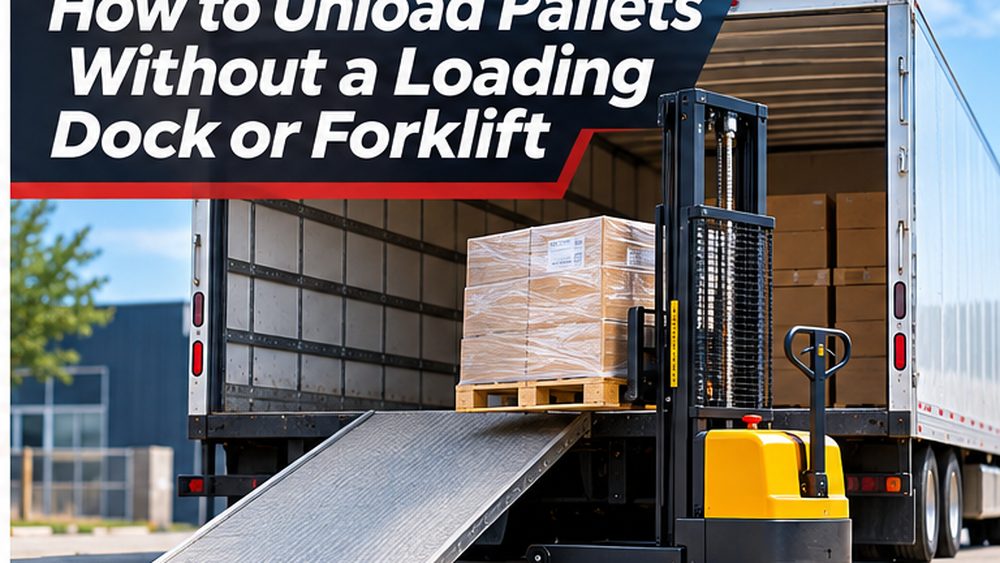
Receiving a palletized shipment without a loading dock creates a simple physical problem: the pallet is several feet above ground level inside the truck, while a standard pallet jack is designed to move a load horizontally at floor level. Without the right equipment, employees may be tempted to improvise with steep ramps, unstable blocking, manual lifting, or equipment that was never designed to bridge the height difference.
There are safer and more practical alternatives. Manual or semi-electric stackers, self-lifting stackers, truck liftgates, properly engineered ramps, and delivery-specific equipment can move palletized goods from vehicle height to ground level without a conventional dock or full-size forklift.
How to Unload Pallets Without a Loading Dock: Quick Answer
| Method | Best For | Main Advantage | Key Limitation |
|---|---|---|---|
| Manual / semi-electric stacker | Occasional truck unloading | Compact vertical lifting | Capacity, geometry, and truck access must match |
| Self-lifting stacker | Delivery routes without dock equipment | Travels with vehicle and unloads itself | Lower capacity than larger warehouse equipment |
| Truck liftgate | Regular curbside or ground-level delivery | Purpose-built bed-to-ground transfer | Requires equipped delivery vehicle |
| Portable/yard ramp | Frequent vehicle access from ground | Creates rolling path to truck height | Requires space, proper slope, and rated equipment |
| External material handler | Heavy or complex loads | High capability | Higher cost and site access needs |
The right method depends on pallet weight, truck type, bed height, available ground space, surface condition, frequency, and what equipment will move the pallet after it reaches the ground.
Why a Pallet Jack Alone Cannot Solve the Height Difference
A standard pallet jack is a low-lift truck. It raises a pallet only enough to clear the floor so the load can roll horizontally. It cannot lower a pallet from a trailer bed to the ground. Even a powered pallet jack still needs a reasonably level travel surface and a safe transition between elevations.
This is why unloading without a dock requires either vertical lifting equipment or a properly designed transition that brings the vehicle and ground to a usable level relationship.
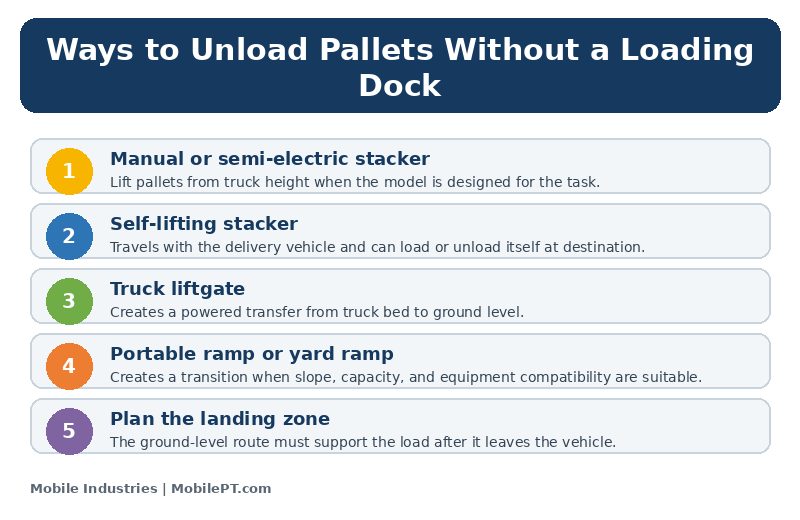
Ways to Unload Pallets Without a Loading Dock
Option 1: Use a Manual Hydraulic Stacker
A manual hydraulic stacker can lift a pallet vertically and may be used in applications where a loading dock is unavailable, provided the specific model and truck geometry allow safe access. The stacker approaches the pallet, lifts it clear of the truck floor, moves it out of the vehicle, then lowers the load to ground level.
Mobile Industries offers warehouse stackers in manual, semi-electric, battery hydraulic, and self-lifting configurations. The equipment must be selected around capacity, fork entry, base-leg clearance, lift height, truck opening, and working space.
When a Manual Stacker Makes Sense
- Occasional deliveries rather than continuous dock traffic.
- Loads within the stacker’s rated capacity.
- Firm, level ground at the receiving area.
- Enough room behind the vehicle to position and lower the load.
- Pallets compatible with the forks and support legs.
Option 2: Use a Semi-Electric or Battery Hydraulic Stacker
Powered lift reduces the manual pumping required to raise or lower the pallet. This can be useful when deliveries are frequent or the pallet must be positioned repeatedly. Travel may still be manual on semi-electric designs, so the route and load weight remain important.
The B-Series Semi-Electric Stacker is specifically described for loading and unloading trucks where loading docks do not exist. Adjustable forks and straddle legs allow it to handle a range of pallet and skid applications, while powered lifting reduces the effort required for the vertical part of the task.
Option 3: Use a Self-Lifting Stacker
A self-lifting stacker is designed around delivery operations. Instead of requiring the destination to own unloading equipment, the stacker travels with the truck or trailer and can load or unload itself. This approach is especially useful for routes that deliver to customers, jobsites, retail locations, small warehouses, or facilities that do not have docks.
The ECO ESLS11 self-lifting stacker can lift or lower the entire unit on and off a delivery vehicle, giving the delivery team an integrated method for handling the pallet at the destination.
Option 4: Use a Truck Liftgate
A hydraulic liftgate is one of the most common solutions for recurring ground-level deliveries. The pallet is moved onto the liftgate platform inside the truck, the platform lowers to the ground, and a pallet jack moves the load away. This method turns the vertical transition into part of the vehicle.
Liftgates work well when the delivery fleet controls the truck specification. The platform must be rated for the combined pallet and handling equipment weight, large enough for safe positioning, and used according to the vehicle manufacturer’s instructions.
Option 5: Use a Properly Rated Portable or Yard Ramp
A ramp can create a rolling path between ground and truck height, but this is not the same as placing a small portable board at the back of a trailer. The slope, capacity, surface traction, edge protection, width, and equipment type must all be appropriate.
Manual pallet jacks can become extremely difficult to control on steep grades. Powered equipment also has gradeability limits and braking considerations. For frequent ramp unloading, use equipment and a ramp specifically engineered for the load and operating environment.
Can You Unload a Pallet With a Manual Pallet Jack and Ramp?
Only when the ramp and route are properly designed and the pallet jack is appropriate for the grade. A steep improvised ramp is not a safe substitute for a dock. The combined load can accelerate downhill, overwhelm the operator, catch small wheels at transitions, or shift if the surface is uneven.
If the pallet must descend a significant height, use a liftgate, stacker, yard ramp, or other engineered solution rather than relying on operator strength to control gravity.
How to Unload a Box Truck Without a Dock
Box trucks are often easier to equip with liftgates because they serve ground-level delivery routes. If no liftgate is available, a compact stacker may work when the truck opening, floor height, pallet orientation, and receiving space are compatible. A self-lifting stacker is another strong option for routes where unloading equipment cannot be guaranteed.
Before dispatch, confirm that the destination has a firm landing area, sufficient turning space, and a route from the vehicle to the storage or work area. Unloading the pallet is only half the problem; the load still needs to travel safely after it reaches the ground.
How to Unload a Semi-Trailer Without a Dock
Semi-trailers sit high above the ground and are designed around dock-height loading. Unloading them without a dock generally requires a yard ramp, mobile ramp system, lift equipment capable of reaching the trailer, or a transfer arrangement at another facility. Small improvised methods are inappropriate for the height and typical load weights involved.
If ground-level receiving is common, consider whether a box truck with liftgate or delivery vehicle designed for curbside unloading is a better logistical fit than a dock-oriented trailer.
How to Unload Pallets at a Jobsite
Jobsites can add uneven ground, gravel, mud, slopes, and limited maneuvering space. Equipment that works perfectly on a warehouse floor may become difficult or unsafe outside. Plan the surface first. A self-lifting stacker or liftgate can solve the vertical transition, but the ground route may still require larger-wheel equipment or another handling method.
Do not assume a standard pallet jack can move a heavy load across gravel after it is lowered. The small load rollers are designed for smooth hard floors.
Check Pallet Type Before Choosing an Unloading Method
Stackers use forks and often support legs or straddle legs. Pallet construction determines whether those components can access the load. Closed-bottom pallets, stringers, perimeter boards, and unusual skid designs may require a straddle or counterbalanced configuration rather than a fork-over design.
Measure fork openings, pallet width, underside clearance, load dimensions, and center of gravity before the delivery. A perfect unloading machine is still useless if it cannot physically engage the pallet.
Capacity: Include Everything on the Platform
Use the complete loaded weight: product, pallet, packaging, containers, and any material handling equipment that will share a liftgate or ramp. A 2,500-pound pallet placed on a liftgate with a 400-pound pallet jack creates a different total platform load than the pallet alone.
Never estimate capacity from appearance. Use verified shipping weights or a documented maximum load and stay within the rated capacity of every component in the unloading system.
Secure the Truck Before Unloading
Vehicle movement can create a serious hazard during loading and unloading. The truck or trailer must be secured according to applicable procedures before material handling equipment enters or interacts with it. Dock-equipment practices, wheel restraints, brakes, and site-specific traffic controls should be part of the receiving plan.
OSHA provides specific guidance on powered industrial truck loading and unloading, including training and truck/trailer operating considerations.
Evaluate the Ground-Level Landing Zone
The landing zone should be firm, level, clear of pedestrians, and large enough to turn the loaded equipment. Gravel, soft soil, potholes, curbs, drainage channels, and steep slopes can make unloading difficult even when the vertical transfer goes smoothly.
If the pallet must cross an outdoor surface, select handling equipment that is designed for that route. The receiving plan should cover the complete path from the truck to the final destination, not only the first five feet behind the vehicle.
Unloading Method Decision Guide
| Situation | Best Starting Option | Why |
|---|---|---|
| Occasional pallets at small warehouse | Manual or semi-electric stacker | Compact vertical handling without dock |
| Regular curbside deliveries | Truck liftgate | Purpose-built bed-to-ground transfer |
| Delivery route with no destination equipment | Self-lifting stacker | Travels with truck and unloads itself |
| High-volume trailer unloading at ground-level site | Engineered yard ramp | Creates repeatable vehicle access path |
| Heavy or specialized loads | Appropriate lift equipment / service | Higher capacity and specialized handling |
What Not to Do
- Do not push a loaded pallet off the truck edge.
- Do not use unstable blocks, makeshift planks, or unverified ramps.
- Do not rely on operators to restrain a heavy pallet on a steep slope.
- Do not exceed liftgate, ramp, stacker, or pallet jack capacity.
- Do not enter an unsecured trailer with powered equipment.
- Do not assume pallet dimensions or fork openings are standard.
- Do not unload onto soft or uneven ground without a plan for moving the load afterward.
Questions to Answer Before the Truck Arrives
- What is the pallet weight and size?
- What is the vehicle bed height and door opening?
- Does the vehicle have a liftgate?
- Can a stacker safely enter or reach the pallet?
- What pallet construction and fork entry are used?
- Is the receiving surface level and firm?
- How far must the pallet travel after unloading?
- Is powered equipment required because of distance or weight?
- Who is trained and authorized to operate the equipment?
Plan for Repeated Deliveries, Not Just One Emergency
A one-time delivery can sometimes justify renting equipment or arranging a liftgate truck. If dockless pallet deliveries happen every week, the better solution is to design a repeatable receiving process. Standardize the maximum pallet weight, preferred truck type, unloading method, landing zone, and equipment that will move the load after it reaches the ground. Then communicate those requirements to suppliers and carriers before they dispatch the shipment.
Repeatable planning reduces surprises such as a trailer arriving too high for the available stacker, a pallet that cannot accept the forks, or a liftgate rated below the combined pallet and pallet-jack weight. It also helps the facility choose whether owning a stacker, self-lifting stacker, or ramp makes more sense than repeatedly arranging special delivery services.
Cost Considerations for Dockless Receiving
Compare the annual cost of the unloading problem, not only the equipment purchase price. Include carrier liftgate fees, equipment rental, delivery delays, labor waiting time, damaged freight, and the operational cost of turning away a shipment that cannot be unloaded. A compact stacker may appear expensive compared with a manual pallet jack, but it can be economical if it eliminates recurring special-handling charges and gives the facility control over receiving schedules.
The same logic applies to yard ramps and self-lifting equipment. The best solution is the one that matches delivery frequency and load profile without creating new space, maintenance, or training problems. For very infrequent shipments, outsourcing the unloading method may still be the most sensible choice.
How to Document the Equipment Decision
For repeatable warehouse procurement, document the measurements and operating assumptions used to select the equipment. Record load dimensions, maximum weight, pallet construction, route conditions, daily cycles, aisle constraints, operator method, and any environmental exposure. This creates a reference that can be used when the facility expands, a supplier changes pallets, or replacement equipment is purchased years later.
A simple equipment record also helps separate specification problems from maintenance problems. If a truck once performed well but later becomes hard to move, the issue may be wheel wear, bearings, floor damage, or hydraulic condition rather than the original model choice. If the workflow itself changes, the documented baseline makes it easier to identify which specification must change.
Procurement should also consider parts availability, service access, operator training, inspection routines, and expected equipment life. The lowest purchase price can become expensive if a specialized component is difficult to replace or if the machine does not match the facility well enough to be used consistently. Selection is strongest when performance, maintainability, and real workflow are evaluated together.
Final Thoughts
You do not need a conventional loading dock or full-size forklift to receive every palletized shipment, but you do need a planned method for the vertical transition from truck bed to ground. Stackers, self-lifting stackers, liftgates, and engineered ramps each solve that problem in different ways.
Choose the method around load weight, pallet design, delivery frequency, truck height, available space, surface condition, and what happens after the pallet reaches the ground. The best unloading system is the one that controls the load from the truck all the way to its destination without improvisation.
Frequently Asked Questions
How can I unload a pallet without a loading dock?
Common options include a manual or powered stacker, a self-lifting stacker, a truck liftgate, or a properly engineered yard ramp. The best method depends on load weight, truck height, pallet type, and site conditions.
Can I unload a pallet without a forklift?
Yes. Stackers, liftgates, self-lifting stackers, and suitable ramp systems can unload palletized goods without a conventional forklift when they are properly rated for the load and application.
Can I use a pallet jack to unload a truck without a dock?
A pallet jack can move the load horizontally, but it cannot by itself lower a pallet from truck-bed height to the ground. A liftgate, stacker, or engineered ramp is needed for the elevation change.
What equipment is best for deliveries to locations without docks?
A self-lifting stacker or liftgate-equipped truck can be especially useful because the unloading capability travels with the delivery vehicle instead of depending on destination equipment.
Is it safe to use a portable ramp with a pallet jack?
Only if the ramp is properly rated, has a suitable slope and surface, and the pallet jack is designed for the grade and load. Improvised steep ramps should not be used for heavy pallet unloading.