
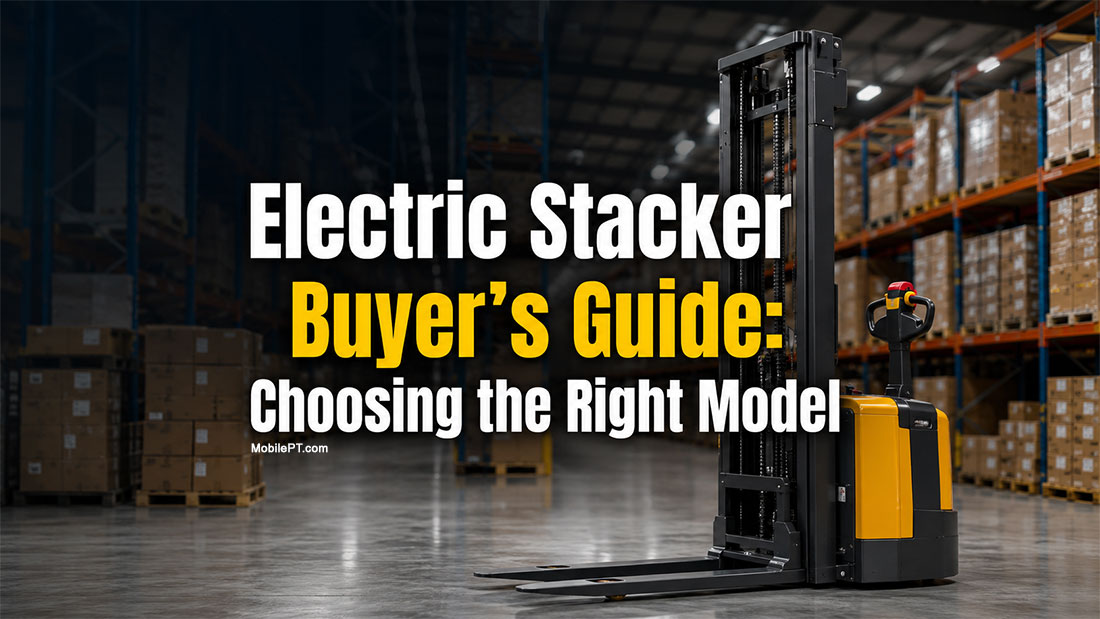
An Electric Stacker is a compact, battery-powered machine designed to move pallets and raise them into storage positions. It gives warehouses vertical lifting capability without requiring a full-size forklift for every task.
Choosing the wrong model creates expensive problems. It may not fit the pallet, reach the rack, last through the shift, or turn inside the working aisle.
This guide explains the main models, the specifications that matter, and how to choose the right equipment.
Electric Stacker: Quick Answer
| Question | Answer |
| What is an Electric Stacker? | A powered machine that transports and vertically lifts palletized loads |
| Best for | Warehouses, factories, stockrooms, and distribution centers |
| Main advantage | Compact vertical lifting and pallet stacking |
| Typical capacity | Approximately 2,000–4,400 lbs, depending on the model |
| Main alternatives | Manual Stacker, Powered Pallet Jack, Forklift |
| Key buying factors | Capacity, lift height, pallet type, aisle width, battery, and workload |
An Electric Stacker is usually the right choice when pallets must be raised above floor level but a forklift would be larger or more expensive than the application requires.
What Is an Electric Stacker?
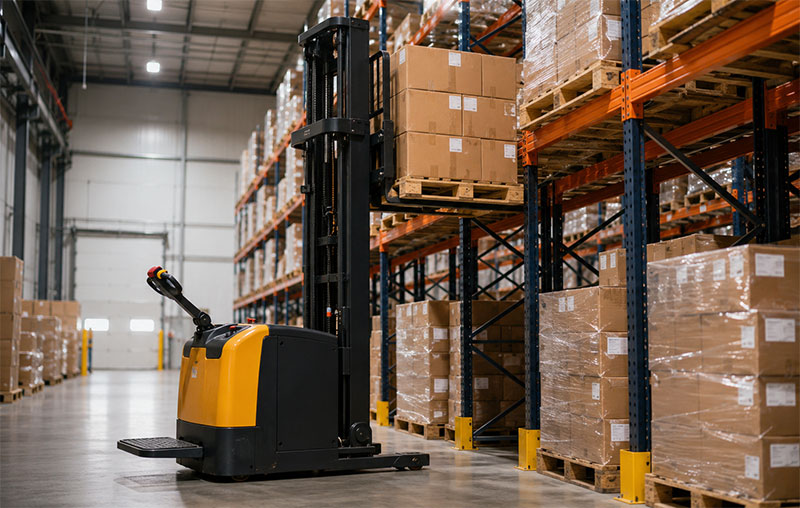
An Electric Stacker uses forks, a vertical mast, hydraulic lifting components, and a rechargeable battery to lift and position palletized loads.
The operator either walks behind the machine or rides on an integrated platform. Some models use electric power only for lifting. Full Electric Stackers use battery power for travel and lifting.
Unlike a standard pallet jack, an Electric Stacker can place pallets into warehouse racking, shelving, platforms, and other elevated positions.
Main Types of Electric Stackers
Semi-Electric Stacker
A semi-electric model uses battery power for lifting but must be moved manually. It is best for occasional stacking, short distances, lower pallet volumes, and smaller facilities.
Full Electric Walkie Stacker
A full electric walkie model powers travel and lifting. It is a strong general-purpose choice for narrow aisles, repeated pallet movement, and warehouse use.
Ride-On Electric Stacker
A ride-on model includes an operator platform. It is better for larger facilities, longer routes, high pallet volumes, and multi-shift operations.
Straddle or Fork-Over Stacker
A straddle stacker places support legs outside the pallet. A fork-over model positions the load forks above those legs. Pallet construction and rack dimensions must match the design.
Counterbalanced Electric Stacker
A counterbalanced model uses rear counterweight instead of front support legs. It handles more pallet configurations but requires additional turning room.
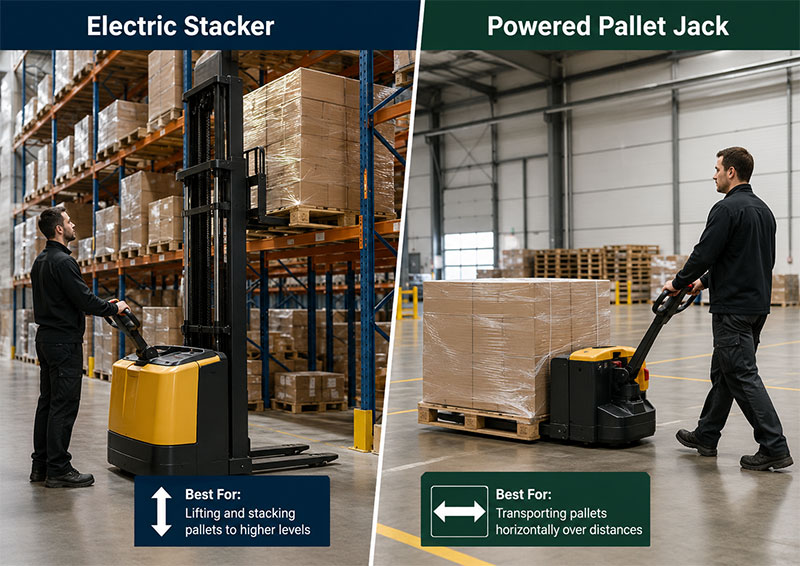
Electric Stacker vs Powered Pallet Jack
| Feature | Electric Stacker | Powered Pallet Jack |
| Ground-level transport | Good | Excellent |
| Vertical lifting | Yes | No |
| Rack placement | Yes | No |
| Long travel routes | Moderate | Better |
| Narrow aisle use | Excellent | Excellent |
| Main purpose | Lifting and stacking | Horizontal movement |
Choose an Electric Stacker when pallets must be raised.
Choose a Powered Pallet Jack when the main goal is moving pallets quickly across the warehouse floor.
Electric Stacker vs Forklift
| Feature | Electric Stacker | Forklift |
| Equipment size | Compact | Larger |
| Turning space | Lower | Higher |
| Initial investment | Generally lower | Generally higher |
| Heavy-duty capacity | Limited by model | Better |
| Outdoor use | Limited | Better with the correct model |
| Narrow aisle work | Excellent | Model dependent |
An Electric Stacker can reduce unnecessary forklift use for routine indoor stacking.
A forklift remains the better choice for heavy loads, outdoor surfaces, specialized attachments, or demanding multi-purpose work.
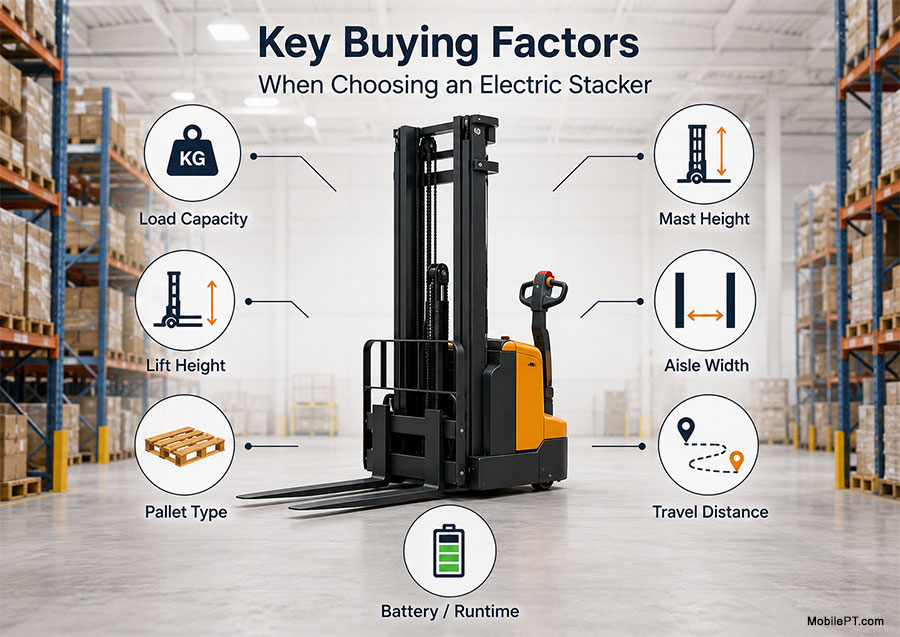
The 7 Most Important Buying Factors
1. Load Capacity
Start with the heaviest pallet the machine will actually lift.
Do not use average weight alone. Consider load center, pallet dimensions, weight distribution, attachments, and lift height. The data plate determines the approved capacity for the specific configuration.
2. Required Lift Height
Measure the highest rack position the pallet must reach, including pallet height, placement clearance, mast dimensions, ceiling obstructions, and doorways.
3. Pallet Type
Identify every pallet style used in the facility.
Open-bottom, closed-bottom, stringer, block, plastic, and custom pallets may require different stacker designs. Confirm fork entry and support-leg clearance before buying.
4. Aisle Width and Turning Radius
Measure both travel aisles and the working aisle used for rack placement.
The stacker must turn, square itself to the rack, enter the pallet, and withdraw safely. Include the load length when calculating space.
5. Mast Height and Free Lift
Check the mast when lowered and fully extended.
A low collapsed mast may be required for doors, trailers, mezzanines, or overhead obstructions. Free lift allows the forks to rise before the mast extends.
6. Travel Distance and Daily Volume
A semi-electric model may be enough for occasional use.
A full electric walkie model is usually better for repeated movement. A ride-on model may be justified for longer routes or high pallet volumes.
7.Battery, Parts, and Service
Confirm expected operating hours, charging time, number of shifts, battery maintenance, warranty coverage, replacement parts, and service support.
A lower purchase price offers little value when downtime interrupts daily operations.
Electric Stacker Selection Chart
| Operating Need | Recommended Model |
| Occasional lifting and short travel | Semi-Electric Stacker |
| Frequent work in narrow aisles | Full Electric Walkie Stacker |
| Long travel and high pallet volume | Ride-On Electric Stacker |
| Closed-bottom pallets | Counterbalanced Stacker |
| Compatible open-bottom pallets | Straddle or Fork-Over Stacker |
| Heavy outdoor or multi-purpose work | Forklift |
Relative Productivity by Stacker Type
Semi-Electric Stacker
██████████████ 60%
Full Electric Walkie Stacker
████████████████████ 85%
Ride-On Electric Stacker
███████████████████████ 95%
These percentages are illustrative. Actual productivity depends on travel distance, pallet volume, lift frequency, operator workflow, and facility layout.
Electric Stacker Buying Decision Framework
Use this five-step process before requesting quotes.
Step 1: Define the Load
Record maximum weight, dimensions, stability, and load center.
Step 2: Define the Pallet
Confirm pallet construction, entry direction, bottom boards, and fork openings.
Step 3: Define the Lift
Measure required fork height, rack clearance, mast clearance, and ceiling height.
Step 4: Define the Space
Measure aisles, doorways, ramps, elevators, trailers, rack openings, and turning areas.
Step 5: Define the Workload
Estimate pallets per hour, travel distance, operating hours, number of shifts, and future growth.
Once these details are clear, unsuitable models can be eliminated quickly.
Common Electric Stacker Buying Mistakes
Avoid these mistakes:
✘ Choosing capacity based only on average loads
✘ Ignoring load center and weight distribution
✘ Selecting the wrong design for the pallet type
✘ Measuring travel aisles but not stacking aisles
✘ Forgetting mast clearance beneath doors and ceilings
✘ Underestimating battery runtime
✘ Choosing manual travel for high-volume work
✘ Buying only on initial price
✘ Overlooking parts and service availability
Safety and Operator Training
Electric Stackers must be operated according to the manufacturer’s instructions, the equipment data plate, and workplace safety requirements.
Operators should understand rated capacity, load center, stability, controls, inspections, charging, pedestrian safety, ramps, docks, and safe stacking procedures.
In the United States, employers must ensure powered industrial truck operators receive training and evaluation for the equipment and workplace conditions involved.
How an Electric Stacker Fits Into a Complete Fleet
A balanced warehouse fleet may include:
- Manual pallet jacks for occasional short moves
- Powered pallet jacks for frequent horizontal travel
- Electric Stackers for vertical storage
- Lift Tables for ergonomic work positioning
- Ride-on pallet trucks for longer routes
- Forklifts for heavier applications
The goal is not to buy the largest machine. It is to match each machine to the task it performs most often.
Final Thoughts
An Electric Stacker can be an excellent investment for facilities that need compact vertical lifting.
The correct model can improve pallet flow, support rack storage, reduce effort, and limit forklift use.
Define the load, pallet, lift height, aisle space, travel distance, battery requirements, and daily workload before choosing a model.
Mobile Industries supplies manual, semi-electric, and full Electric Stackers for many material handling applications. Explore Electric Stackers, Powered Pallet Jacks, Lift Tables, and other equipment at MobilePT.com.
Frequently Asked Questions
What is an Electric Stacker?
An Electric Stacker is a battery-powered machine that raises palletized loads into racking, shelving, platforms, or other elevated positions.
What is the difference between an Electric Stacker and an electric pallet jack?
An Electric Stacker has a mast and lifts pallets vertically. An electric pallet jack primarily transports pallets at floor level.
How much weight can an Electric Stacker lift?
Many models handle approximately 2,000 to 4,400 pounds. Approved capacity can change according to lift height, load center, and configuration.
How high can an Electric Stacker lift?
Lift height varies by model. Low-lift machines may raise loads only a few feet, while high-mast stackers can reach elevated warehouse racking.
Can an Electric Stacker replace a forklift?
It can replace a forklift for many light-to-medium indoor stacking tasks. It may not suit heavy loads, rough outdoor surfaces, or specialized attachments.
Is a semi-electric or full Electric Stacker better?
A semi-electric model may be enough for occasional use. A full Electric Stacker is usually better for frequent handling, longer distances, and heavier daily workloads.
Does an Electric Stacker require operator training?
Yes. Operators should receive equipment-specific and workplace-specific training before using an Electric Stacker.
Where can I buy an Electric Stacker in the USA?
Mobile Industries supplies Electric Stackers, Powered Pallet Jacks, Lift Tables, pallet trucks, and other warehouse equipment at MobilePT.com.