
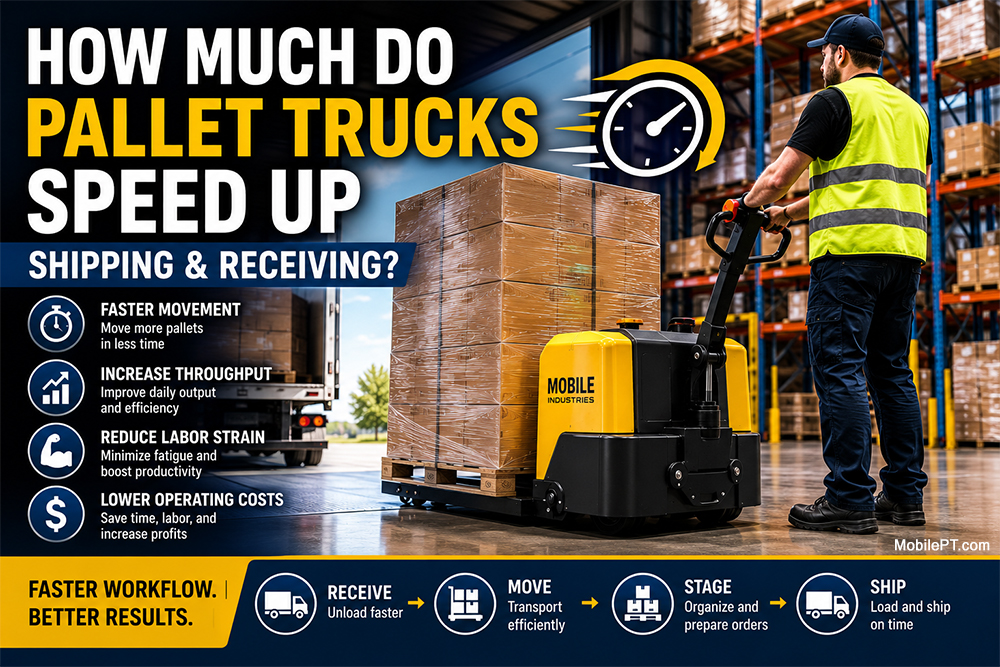
In most warehouses, shipping and receiving are the busiest areas of the operation.
Products arrive.
Products leave.
Pallets constantly move between trucks, staging areas, storage locations, and production floors.
The faster these movements happen, the more efficient the warehouse becomes.
That’s where pallet trucks make a major difference.
Whether you’re using a manual pallet truck, electric pallet truck, or powered pallet truck, the right equipment can dramatically improve workflow.
But how much do pallet trucks actually speed up shipping and receiving?
The answer depends on several factors.
Travel distance.
Load weight.
Warehouse layout.
Equipment type.
And daily pallet volume.
In this guide, we’ll break down the productivity impact of pallet trucks and explain where warehouses typically see the biggest gains.
Quick Answer
A pallet truck can significantly improve shipping and receiving efficiency by reducing the time required to move palletized loads throughout a warehouse.
Compared to moving loads manually or using inefficient workflows, pallet trucks can:
✓ Speed up pallet movement
✓ Reduce loading and unloading times
✓ Improve staging efficiency
✓ Increase daily throughput
✓ Reduce worker fatigue
✓ Improve overall warehouse productivity
Electric pallet trucks often provide the largest productivity gains in medium and large warehouse environments.
Why Shipping And Receiving Efficiency Matters
Shipping and receiving are often the heartbeat of a warehouse.
If products cannot move efficiently through these departments, delays occur throughout the operation.
Common consequences include:
✗ Slower truck turnaround times
✗ Shipping delays
✗ Congested staging areas
✗ Reduced productivity
✗ Increased labor costs
✗ Customer service issues
Even small inefficiencies can compound quickly.
That’s why material handling equipment plays such an important role.
What Is A Pallet Truck?
A pallet truck is a material handling device designed to lift and move palletized loads at ground level.
Common types include:
- Manual pallet trucks
- Electric pallet trucks
- Powered pallet trucks
- Lithium-powered pallet trucks
Each serves a similar purpose.
Move pallets quickly and efficiently.
The difference is how much operator effort is required.
Shipping And Receiving Workflow Overview
Let’s look at a typical receiving process.
Without A Pallet Truck
Workers must:
- Unload products
- Move loads manually
- Reposition inventory
- Transport products to staging
This process is slower and more physically demanding.
With A Pallet Truck
Workers can:
✓ Lift pallets quickly
✓ Move larger loads efficiently
✓ Reduce manual handling
✓ Transport products faster
✓ Improve workflow consistency
The result is a more productive operation.
Typical Productivity Gains
The actual productivity improvement varies.
However, most warehouses experience measurable gains after implementing pallet trucks.
Relative Productivity Comparison
| Equipment | Relative Productivity | Visual |
| Manual Handling | 100% | ██████████ |
| Manual Pallet Truck | 130–150% | █████████████ |
| Electric Pallet Truck | 150–180% | █████████████████ |
| Powered Pallet Truck | 160–200% | ██████████████████ |
The larger the warehouse, the more noticeable the improvement becomes.
How Pallet Trucks Improve Receiving Efficiency
Receiving departments often experience the first productivity gains.
Inbound products need to move quickly.
Delays create congestion.
A pallet truck allows operators to unload and transport goods faster.
Benefits In Receiving
✓ Faster unloading
✓ Reduced bottlenecks
✓ Improved staging
✓ Better inventory flow
✓ Reduced labor strain
This helps products reach storage locations sooner.
How Pallet Trucks Improve Shipping Efficiency
Shipping departments face similar challenges.
Orders must move from storage to staging and eventually onto outbound trucks.
Every minute matters.
Shipping Improvements
| Activity | Impact Level |
| Order Staging | High |
| Truck Loading | High |
| Dock Operations | High |
| Cross Docking | High |
| Inventory Transfers | Medium |
| Replenishment | Medium |
The faster pallets move, the faster orders leave the facility.
Manual Pallet Truck vs Electric Pallet Truck
One of the biggest questions warehouse managers ask is whether electric pallet trucks provide meaningful speed advantages.
The answer is usually yes.
Especially when travel distances increase.
Comparison Table
| Feature | Manual Pallet Truck | Electric Pallet Truck |
| Travel Speed | Moderate | High |
| Operator Effort | High | Low |
| Long Distances | Moderate | Excellent |
| Heavy Loads | Moderate | Excellent |
| Productivity | Moderate | High |
Manual pallet trucks remain useful.
But electric pallet trucks often improve efficiency in larger operations.
Travel Distance Has A Huge Impact
Many businesses underestimate this factor.
The farther pallets travel, the greater the benefit of powered equipment.
Productivity Impact By Travel Distance
| Travel Distance | Manual Pallet Truck | Electric Pallet Truck |
| Under 50 ft | Similar Performance | Similar Performance |
| 50–150 ft | Moderate Advantage | Better Choice |
| 150–300 ft | Significant Advantage | Strongly Recommended |
| 300+ ft | Inefficient | Best Choice |
Longer routes magnify productivity gains.
Heavy Loads Slow Down Operations
Pallet weight matters.
A 1,000 lb pallet is very different from a 5,000 lb pallet.
As weight increases, manual movement becomes more difficult.
Load Handling Efficiency
| Load Weight | Manual Pallet Truck | Electric Pallet Truck |
| Under 2,000 lbs | Excellent | Excellent |
| 2,000–4,000 lbs | Good | Excellent |
| 4,000–5,500 lbs | Moderate | Excellent |
| 5,500+ lbs | Difficult | Better Choice |
Heavier loads generally favor powered equipment.
Common Industries Seeing The Biggest Gains
Certain industries benefit more than others.
High-Impact Industries
- Warehousing
- Distribution Centers
- Manufacturing
- Food & Beverage
- Automotive Parts
- Logistics
- Retail Distribution
- E-Commerce Fulfillment
These industries often move hundreds or thousands of pallets daily.
Signs Your Shipping And Receiving Process Is Slowing Down
Many businesses don’t realize inefficiencies are costing them money.
Watch for these warning signs.
✗ Truck loading delays
✗ Congested dock areas
✗ Growing labor costs
✗ Excessive overtime
✗ Worker fatigue complaints
✗ Increasing order volume
✗ Slow inventory movement
These indicators often suggest better material handling equipment is needed.
How Much Time Can Pallet Trucks Save?
Every operation is different.
However, many warehouses report:
✓ Faster truck unloading
✓ Faster truck loading
✓ Improved staging efficiency
✓ Reduced labor hours
✓ Increased daily pallet throughput
Even saving a few minutes per pallet can add up quickly across hundreds of loads.
Example Daily Impact
| Daily Pallets Moved | Time Saved Per Pallet | Daily Time Saved |
| 50 Pallets | 2 Minutes | 100 Minutes |
| 100 Pallets | 2 Minutes | 200 Minutes |
| 200 Pallets | 2 Minutes | 400 Minutes |
| 500 Pallets | 2 Minutes | 1,000 Minutes |
Small improvements create significant gains at scale.
Common Buying Mistakes
Many warehouses focus only on upfront equipment cost.
That can be expensive in the long run.
Avoid these mistakes.
✗ Buying only on price
✗ Ignoring travel distances
✗ Underestimating growth
✗ Choosing insufficient capacity
✗ Overlooking labor costs
✗ Waiting too long to upgrade
The goal isn’t simply buying equipment.
The goal is improving efficiency.
How To Choose The Right Pallet Truck
Before purchasing, consider:
Daily Pallet Volume
Higher volume usually favors electric equipment.
Travel Distance
Longer distances increase the value of powered movement.
Load Weight
Heavier loads justify stronger equipment.
Warehouse Layout
Aisle width and workflow matter.
Future Growth
Always consider where the business will be in several years.
Not just where it is today.
Final Thoughts
So, how much do pallet trucks speed up shipping and receiving?
For many warehouses, the answer is significantly.
Pallet trucks reduce manual effort, improve workflow, and help products move more efficiently through receiving, staging, storage, and shipping operations.
Manual pallet trucks remain effective for smaller facilities.
Electric pallet trucks and powered pallet trucks often deliver the largest productivity gains in medium and large warehouse environments.
The right equipment helps reduce delays, improve throughput, and support long-term operational growth.
Mobile Industries offers a wide range of pallet trucks, electric pallet trucks, powered pallet trucks, and warehouse material handling solutions designed to improve shipping and receiving efficiency.
Visit MobilePT.com to learn more.
Frequently Asked Questions
How much faster is a pallet truck compared to manual handling?
Many warehouses experience productivity improvements of 30% to 100% or more when using pallet trucks compared to manual handling methods.
Do electric pallet trucks improve shipping efficiency?
Yes. Electric pallet trucks often improve shipping efficiency by reducing travel times and operator fatigue.
Are pallet trucks useful in receiving departments?
Absolutely. Pallet trucks help unload, stage, and transport incoming products more efficiently.
When should I upgrade to an electric pallet truck?
If pallet volumes are increasing, travel distances are long, or employees are experiencing fatigue, it may be time to upgrade.
What industries benefit most from pallet trucks?
Warehousing, manufacturing, logistics, food distribution, retail distribution, and e-commerce fulfillment operations commonly benefit from pallet trucks.