
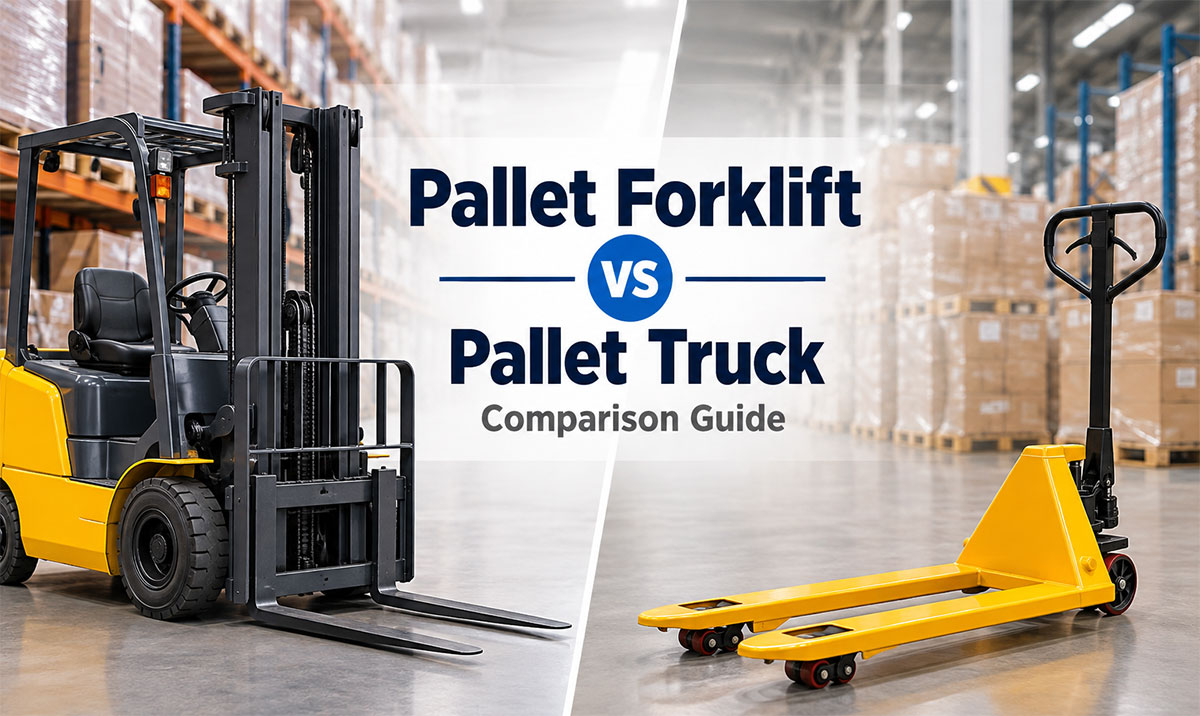
A pallet forklift and a pallet truck can both move palletized loads, but they are designed for very different jobs.
A pallet truck is primarily used to move pallets horizontally at floor level. A forklift can transport pallets while also lifting them vertically into warehouse racks, loading trailers, and handling heavier or more demanding material-handling applications.
For many warehouses, the decision is not about choosing one machine for everything. It is about matching the equipment to the task.
This guide compares pallet forklifts and pallet trucks by capacity, lift height, travel distance, maneuverability, cost, operator requirements, and the applications where each performs best.
Pallet Forklift vs Pallet Truck: Quick Answer
| Question | Pallet Forklift | Pallet Truck |
|---|---|---|
| Primary purpose | Lift, stack, and transport pallets | Move pallets horizontally |
| Vertical lifting | Yes | Minimal |
| Rack placement | Yes | No |
| Best travel distance | Medium to long | Short to medium |
| Maneuverability | Requires more room | Excellent in tight spaces |
| Typical cost | Higher | Lower |
| Operator position | Usually seated or standing | Walk-behind or ride-on |
| Best application | Heavy lifting and elevated storage | Floor-level pallet movement |
Choose a pallet truck when pallets mainly need to move across the floor. Choose a forklift when pallets must also be lifted, stacked, or placed into elevated storage.
What Is a Pallet Forklift?
The term pallet forklift generally refers to a forklift being used to transport and vertically position palletized loads.
A forklift typically includes:
- A vertical mast
- Adjustable forks
- Hydraulic lifting equipment
- A counterweight or stabilizing design
- Operator controls
- Powered travel
- Braking and steering systems
The forks slide beneath the pallet, allowing the machine to raise the entire load.
Unlike a pallet truck, a forklift can lift the pallet several feet or more above the floor depending on the truck and mast configuration.
Forklifts are commonly used for:
- Loading and unloading trucks
- Placing pallets into warehouse racks
- Removing pallets from elevated storage
- Moving heavy materials
- Manufacturing operations
- Outdoor material handling
- High-volume warehouse work
The Occupational Safety and Health Administration classifies forklifts as powered industrial trucks and provides requirements and guidance covering their operation, workplace conditions, and operator training.
What Is a Pallet Truck?
A pallet truck is a compact material-handling device designed to raise a pallet slightly off the floor and move it horizontally.
It may also be called a:
- Pallet jack
- Hand pallet truck
- Electric pallet truck
- Powered pallet jack
- Pump truck
Manual pallet trucks use a hydraulic pump and operator effort for movement.
Electric models use battery power for travel, lifting, or both.
Pallet trucks are commonly used for:
- Receiving
- Shipping
- Staging
- Order picking
- Inventory repositioning
- Trailer unloading
- Production support
- Short-distance warehouse movement
For a detailed explanation of the equipment category, read What Is a Pallet Truck? Complete Guide for Warehouses.
Pallet Forklift vs Pallet Truck: Main Differences
| Feature | Pallet Forklift | Pallet Truck |
|---|---|---|
| Horizontal transport | Excellent | Excellent |
| Vertical lifting | Excellent | Very limited |
| Warehouse rack storage | Yes | No |
| Tight-space operation | Moderate | Excellent |
| Heavy loads | Excellent | Model dependent |
| Long travel routes | Excellent | Model dependent |
| Trailer use | Good | Excellent |
| Outdoor use | Model dependent | Usually limited |
| Specialized attachments | Available | Limited |
| Initial investment | Higher | Lower |
| Operator training | More extensive | Depends on equipment type |
The biggest difference is lift height.
A pallet truck lifts a pallet only enough to clear the floor.
A forklift raises pallets vertically for stacking, loading, unloading, and elevated storage.
When a Pallet Truck Is the Better Choice
A pallet truck is usually the better choice when vertical lifting is not required.
Floor-Level Pallet Movement
Warehouses constantly move pallets between:
- Receiving areas
- Storage zones
- Production departments
- Packing stations
- Staging lanes
- Shipping docks
A pallet truck handles these movements without the size and complexity of a forklift.
Tight Warehouse Spaces
Pallet trucks typically have a smaller footprint and turning radius.
They work well in:
✓ Narrow aisles
✓ Trailers
✓ Retail stockrooms
✓ Compact warehouses
✓ Crowded staging areas
✓ Shipping departments
A forklift may be unnecessary when the load only needs to travel across a smooth warehouse floor.
Short and Medium Travel Distances
Manual pallet trucks work well for occasional short-distance moves.
Powered pallet trucks become more useful as travel distance and pallet volume increase.
If your operation moves pallets frequently, the Powered Pallet Jack: Complete Buyer’s Guide explains how to evaluate electric models, batteries, capacities, and operating styles.
Lower Equipment Cost
Pallet trucks generally cost less than forklifts.
They may also require:
- Less storage space
- Simpler maintenance
- Smaller batteries
- Fewer facility modifications
- Lower operating expenses
For straightforward floor-level movement, purchasing a forklift may mean paying for lifting capability the application rarely uses.
When a Pallet Forklift Is the Better Choice
A forklift becomes necessary when the work goes beyond horizontal movement.
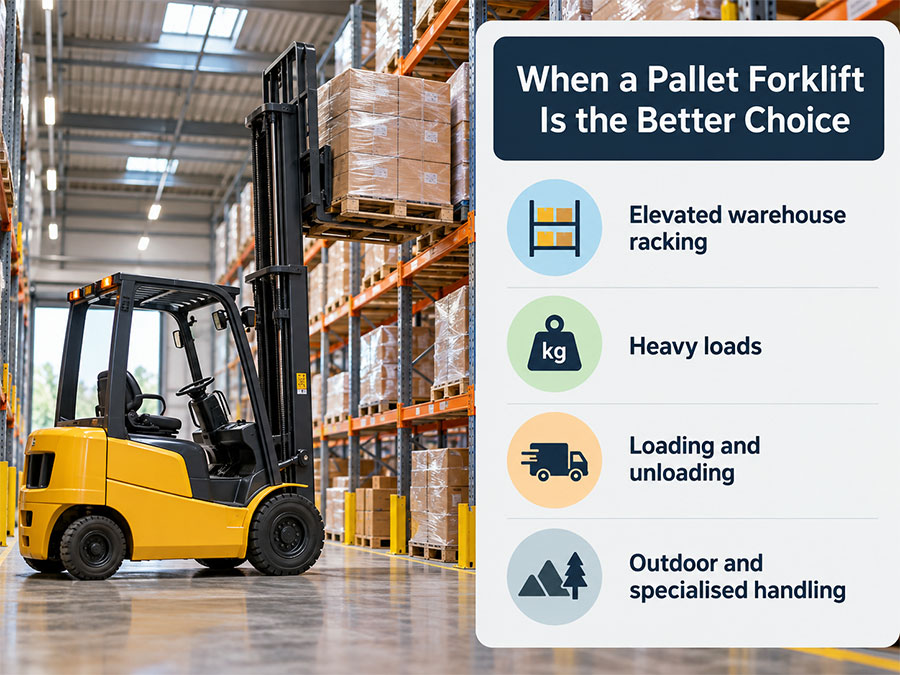
Elevated Warehouse Racking
This is the clearest dividing line.
A pallet truck cannot place a pallet into elevated rack storage.
A forklift can lift pallets from the floor and position them onto rack beams at different heights.
Heavy Loads
Forklifts are available in a broad range of capacities for heavier industrial loads.
They are commonly used for:
- Building materials
- Machinery
- Manufacturing components
- Bulk products
- Dense palletized inventory
- Oversized loads
The correct forklift capacity depends on the load center, attachment, mast configuration, and lift height.
Loading and Unloading
Forklifts can remove pallets from trucks, move them across docks, and place them directly into storage.
This can eliminate additional material-handling steps in high-volume operations.
Outdoor Applications
Properly configured forklifts can operate in yards, loading areas, and other outdoor environments.
Most standard warehouse pallet trucks are better suited to hard, smooth, level surfaces.
Specialized Handling
Forklifts may support attachments such as:
- Fork positioners
- Side shifters
- Clamps
- Rotators
- Drum handlers
- Extended forks
These attachments make forklifts more versatile when a facility handles different types of loads.
Pallet Forklift vs Manual Pallet Truck
| Feature | Forklift | Manual Pallet Truck |
|---|---|---|
| Powered travel | Yes | No |
| Vertical stacking | Yes | No |
| Initial cost | High | Low |
| Maintenance | More complex | Simple |
| Tight-space use | Moderate | Excellent |
| Heavy workload | Excellent | Limited |
| Short occasional moves | Overqualified | Excellent |
| Operator effort | Low | Higher |
A manual pallet truck remains one of the simplest solutions for moving pallets short distances.
A forklift should not be used simply because one is available if a smaller machine can complete the task efficiently.
Pallet Forklift vs Electric Pallet Truck
Electric pallet trucks narrow the productivity gap between manual pallet jacks and forklifts.
| Feature | Forklift | Electric Pallet Truck |
|---|---|---|
| Powered travel | Yes | Yes |
| Powered lifting | Yes | Yes |
| Elevated rack placement | Yes | No |
| Long travel | Excellent | Good to excellent |
| Tight spaces | Moderate | Excellent |
| Operator effort | Low | Low |
| Equipment footprint | Larger | Smaller |
| Best use | Lift and transport | Floor-level transport |
A powered pallet truck can be an excellent choice when the warehouse moves a high volume of pallets but does not need vertical rack placement.
Pallet Forklift vs Electric Stacker
There is also a middle option between a pallet truck and a full-size forklift.
An Electric Stacker can transport pallets and raise them into storage positions while remaining more compact than many conventional forklifts.
| Feature | Pallet Truck | Electric Stacker | Forklift |
|---|---|---|---|
| Floor transport | Excellent | Good | Excellent |
| Vertical lifting | No | Yes | Yes |
| Rack placement | No | Yes | Yes |
| Equipment size | Small | Medium | Larger |
| Capacity range | Light to heavy | Light to medium | Medium to very heavy |
| Tight aisles | Excellent | Excellent | Model dependent |
| Outdoor work | Limited | Limited | Better with suitable model |
An Electric Stacker may be the right choice when a pallet truck cannot lift high enough but a full-size forklift is more machine than the operation requires.
Read the Electric Stacker Buyer’s Guide: Choosing the Right Model for a detailed breakdown of stacker configurations and buying factors.
Relative Equipment Capability
Manual Pallet Truck
██████████ 40%
Electric Pallet Truck
██████████████ 60%
Electric Stacker
██████████████████ 78%
Forklift
██████████████████████ 95%
These percentages are illustrative and represent overall material-handling versatility rather than a universal productivity rating.
A pallet truck can still outperform a forklift for simple floor-level movement in a tight warehouse.
How to Choose Between a Pallet Forklift and Pallet Truck
1. Determine Whether You Need Vertical Lift
Ask one question first:
Does the pallet need to go into elevated storage?
If yes, you need a forklift, stacker, or another high-lift machine.
If no, a pallet truck may be enough.
2. Calculate Maximum Load Weight
Record the heaviest complete load.
Include:
- Product
- Pallet
- Packaging
- Containers
- Fixtures
Do not choose equipment based only on average weight.
3. Measure Travel Distance
For occasional short trips, a manual pallet truck may be sufficient.
For frequent or longer travel, consider an electric pallet truck.
For longer routes combined with vertical lifting, a forklift may be more appropriate.
4. Measure Aisle Width
Include the complete load when evaluating turning room.
The machine must be able to:
- Enter the aisle
- Turn safely
- Approach the pallet
- Pick up the load
- Reverse
- Exit the space
A compact pallet truck may perform better than a forklift in tight areas.
5. Review Floor and Outdoor Conditions
Smooth indoor concrete is ideal for most pallet trucks.
Outdoor surfaces, uneven floors, grades, and rough environments may require a more capable forklift.
6. Calculate Daily Pallet Volume
A machine moving five pallets per day has very different requirements from one moving hundreds.
Higher usage can justify powered travel, rider equipment, or a forklift.
Pallet Forklift vs Pallet Truck Decision Guide
| Warehouse Requirement | Best Direction |
|---|---|
| Occasional short pallet moves | Manual Pallet Truck |
| Frequent floor-level movement | Electric Pallet Truck |
| Tight aisles and trailers | Pallet Truck |
| Low or medium rack storage | Electric Stacker or Forklift |
| High rack placement | Forklift |
| Heavy industrial loads | Forklift |
| Outdoor material handling | Suitable Forklift |
| High-volume horizontal transport | Powered Pallet Truck |
| Specialized load attachments | Forklift |
Cost Considerations
Purchase price is only one part of equipment cost.
Consider:
- Maintenance
- Batteries or fuel
- Charging infrastructure
- Operator training
- Parts availability
- Inspection requirements
- Equipment storage
- Downtime
- Expected service life
The lowest-cost solution is usually the machine that performs the required task reliably without adding unnecessary capability.
Common Buying Mistakes
Avoid these mistakes:
✘ Buying a forklift when the work is entirely floor-level
✘ Buying a pallet truck when rack storage is required
✘ Ignoring aisle width
✘ Underestimating maximum pallet weight
✘ Forgetting travel distance
✘ Choosing manual equipment for high-volume work
✘ Ignoring floor and outdoor conditions
✘ Selecting equipment based only on purchase price
✘ Failing to consider future warehouse growth
Final Thoughts
The Pallet Forklift vs Pallet Truck decision comes down to what must happen to the pallet after it is picked up.
If the pallet only needs to move across the warehouse floor, a pallet truck is often the simplest, most maneuverable, and most cost-effective choice.
If the pallet needs to be lifted into racking, handled at significant heights, moved outdoors, or used in demanding industrial applications, a forklift may be the better solution.
Electric Stackers can also bridge the gap for warehouses that need vertical lifting without the size of a conventional forklift.
Before purchasing, evaluate load weight, lift height, travel distance, aisle width, pallet volume, floor conditions, operating environment, and future growth.
The best material-handling fleet often uses several equipment types rather than forcing one machine to perform every job.
Mobile Industries supplies manual and electric pallet trucks, Powered Pallet Jacks, Electric Stackers, and other material-handling equipment for warehouses and industrial facilities throughout the United States through MobilePT.com.
Frequently Asked Questions
What is the difference between a pallet forklift and a pallet truck?
A pallet truck primarily moves pallets horizontally at floor level, while a forklift can move pallets horizontally and lift them vertically into warehouse racks or other elevated positions.
Can a pallet truck replace a forklift?
A pallet truck can replace a forklift for many floor-level transport tasks. It cannot replace a forklift when pallets need to be stacked or placed into elevated storage.
Which is better for narrow warehouse aisles?
A pallet truck is generally more maneuverable in tight spaces because it has a smaller footprint and turning radius than a conventional forklift.
Is an electric pallet truck the same as a forklift?
No. An electric pallet truck uses battery power to move pallets at floor level. A forklift includes a mast that allows pallets to be raised to significantly greater heights.
Which costs less, a forklift or pallet truck?
Pallet trucks generally have a lower purchase price and simpler operating requirements. Forklifts cost more but provide greater lifting height, capacity, and versatility.
Can pallet trucks be used inside trailers?
Yes. Pallet trucks are commonly used inside trailers because their compact design works well in confined spaces, provided the trailer floor and load conditions are suitable.
When should I choose an Electric Stacker instead of a forklift?
An Electric Stacker can be a good choice when you need vertical pallet lifting in a compact indoor warehouse but do not require the capacity, outdoor performance, or versatility of a full-size forklift.
What should I consider before buying a pallet truck or forklift?
Evaluate maximum load weight, required lift height, travel distance, aisle width, pallet dimensions, floor conditions, daily workload, operator requirements, and whether the equipment will be used indoors or outdoors.
Where can I buy pallet trucks in the USA?
Mobile Industries supplies manual pallet trucks, electric pallet trucks, Powered Pallet Jacks, Electric Stackers, and other material-handling equipment through MobilePT.com.