
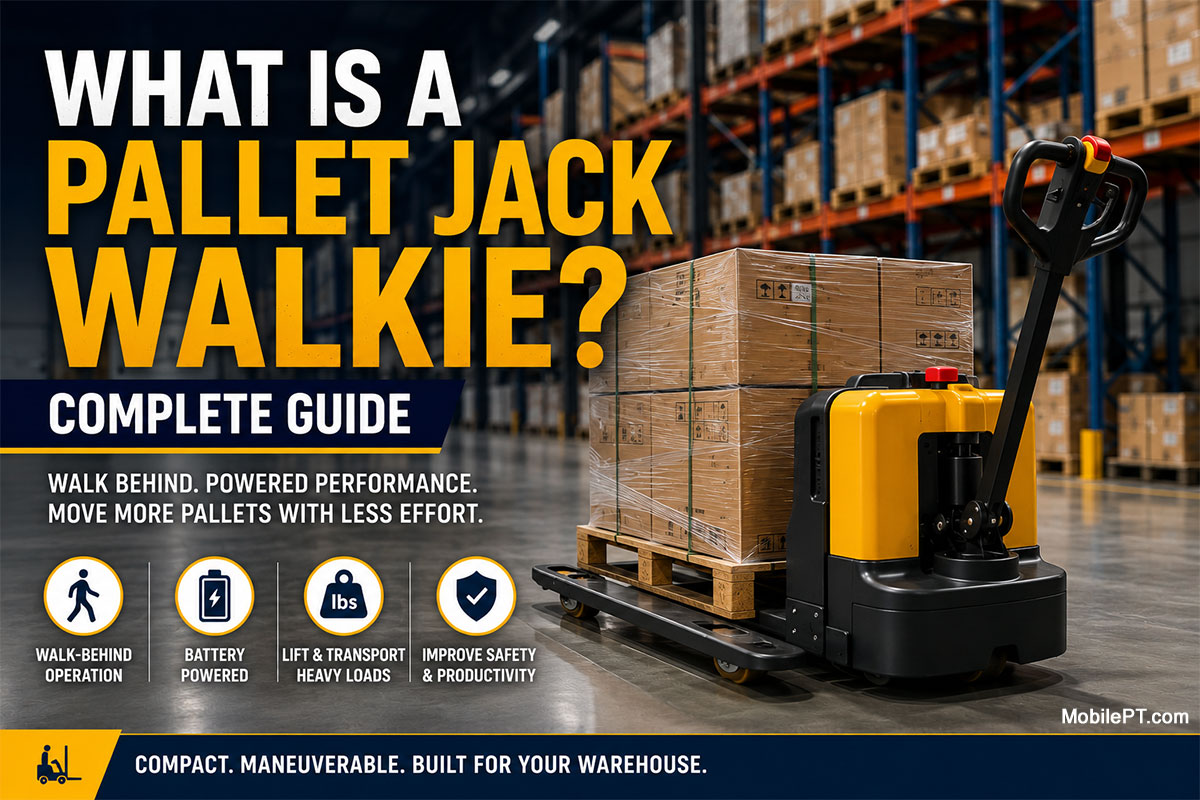
A Pallet Jack Walkie is a compact, battery-powered machine designed to lift and transport palletized loads while the operator walks behind it. It combines the simplicity of a manual pallet jack with powered travel, helping warehouse teams move heavier loads with less physical effort.
Walkie pallet jacks are commonly used in warehouses, distribution centers, manufacturing plants, retail stockrooms, shipping departments, and loading areas. They are especially valuable when workers move pallets frequently but do not need the speed, size, or cost of a ride-on pallet truck or forklift.
The term Pallet Jack Walkie may sound unusual because equipment suppliers more commonly use names such as walkie pallet jack, walk-behind pallet jack, electric pallet jack, or powered pallet jack. In most cases, these terms describe closely related equipment operated by a person walking beside or behind the machine.
This guide explains how a Pallet Jack Walkie works, where it performs best, how it compares with other warehouse equipment, and what to consider before buying one.
Pallet Jack Walkie: Quick Answer
| Question | Answer |
| What is a Pallet Jack Walkie? | A battery-powered pallet jack operated by a person walking behind it. |
| What does “walkie” mean? | The operator walks with the equipment instead of riding on it. |
| Best for | Short-to-medium warehouse travel and frequent pallet movement |
| Typical capacity | Approximately 3,000–6,000 lbs, depending on the model |
| Main advantage | Powered travel with lower operator effort |
| Common alternatives | Manual Pallet Jack, Ride-On Pallet Truck, Electric Stacker |
A Pallet Jack Walkie is usually the right choice when a warehouse needs more productivity than a manual pallet jack can provide but does not require a rider-style machine.
What Is a Pallet Jack Walkie?
A Pallet Jack Walkie is an electric material handling machine with two forks that enter a pallet, a powered hydraulic lifting system, and an electric drive motor.
The operator controls the equipment using a handle or tiller arm. Typical controls include:
- Forward and reverse travel
- Fork raising and lowering
- Speed adjustment
- Emergency reverse protection
- Horn
- Braking controls
Once the forks are positioned beneath the pallet, the operator raises the load slightly above the floor and uses powered travel to move it.
Unlike a manual pallet jack, the operator does not need to push or pull the full pallet weight. The motor moves the load, while the operator walks behind the machine and guides it through the facility.
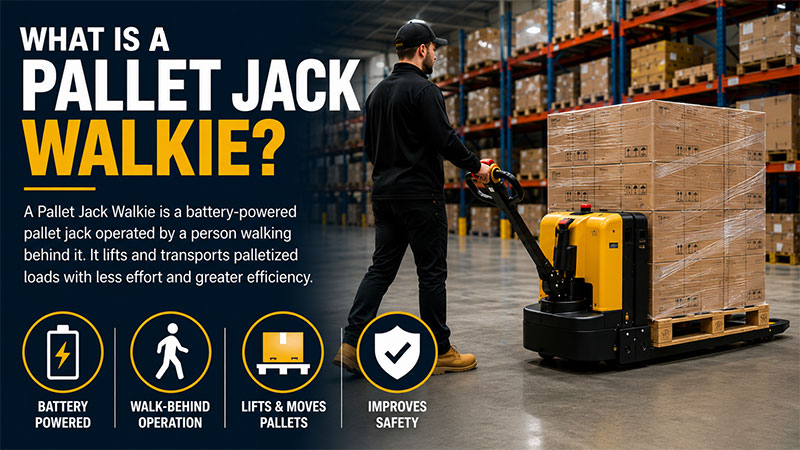
Why Is It Called a Walkie Pallet Jack?
The word “walkie” describes the operator position.
With a walkie-style machine:
- The operator remains on foot
- The operator walks behind or beside the equipment
- There is no standing platform or operator seat
- The machine is controlled through the tiller handle
This design makes walkie pallet jacks compact and easy to maneuver in tighter warehouse spaces.
A ride-on pallet truck, by comparison, includes a platform or operator compartment that allows the user to travel on the machine.
How Does a Walkie Pallet Jack Work?
A Pallet Jack Walkie uses three primary systems.
Electric Drive System
A battery powers the drive motor, allowing the equipment to move forward and backward without manual pushing.
Hydraulic Lift System
The forks rise enough to lift the pallet clear of the floor. A Pallet Jack Walkie is designed for ground-level transportation, not high stacking.
Tiller Handle Controls
The operator uses the handle to control:
- Direction
- Travel speed
- Braking
- Fork height
- Emergency stopping
The tiller arm also helps the operator steer the machine around corners, through aisles, and into trailers or staging areas.
Where Are Pallet Jack Walkies Used?
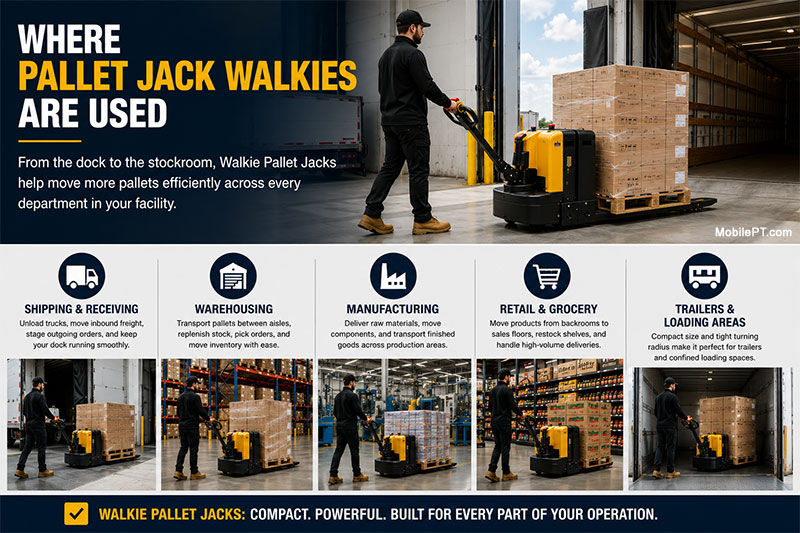
Walkie pallet jacks are highly versatile and can support many departments within a facility.
Shipping and Receiving
Common tasks include:
- Unloading incoming pallets
- Moving freight from dock areas
- Staging outbound orders
- Positioning pallets for shipment
- Moving goods into inspection areas
Warehousing
Walkie models help with:
- Replenishment
- Order fulfillment
- Inventory transfers
- Pallet staging
- Moving products between warehouse zones
Manufacturing
Production teams use them for:
- Delivering components
- Moving raw materials
- Transporting finished goods
- Supporting assembly lines
- Removing completed pallets
Retail and Grocery Operations
Walkie pallet jacks are frequently used for:
- Stockroom handling
- Store replenishment
- Grocery distribution
- Beverage movement
- Moving bulk merchandise
Pallet Jack Walkie Productivity Comparison
The best equipment depends on how far pallets travel and how often they are moved.
Relative Pallet-Moving Productivity
Manual Pallet Jack
███████████ 45%
Pallet Jack Walkie
█████████████████████ 85%
Ride-On Pallet Truck
████████████████████████ 95%
These percentages are illustrative, but they demonstrate the operational difference. A walkie pallet jack can significantly reduce the time and physical effort required to move pallets throughout a facility.
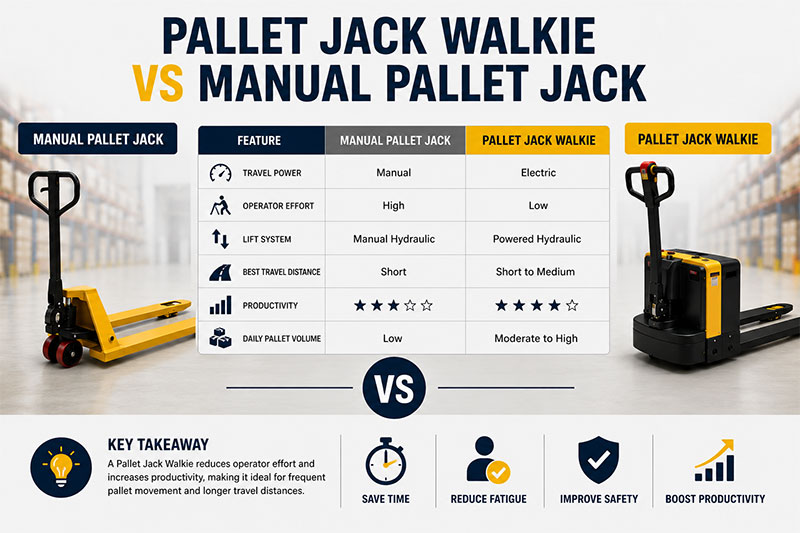
Pallet Jack Walkie vs Manual Pallet Jack
| Feature | Manual Pallet Jack | Pallet Jack Walkie |
| Travel power | Manual | Electric |
| Lift operation | Manual hydraulic | Powered hydraulic |
| Operator effort | High | Low |
| Best travel distance | Short | Short to medium |
| Daily pallet volume | Low | Moderate to high |
| Initial cost | Lower | Higher |
| Battery required | No | Yes |
| Productivity | Moderate | High |
A manual pallet jack remains practical for occasional pallet movement and very short distances.
A Pallet Jack Walkie becomes more valuable when:
- Pallets are moved repeatedly
- Loads are heavy
- Travel routes are longer
- Workers experience fatigue
- Faster material flow is needed
For a broader look at powered models, read our Powered Pallet Jack Buyer’s Guide.
Pallet Jack Walkie vs Powered Pallet Jack
A Pallet Jack Walkie is a type of powered pallet jack.
The difference is mainly terminology.
| Term | Typical Meaning |
| Powered Pallet Jack | General category of motorized pallet-moving equipment |
| Walkie Pallet Jack | Powered model operated by a person walking |
| Ride-On Pallet Jack | Powered model with a platform or operator compartment |
| Electric Pallet Jack | Broad term for battery-powered pallet jacks |
| Walk-Behind Pallet Jack | Another name for a walkie pallet jack |
When comparing products, focus on the machine’s specifications rather than the name alone.
Walkie Pallet Jack vs Ride-On Pallet Truck
| Feature | Walkie Pallet Jack | Ride-On Pallet Truck |
| Operator position | Walking | Riding |
| Best distance | Short to medium | Medium to long |
| Maneuverability | Excellent | Moderate |
| Warehouse space required | Lower | Higher |
| Productivity | High | Very high |
| Best for trailers | Excellent | Model dependent |
| Best for high-volume travel | Good | Excellent |
| Initial investment | Lower | Higher |
Choose a walkie model when the equipment must operate in tighter spaces or travel moderate distances.
Choose a ride-on model when operators move pallets continuously over long warehouse routes.
Pallet Jack Walkie vs Electric Stacker
Walkie pallet jacks and electric stackers may look similar, but they solve different problems.
| Feature | Pallet Jack Walkie | Electric Stacker |
| Moves pallets | Yes | Yes |
| Ground-level transportation | Excellent | Good |
| Lifts pallets into racks | No | Yes |
| Works in narrow aisles | Yes | Yes |
| Best for long travel | Better | Moderate |
| Best for vertical storage | No | Yes |
A Pallet Jack Walkie is intended primarily for horizontal pallet transportation.
An electric stacker is designed to raise pallets higher for shelving, racking, or vehicle loading.
Facilities that need vertical lifting should review our Electric Stacker Buyer’s Guide.
Pallet Jack Walkie vs Forklift
| Feature | Pallet Jack Walkie | Forklift |
| Ground-level pallet movement | Excellent | Excellent |
| High stacking | No | Yes |
| Tight-space maneuverability | Excellent | Moderate |
| Operator training requirements | Lower | Higher |
| Equipment cost | Lower | Higher |
| Maintenance needs | Moderate | Higher |
| Indoor warehouse use | Excellent | Excellent |
A forklift provides greater lifting height and flexibility, but a walkie pallet jack is often more efficient for routine ground-level movement.
Using a forklift for every pallet transfer can increase fuel, maintenance, and operator costs when the load only needs to move across the floor.
Main Benefits of a Pallet Jack Walkie
1. Reduced Operator Effort
The electric drive motor eliminates much of the pushing and pulling associated with manual pallet handling.
2. Faster Pallet Movement
Operators can move loads more consistently across receiving, staging, production, and shipping areas.
3. Better Productivity
Less fatigue helps employees maintain performance throughout the workday.
4. Compact Maneuverability
Walkie pallet jacks can turn within tight warehouse areas and enter spaces that may be difficult for larger equipment.
5. Lower Cost Than Ride-On Equipment
A walkie model can deliver powered performance without the cost or size of a rider pallet truck.
6. Improved Load Control
Powered travel, braking systems, and ergonomic controls help operators position loads more precisely.
7. Flexible Warehouse Use
The same machine can support shipping, receiving, production, inventory, and order fulfillment.
Important Pallet Jack Walkie Features
Load Capacity
Select a model rated above the heaviest pallet normally handled.
Common capacities may include:
- 3,000 lbs
- 3,300 lbs
- 4,500 lbs
- 5,500 lbs
- 6,000 lbs
Never assume every pallet jack can safely handle the same load.
Fork Dimensions
The forks must match the pallets used in your operation.
Consider:
- Fork length
- Fork width
- Overall fork spread
- Pallet entry style
- Minimum lowered fork height
Turning Radius
A compact turning radius is important for:
- Narrow aisles
- Trailers
- Retail stockrooms
- Crowded staging areas
- Production floors
Battery Technology
Common battery options include:
- Lead-acid
- AGM
- Lithium-ion
Lithium-ion batteries are increasingly popular because they may offer faster charging, lower maintenance, and opportunity charging during breaks.
Travel Speed
Faster is not always better.
Choose equipment with safe, controlled acceleration and a speed appropriate for the warehouse environment.
Braking and Safety Controls
Look for features such as:
- Emergency reverse button
- Automatic braking
- Horn
- Anti-roll-back control
- Speed reduction during turns
- Ergonomic tiller positioning
Pallet Jack Walkie Selection Chart
| Operating Requirement | Recommended Equipment |
| Occasional short moves | Manual Pallet Jack |
| Frequent short-to-medium moves | Pallet Jack Walkie |
| Long-distance, high-volume travel | Ride-On Pallet Truck |
| Pallet stacking and racking | Electric Stacker |
| Ergonomic workstation positioning | Lift Table |
| High-level storage and heavy lifting | Forklift |
Selecting equipment based on the primary task prevents businesses from paying for capabilities they do not need.
When Should You Upgrade to a Pallet Jack Walkie?
A powered walkie model may be justified when:
✓ Employees move pallets throughout most of the workday
✓ Manual pallet movement is slowing production
✓ Loads regularly exceed comfortable manual handling levels
✓ Workers travel moderate distances between departments
✓ Operator fatigue is increasing
✓ Shipping and receiving teams need faster turnaround
✓ The facility wants to reduce unnecessary forklift use
A simple rule is this: when manual pallet handling becomes a daily productivity bottleneck, powered equipment deserves serious consideration.
Questions to Ask Before Buying
Before selecting a Pallet Jack Walkie, ask:
- What is the heaviest pallet we move?
- How many pallets are transported each shift?
- How far does each pallet travel?
- What are the narrowest aisle dimensions?
- Will the equipment operate inside trailers?
- What battery and charging system fits our schedule?
- How many shifts will use the machine?
- Are replacement parts and service readily available?
- Could daily pallet volume increase in the future?
These questions will help you compare models based on real operating needs rather than price alone.
Common Buying Mistakes
Avoid these errors when choosing a walkie pallet jack:
✘ Selecting insufficient load capacity
✘ Ignoring aisle and turning-space limitations
✘ Choosing the wrong fork dimensions
✘ Underestimating daily pallet volume
✘ Failing to plan for battery charging
✘ Buying based only on the lowest initial price
✘ Overlooking service and parts availability
✘ Choosing a manual pallet jack when the operation already requires powered productivity
How a Pallet Jack Walkie Fits Into a Complete Equipment Fleet
Most warehouses should not rely on one machine for every task.
A balanced equipment fleet may include:
- Manual pallet jacks for occasional moves
- Walkie pallet jacks for routine transportation
- Ride-on pallet trucks for longer travel
- Electric stackers for vertical storage
- Lift tables for ergonomic positioning
- Forklifts for high racking and heavy-duty handling
The Pallet Jack Walkie often becomes the everyday workhorse between manual equipment and larger powered machines.
When a facility needs to position materials at an ergonomic working height instead of transporting them, a Lift Table may be the more appropriate solution.
Final Thoughts
A Pallet Jack Walkie is a practical upgrade for warehouses that want faster pallet movement without the size or expense of larger ride-on equipment.
It reduces operator effort, improves material flow, and supports frequent pallet transportation across shipping, receiving, manufacturing, retail, and distribution environments. Its compact design also makes it useful in narrow aisles, trailers, stockrooms, and busy warehouse staging areas.
The right model should be selected according to load capacity, fork dimensions, battery technology, daily travel distance, aisle width, and expected operating frequency.
A manual pallet jack may still be sufficient for occasional use. A ride-on machine may be better for very long travel routes. An electric stacker is the right choice when pallets must be raised vertically.
For many operations, however, the Pallet Jack Walkie provides the best balance of maneuverability, productivity, operator comfort, and long-term value.
Explore Pallet Jack Walkies, Powered Pallet Jacks, Electric Stackers, Lift Tables, and other material handling equipment at MobilePT.com.
Frequently Asked Questions
What is a Pallet Jack Walkie?
A Pallet Jack Walkie is a battery-powered pallet jack operated by a person walking behind or beside the equipment. It uses electric travel and hydraulic lifting to transport palletized loads with less physical effort.
Is a Pallet Jack Walkie the same as a walkie pallet jack?
Yes. The terms Pallet Jack Walkie and walkie pallet jack generally refer to the same walk-behind powered pallet-handling equipment.
How much weight can a walkie pallet jack carry?
Capacity varies by model, but many walkie pallet jacks are rated to handle approximately 3,000 to 6,000 pounds. Always verify the manufacturer’s rated capacity before use.
Is a walkie pallet jack better than a manual pallet jack?
A walkie pallet jack is usually better for frequent movement, heavier loads, and longer travel distances. A manual pallet jack may be more economical for occasional short-distance tasks.
Can a Pallet Jack Walkie lift pallets into warehouse racks?
No. A standard Pallet Jack Walkie only raises pallets high enough for ground-level transportation. Use an Electric Stacker or forklift when pallets must be lifted into racking.
Does a walkie pallet jack require a battery?
Yes. Powered walkie pallet jacks use rechargeable batteries. Depending on the model, the battery may be lead-acid, AGM, or lithium-ion.
Can a Pallet Jack Walkie be used inside a trailer?
Many compact walkie pallet jacks can operate inside trailers, provided the floor, ramp, weight limits, and turning space are suitable for the equipment.
When should a warehouse choose a ride-on pallet truck instead?
A ride-on pallet truck may be better when operators travel long distances continuously or move very high pallet volumes across a large facility.
Where can I buy a Pallet Jack Walkie in the USA?
Mobile Industries supplies walkie pallet jacks, Powered Pallet Jacks, Electric Stackers, Lift Tables, and other warehouse equipment through MobilePT.com.