
Many warehouses start with manual pallet trucks.
They’re affordable.
They’re simple.
They’re reliable.
And for smaller operations, they often get the job done.
But as a warehouse grows, there comes a point where manual pallet trucks start creating bottlenecks.
Workers become fatigued.
Travel distances increase.
Shipping volumes rise.
And productivity starts to plateau.
That’s usually when warehouse managers begin asking:
Is it time to upgrade to electric pallet trucks?
For many operations, the answer is yes.
The challenge is knowing exactly when that upgrade makes financial and operational sense.
In this guide, we’ll explain the signs that indicate it’s time to upgrade to electric pallet trucks, how they compare to manual pallet trucks, and what benefits businesses typically see after making the switch.
Quick Answer
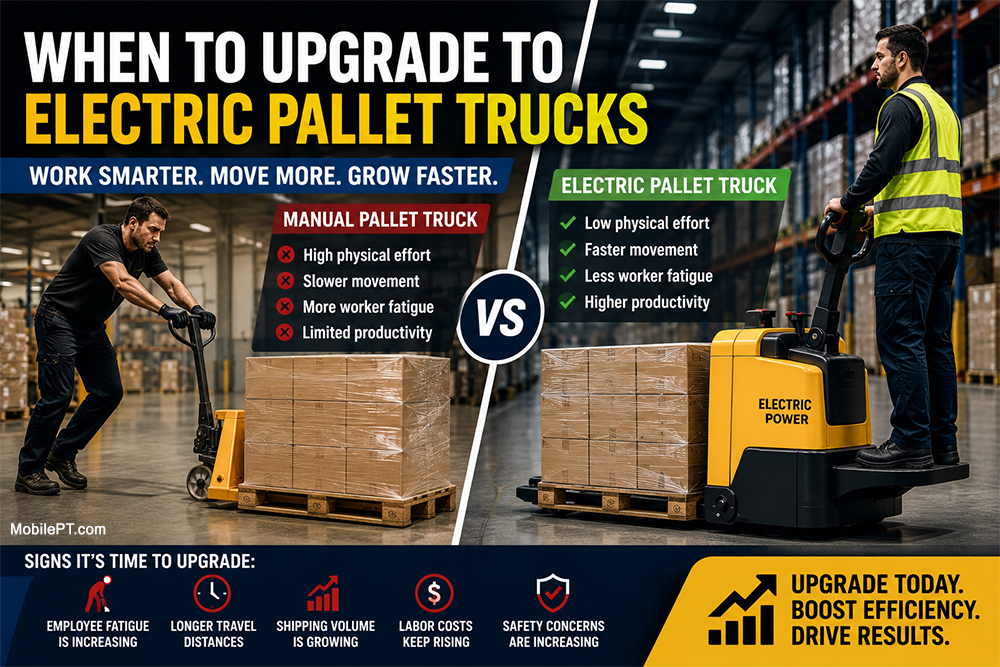
Most warehouses should consider upgrading to electric pallet trucks when:
✓ Pallets are moved constantly throughout the day
✓ Workers are experiencing fatigue
✓ Travel distances are increasing
✓ Shipping volume is growing
✓ Labor costs are rising
✓ Productivity goals are becoming harder to achieve
Electric pallet trucks are designed to improve efficiency, reduce physical strain, and support higher-volume warehouse operations.
Manual Pallet Truck vs Electric Pallet Truck
Before discussing upgrade indicators, let’s look at the fundamental differences.
| Feature | Manual Pallet Truck | Electric Pallet Truck |
| Power Source | Manual | Battery |
| Operator Effort | High | Low |
| Productivity | Moderate | High |
| Long Distance Travel | Moderate | Excellent |
| Heavy Loads | Moderate | Excellent |
| Worker Fatigue | High | Low |
| Purchase Cost | Lower | Higher |
| Efficiency | Moderate | High |
Manual pallet trucks remain useful.
But they aren’t always the most efficient solution.
Why Warehouses Eventually Upgrade
Most warehouses don’t upgrade because manual pallet trucks stop working.
They upgrade because business requirements change.
Common reasons include:
- More inventory
- More shipments
- More receiving activity
- Larger warehouse footprints
- Increased labor costs
- Faster customer expectations
The equipment that worked five years ago may no longer be the best fit today.
Sign #1: Employees Move Pallets All Day
This is often the clearest indicator.
If workers spend most of their shift moving pallets, manual equipment may be limiting productivity.
Manual pallet trucks require:
- Pushing
- Pulling
- Steering
- Repositioning
Repeated hundreds of times per day.
An electric pallet truck dramatically reduces this effort.
Daily Workload Comparison
| Activity Level | Manual Pallet Truck | Electric Pallet Truck |
| Low Volume | Good Choice | Optional |
| Medium Volume | Acceptable | Better Choice |
| High Volume | Inefficient | Recommended |
The more pallets being moved, the greater the benefit.
Sign #2: Worker Fatigue Is Increasing
Warehouse work is physically demanding.
Especially when workers move heavy pallets all day.
Fatigue can lead to:
✗ Slower performance
✗ Reduced productivity
✗ Increased mistakes
✗ Safety concerns
✗ Employee dissatisfaction
Electric pallet trucks reduce much of the physical strain associated with pallet movement.
Benefits For Employees
✓ Less pushing and pulling
✓ Reduced physical strain
✓ Better comfort during long shifts
✓ Improved morale
✓ Less fatigue at the end of the day
This often improves retention as well.
Sign #3: Travel Distances Are Getting Longer
A pallet moved 20 feet is one thing.
A pallet moved 300 feet is another.
As warehouses expand, travel distances often increase.
This is where electric pallet trucks provide some of their greatest value.
Productivity By Travel Distance
| Distance | Manual Pallet Truck | Electric Pallet Truck |
| Under 50 ft | Similar Performance | Similar Performance |
| 50–150 ft | Moderate Advantage | Better Choice |
| 150–300 ft | Significant Advantage | Strongly Recommended |
| 300+ ft | Inefficient | Best Choice |
Long travel routes create significant productivity opportunities.
Sign #4: Shipping And Receiving Volumes Are Growing
As businesses grow, pallet movement usually increases.
More inbound shipments.
More outbound shipments.
More staging.
More inventory transfers.
Typical Areas Impacted
| Warehouse Activity | Impact From Electric Pallet Trucks |
| Receiving | High |
| Shipping | High |
| Staging | High |
| Cross Docking | High |
| Manufacturing Support | High |
| Order Picking | Medium |
Growing operations often outgrow manual equipment faster than expected.
Sign #5: Labor Costs Continue To Rise
Labor is one of the largest operating expenses in many warehouses.
While electric pallet trucks require a larger upfront investment, they often improve labor efficiency.
Benefits may include:
✓ More pallets moved per hour
✓ Better employee utilization
✓ Reduced overtime
✓ Faster workflows
✓ Improved throughput
The goal isn’t replacing workers.
The goal is helping workers accomplish more.
Sign #6: Heavy Loads Are Becoming Common
Load weight matters.
Moving a 1,500-pound pallet manually is manageable.
Moving a 5,000-pound pallet repeatedly throughout the day is a different story.
Heavy Load Handling Comparison
| Load Weight | Manual Pallet Truck | Electric Pallet Truck |
| Under 2,000 lbs | Excellent | Excellent |
| 2,000–4,000 lbs | Good | Excellent |
| 4,000–5,500 lbs | Moderate | Excellent |
| 5,500+ lbs | Difficult | Better Choice |
The heavier the loads, the greater the benefit of powered movement.
Sign #7: Productivity Has Stalled
Many warehouses reach a point where productivity improvements become difficult.
Workers are already working hard.
Processes are already optimized.
Yet throughput remains unchanged.
This often indicates that equipment has become the bottleneck.
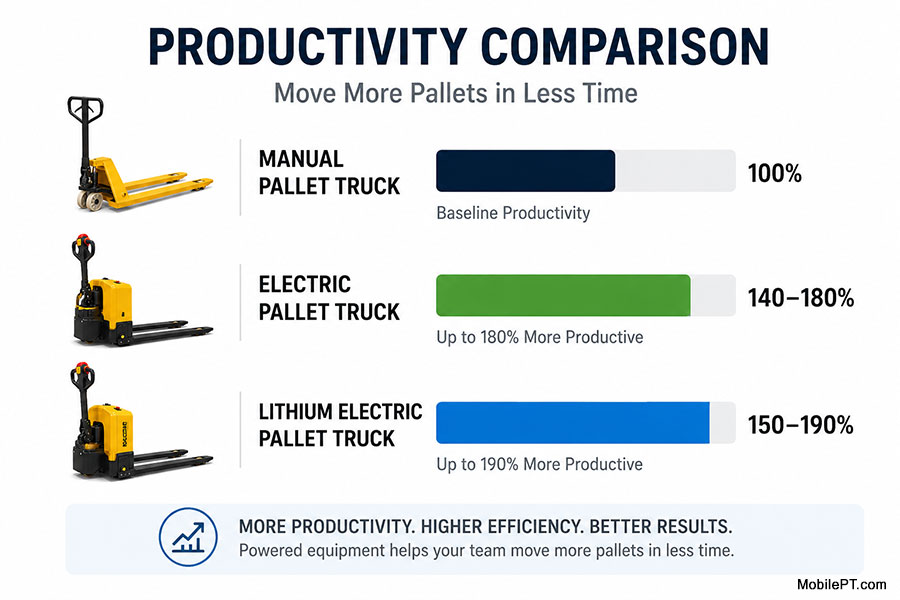
Relative Productivity Comparison
| Equipment | Relative Productivity | Visual |
| Manual Pallet Truck | 100% | ██████████ |
| Electric Pallet Truck | 140–180% | █████████████████ |
Electric pallet trucks frequently create immediate efficiency improvements.
Sign #8: Workplace Safety Is Becoming A Concern
Safety matters.
Fatigued employees are more likely to make mistakes.
Heavy loads increase risk.
Manual handling creates additional strain.
Electric pallet trucks help reduce many common risks.
Safety Advantages
✓ Better load control
✓ Reduced physical strain
✓ Improved operator comfort
✓ More consistent handling
✓ Smoother movement
Safety improvements often have long-term operational benefits.
Common Mistakes When Upgrading
Not every upgrade is successful.
Avoid these common mistakes.
✗ Buying based only on purchase price
✗ Choosing the wrong capacity
✗ Ignoring future growth
✗ Underestimating travel distances
✗ Selecting equipment without operator input
✗ Waiting until productivity problems become severe
A proactive upgrade is usually more effective than a reactive one.
Industries That Commonly Upgrade First
Some industries see faster returns than others.
High-Volume Industries
- Warehousing
- Distribution Centers
- Manufacturing
- Logistics
- Food & Beverage
- Automotive
- Retail Distribution
- E-Commerce Fulfillment
These operations often move enough pallets daily to justify electric equipment.
How To Determine If The Upgrade Makes Sense
Ask yourself these questions.
How Many Pallets Move Daily?
Higher volume generally favors electric pallet trucks.
How Far Do Loads Travel?
Longer routes increase the value of powered movement.
How Heavy Are The Loads?
Heavier loads justify stronger equipment.
How Much Fatigue Exists?
Worker feedback can be valuable.
Is The Business Growing?
Growth often creates the strongest case for upgrading.
Upgrade Checklist
If you answer “yes” to several of these questions, it may be time to upgrade.
✓ Pallets move constantly throughout the day
✓ Employees report fatigue
✓ Travel distances are increasing
✓ Shipping volume is growing
✓ Labor costs are rising
✓ Productivity goals are difficult to achieve
✓ Heavy loads are common
✓ Warehouse expansion is planned
The more checkmarks you have, the stronger the business case becomes.
Final Thoughts
Knowing when to upgrade to electric pallet trucks can have a major impact on warehouse productivity.
For smaller operations with limited pallet movement, manual pallet trucks may still be the right solution.
For growing businesses, however, electric pallet trucks often provide substantial advantages.
They reduce fatigue.
They improve efficiency.
They support heavier workloads.
And they help warehouses scale more effectively.
Mobile Industries offers a wide range of electric pallet trucks, powered pallet trucks, pallet trucks, and warehouse material handling equipment designed to support growing operations.
Visit MobilePT.com to learn more.
Frequently Asked Questions
When should I upgrade to an electric pallet truck?
Most businesses should consider upgrading when pallet movement increases, travel distances grow, or employee fatigue becomes a concern.
Are electric pallet trucks worth the investment?
For many warehouses, electric pallet trucks improve productivity enough to justify the higher purchase cost.
Do electric pallet trucks reduce worker fatigue?
Yes. Electric pallet trucks reduce the physical effort required to move palletized loads.
Are electric pallet trucks faster than manual pallet trucks?
Generally, yes. Electric pallet trucks often improve productivity, especially in larger facilities and longer travel routes.
What industries benefit most from electric pallet trucks?
Warehousing, logistics, manufacturing, distribution, food processing, retail distribution, and e-commerce fulfillment operations commonly benefit from electric pallet trucks.